Your profile is already the first draft of everything you'll post
Your EveryExpert profile already holds months of stories, opinions and buyer questions. Pull them out first, with AI asking the questions, and posting stops being a blank-page problem.
Article 1 of 11 · Foundation
The situation
You know your field. You've helped people, and you could talk about your work for an hour without notes. But when you sit down to write a post, nothing comes. Or something comes, and it reads like everyone else's post.
So you post once, it gets a handful of likes, and three weeks go by before you try again. Meanwhile your EveryExpert page sits there, ready to take bookings, with nobody being sent to it.
The complication
The usual fix is to open an AI tool and type "write me a LinkedIn post about [my topic]." It will, instantly. And it will be fine, and generic, because it had nothing of yours to work with. It filled the gaps with the average of everything it has read.
The cost is real. A generic post teaches readers you sound like everyone else in your category, which is the opposite of the reason anyone books a specific person. Worse, it can invent a statistic or a client story that you never lived, and your name ends up on it.
The question
How do you produce a steady supply of material that sounds like you and holds up to scrutiny, without writing from a blank page every week?
The answer
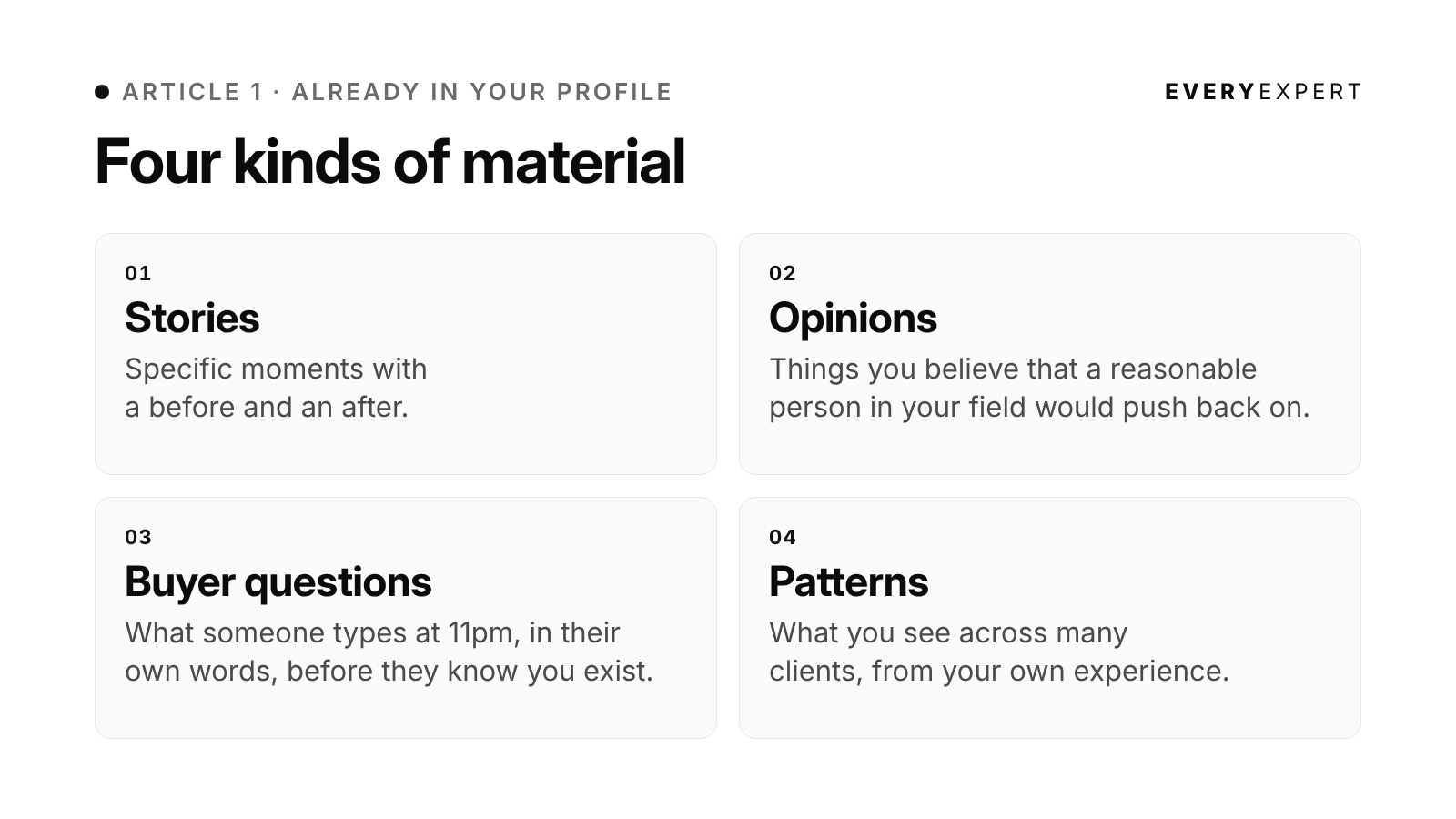
Build a small bank of material before you post anything. You need four kinds, and most of it is already sitting in your profile.
Stories are specific moments with a before and an after. A client conversation, a mistake you made early, a phone call that changed how you work. They hide in the first line of your bio and in every "I used to..." you've ever said out loud.
Opinions are things you believe that a reasonable person in your field would push back on. They hide in the advice that makes you wince when you see it repeated.
Buyer questions are what someone types at 11pm, in their own words, before they know you exist. They hide in the first five minutes of your intro calls.
Patterns are what you see across many clients: the mistake most people make before they find you, the question that comes up in almost every first call. They come from your own experience, so nobody can argue with where they came from.
Here's how to fill the bank in about an hour.
1. Let AI interview you before it writes anything
Flip the usual order. Instead of asking AI to write, ask it to interview you, one question at a time, and push back when your answer is vague. Answer by voice if typing slows you down. Many phones and AI apps can transcribe for you.
A short interview usually gives you more specific material than starting from a blank prompt, because every story in it actually happened.
Paste your EveryExpert profile here:
[paste profile]

You're an interviewer helping an expert find material for posts
and talks. Interview me one question at a time. Ask about:
- a client moment that changed how I work
- a mistake I made early on
- advice in my field I disagree with
- the question clients ask in the first five minutes
- what people get wrong right before they find me
- something I see in almost every client

Ask only one question, then wait for my answer. Ask a follow-up
whenever my answer is vague. After 10 questions, stop and list
every usable story, opinion, pattern and buyer question from my
answers, in my own words.

Use only what I tell you. If you need a fact or story I haven't
given you, ask me instead of making one up.
Feed it your real work, not just your answers.
The interview is a start. What makes the output sound like you over time is volume of real examples: notes from client calls, transcripts from a meeting note-taker, emails you've sent, answers you've written in the EveryExpert community, even voice memos you recorded on a walk.
Protect your clients while you do it. Check your client agreement, any professional rules you work under, and your AI tool's data settings before anything from a session goes in. Remove names, companies and any detail that could identify someone. If a story could still point to a real person, change the details or leave it out. If your note-taking tool can connect directly to your AI tool, check those same settings before you connect them.
Done that way, you stop inventing content and start sharing what you already do every day.
New to client work? Use what you have: your own early mistakes, problems you solved in a previous job, and the questions friends and colleagues already bring you. All of that counts.
2. Mine the profile you already wrote
Your bio holds your origin. Your session descriptions hold the problems people pay you to solve. Your session titles are a list of promises. A second prompt turns those few hundred words into a list of post ideas, and marks anything it guessed, so you know what to check.
Paste your EveryExpert profile here:
[paste profile]

I help: [who you help, in your words]

From this profile only, give me:
1. Ten story prompts: moments I've probably lived that I should
   tell. Phrase each as a question for me to answer, since you
   don't know the details.
2. Five opinions I might hold that a reasonable person in my
   field could push back on.
3. Five questions my buyers type at 11pm, in their words.
4. Three patterns I've probably noticed across clients, phrased
   as questions for me to confirm or correct.

Mark anything you inferred rather than read in my profile.
Don't invent client names, numbers or results.
Notice that the story prompts come back as questions. That's deliberate. The AI doesn't know what happened in your work, so it shouldn't pretend to.
3. Teach the tool your voice
Before you use AI to draft anything, give it three things you wrote yourself: posts, emails, even a long text to a colleague. Ask it to describe your voice as rules, then save those rules and paste them at the top of every future prompt.
Here are three things I've written myself:
[paste 1]
[paste 2]
[paste 3]

Describe my writing voice in 8 short rules someone else could
follow: sentence length, how I open, words I use, words I'd
never use, how I sound when I'm being direct, and how I end.

Use only what I've given you. Don't invent stories, facts,
numbers, quotes or credentials. If something is missing, ask me.
A note on numbers. Stick to what you've seen in your own work, described honestly. "Most of the people I work with ask about this in the first five minutes" is yours, and it's more convincing than a statistic nobody can trace. AI tools will also invent statistics, confidently, with links that go nowhere. If you ever use an outside number, click through to the original source yourself before it goes anywhere near a post.
Tasha's version. Tasha, the leadership coach you'll follow in article 11, answers the interview prompt by voice on a walk. One walk gives her a story (the client promoted on a Friday who was still answering support tickets the next Thursday), an opinion (most new managers never saw anyone delegate well, so they don't know what it looks like), and the question she hears most ("How do I manage people who used to be my peers?"). And a pattern: almost every new manager she works with is still doing a big part of their old job three months in.
How this looks in practice
These are illustrations of the pattern, not case studies.
A grant writer who posts "tips for better proposals" is competing with every other grant writer online. Run the interview, and a better story tends to surface: the nonprofit that lost a renewal because nobody wrote down why the first grant was awarded. That story is specific, and it points straight at a session she could sell, a renewal review. The post changes from advice anyone could give to a problem only her readers recognize.
A parenting coach may assume he has nothing controversial to say. The profile mining prompt often finds the opinion hiding in plain sight, in a session description that quietly contradicts the most common advice in his field. Written as an opinion post, it invites parents to describe their own version of the problem in the comments. Each of those comments is a conversation he can continue, which article 6 covers.
An AI automation consultant might want to lead with a dramatic adoption statistic she's seen everywhere. Instead, she leads with a pattern from her own work: the tool most of her clients already pay for and never use. For buyers who are paying her to cut through hype, a real observation from her own clients is more convincing than a number nobody can trace.
Do this today
Run the interview prompt and answer five questions by voice. One walk is usually enough. Save the output somewhere you'll find it again. It's the start of your bank. Every post, issue and workshop in this series draws from it, and so does your next booked call.
Bring it back
Post one story or opinion from your interview in the EveryExpert community and say which question surfaced it. If the interview kept producing generic answers, bring it to office hours with the exact question that stalled you. The room can usually find the story hiding behind a vague answer in a couple of minutes.