You already have a method. Give it a name people can repeat.
A framework is how you already do the work, written down so someone else can follow it. Naming yours makes it easier to remember, share and book.
Article 2 of 11 · Foundation
The situation
You have a way of working with clients. You probably don't think of it as a method. It's just what you do: the questions you ask first, the thing you always check, the order you tackle problems in, the moment where most people finally get it.
When someone asks what you do, you describe the outcome, or you describe your background. Either way, they nod politely and forget it by the next conversation.
The complication
Without a name, your expertise is invisible in the moments that matter. A potential client can't repeat what you do to their boss or partner. A community organizer can't picture the workshop you'd teach. And every post you write has to explain your whole approach from scratch, which makes posting feel like work.
The instinct is to invent something impressive: a clever acronym, a trademark symbol, seven pillars. That usually backfires. People can tell when a framework was built for marketing instead of for clients, and a method that doesn't match what happens in your sessions creates a gap the first time someone books.
The question
How do you turn the way you already work into a named framework that's honest, easy to repeat, and connected to the sessions people can book with you?
The answer
Most experts already repeat more of a method than they realize. The work is writing yours down. It takes three passes, and your AI tool can do most of the organizing while you supply the substance.
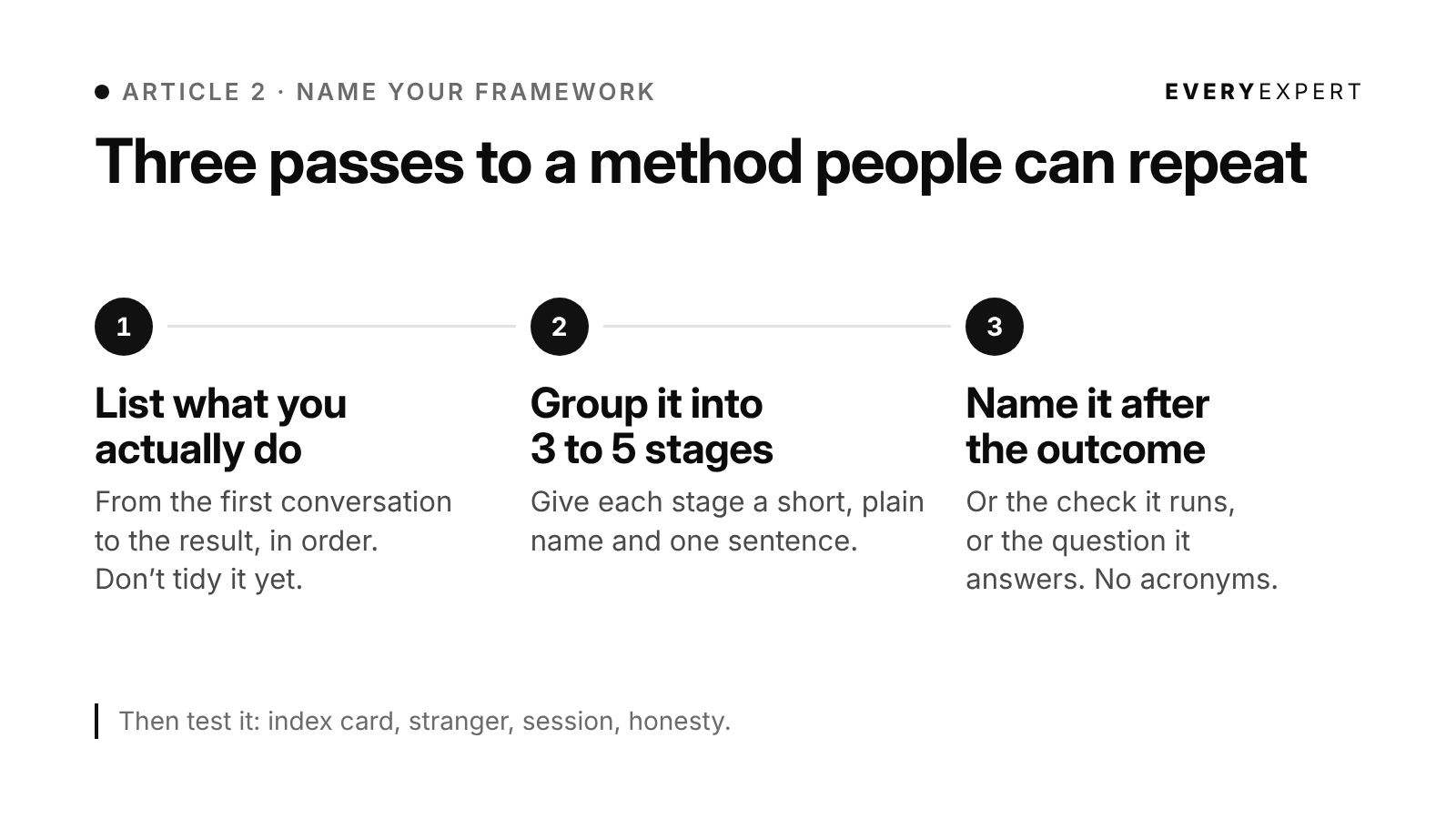
1. List what you actually do, in order
Start from the first conversation with a client and walk forward to the result. Don't tidy anything yet. Include the questions you always ask, the thing you check that others skip, the point where clients usually push back, and what they have in hand when you're done.
This is easier out loud than on paper. Let your AI tool interview you about a real client you've helped, start to finish, and it will pull out the steps you do without noticing. If you have notes or transcripts from real sessions, add them. Your actual conversations show your method more honestly than your memory does.
Paste your EveryExpert profile here:
[paste profile]

If you have them, paste notes or transcripts from two or three
client sessions here, with names and identifying details removed:
[paste notes]

I want to find the method I already use with clients. Interview
me one question at a time about a real client I've helped, from
our first conversation to the result. Ask what I did first, what
I checked, where they got stuck, and what changed. Ask follow-up
questions whenever my answer is vague.

When you have the full sequence, list every step I described, in
order, in my words. Don't add steps I didn't mention. If you need
something I haven't told you, ask me instead of guessing.

Use only what I've given you. Don't invent stories, facts,
numbers, quotes or credentials. If something is missing, ask me.
2. Group the steps into three to five stages
Look at the raw list and group it. Most methods fall into three to five stages. If you have more than five, you're probably describing tasks inside a stage rather than the stages themselves. If you have fewer than three, you might be skipping the part you do automatically, which is often the part clients value most.
Give each stage a short name and one sentence explaining it. Plain words beat clever ones. "Find the gap" is more useful than "Discovery Protocol."
3. Name it after the outcome or the question it answers
The name should tell a stranger what the framework is for. Names that describe the result or the question travel further than names built on your own name or an acronym people have to decode.
A few patterns that work:
Named after the check it runs: a "Renewal Readiness Review," a "First Impression Check."
Named after the question it answers: "Is it the offer or the audience?"
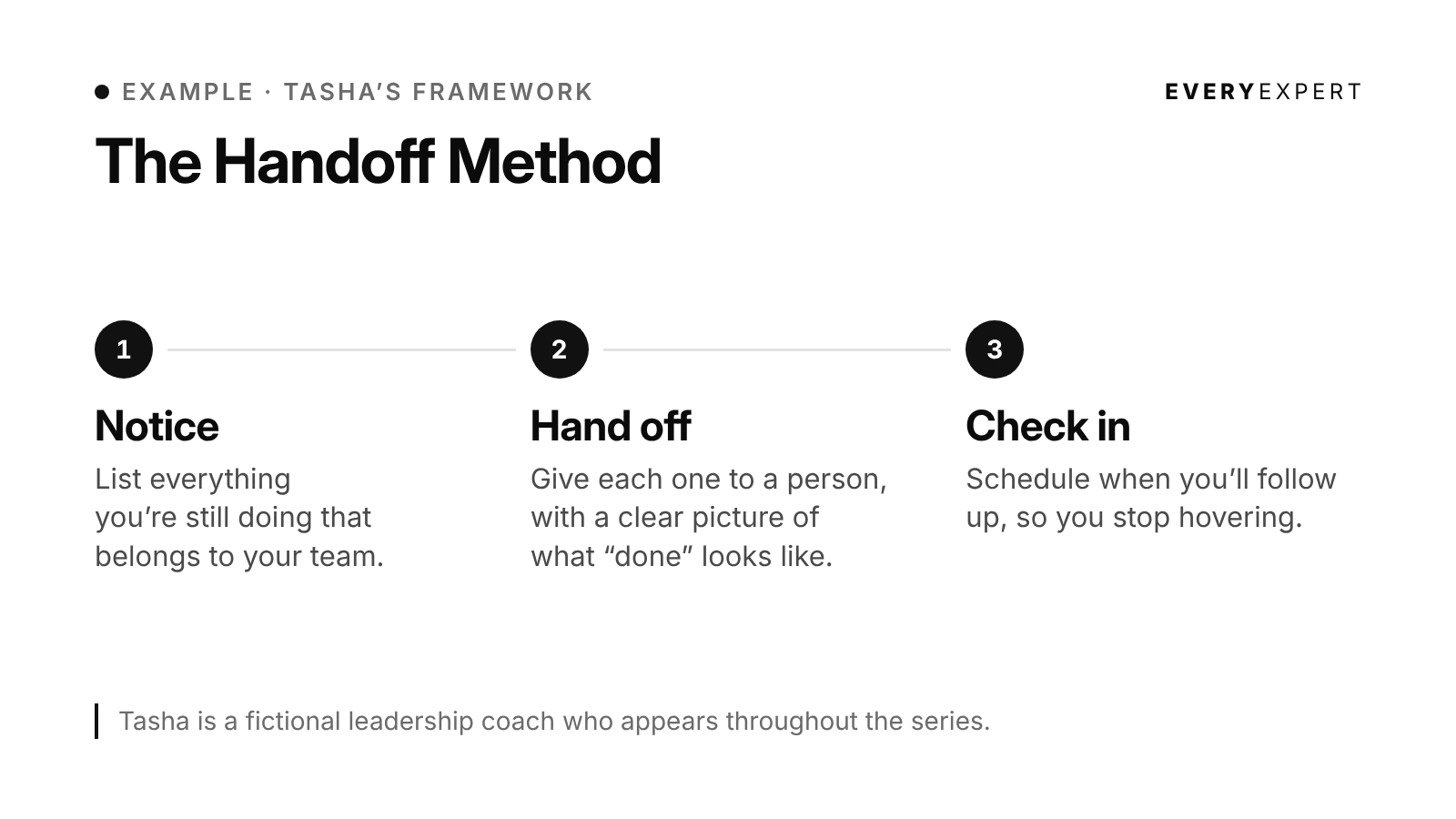
Named after the outcome or the move: "The First Ninety Days Plan," "The Handoff Method."
Take Tasha, a leadership coach for first-time managers. You'll follow her through every step of this series in article 11. When she walked through what she actually does with clients, the same three moves kept coming up: notice everything you're still doing that belongs to your team, hand each one off with a clear picture of what "done" looks like, and check in on a schedule so you stop hovering. She named it the Handoff Method: Notice, Hand off, Check in. The name tells a new manager exactly what it's for, which is why it works on her profile, in her posts, and as the title of a workshop.
Here are the steps of my method, in order:
[paste the list from the interview]

Group these into three to five stages. Give each stage a short
plain-language name and a one-sentence description. Then suggest
eight names for the whole framework: some named after the check
it runs, some after the question it answers, some after the
outcome. No acronyms, no invented jargon, and no names built on
my own name.

Use only the steps I gave you. Don't add stages I didn't describe.
Test it before you use it
A framework earns its place when it survives four tests.
The index card test. The whole thing fits on one card, readable.
The stranger test. Someone outside your field can explain it back to you after one read.
The session test. A client could book one hour with you to work through one stage.
The honesty test. It describes what you actually do, not what sounds impressive.
The session test matters most. When your framework maps onto what people can book, every framework post becomes a natural invitation: "this is stage two, and stage two is what we'd work on together." Your content and your EveryExpert page start pointing at the same thing.
Here's my framework:
[paste name, stages and descriptions]

Here are the sessions on my EveryExpert page:
[paste your session titles and descriptions]

Test it honestly:
1. Could someone outside my field explain it back after one
   read? Rewrite any stage that fails.
2. Does it fit on an index card?
3. Is any stage really two stages, or are two stages really one?
4. Does each stage describe something I actually do, or
   something that sounds impressive?
5. Which of my sessions matches which stage? Where is there a
   stage with no session, or a session with no stage?

Be blunt. Then give me the revised version.

Use only what I've given you. Don't invent stories, facts,
numbers, quotes or credentials. If something is missing, ask me.
That last question often surfaces something useful. A stage with no matching session might be a new offer worth testing, especially if clients already ask for it in their own words. A session that fits no stage might have a title that needs rewriting so buyers can see where it fits.
How this looks in practice
These are illustrations of the pattern, not case studies.
A workplace mediator describes her work as "helping teams resolve conflict," which sounds like every other mediator. The interview surfaces what she actually does: she meets each person separately before anyone is in a room together, and she won't start the joint session until both people can describe the other's position fairly. Written down, that becomes three stages, and the second one, "Say it back," is a phrase managers remember. It also gives her a clear entry session: one separate conversation, booked on its own.
A bookkeeper for creative businesses thinks bookkeeping is too dry for a framework. The stress test shows he already runs the same monthly routine with every client: sort, check, and one conversation about what the numbers mean for the next month. Named the "Monthly Money Hour," it's easy to explain, easy to post about, and it matches a recurring session he can put on his page.
A college admissions advisor has a method with eleven steps. The grouping prompt pulls them into four stages, and the session test reveals that nothing on her page matches the first stage, choosing where to apply. That's often the stage worried parents ask about first. A single session for it would likely be the easiest thing on her page to book.
Do this today
Run the first prompt and describe one real client from start to finish. That's about fifteen minutes. You don't need a name yet. A list of the steps you actually took is enough to start. Once it has a name, every post and pitch gets easier, and people get a clearer picture of what they're booking.
Bring it back
Post your framework's working name and its stages in the EveryExpert community, and ask other experts to run the stranger test on it. If you can't get your steps into fewer than six stages, bring the list to office hours. It's much easier for someone else to spot the grouping than for you to see it in your own work.
Next: Article 3: Use a newsletter to get booked, whether you have one or not
Back to: The series hub