The post opens the door. The conversation books the call.
Many people who book an expert do it after a short, genuine conversation that started with a post. Here's how to reply, what to send, and when to mention your page.
Article 6 of 11 · Route 2: Social media
The situation
You've been posting. Some posts get a handful of likes, a few get comments, and now and then someone you've never met reacts to something you wrote. You check the numbers, feel good or bad about them, and move on to the next post.
Your EveryExpert page sits there, ready to take bookings. Nobody books.
The complication
It's easy to treat engagement as a scoreboard. Likes feel like the result, so you measure the post by them and stop there. But a like is someone raising their hand a few inches, and a comment is someone raising it all the way. Leaving those hands in the air is where most of the value of posting gets lost.
The other extreme doesn't work either. Messaging everyone who tapped a heart with a pitch and a link turns a warm signal cold, and it's the kind of message you probably ignore yourself.
The question
How do you turn the people who engage with your posts into real conversations, and some of those conversations into bookings, without it feeling like selling?
The answer
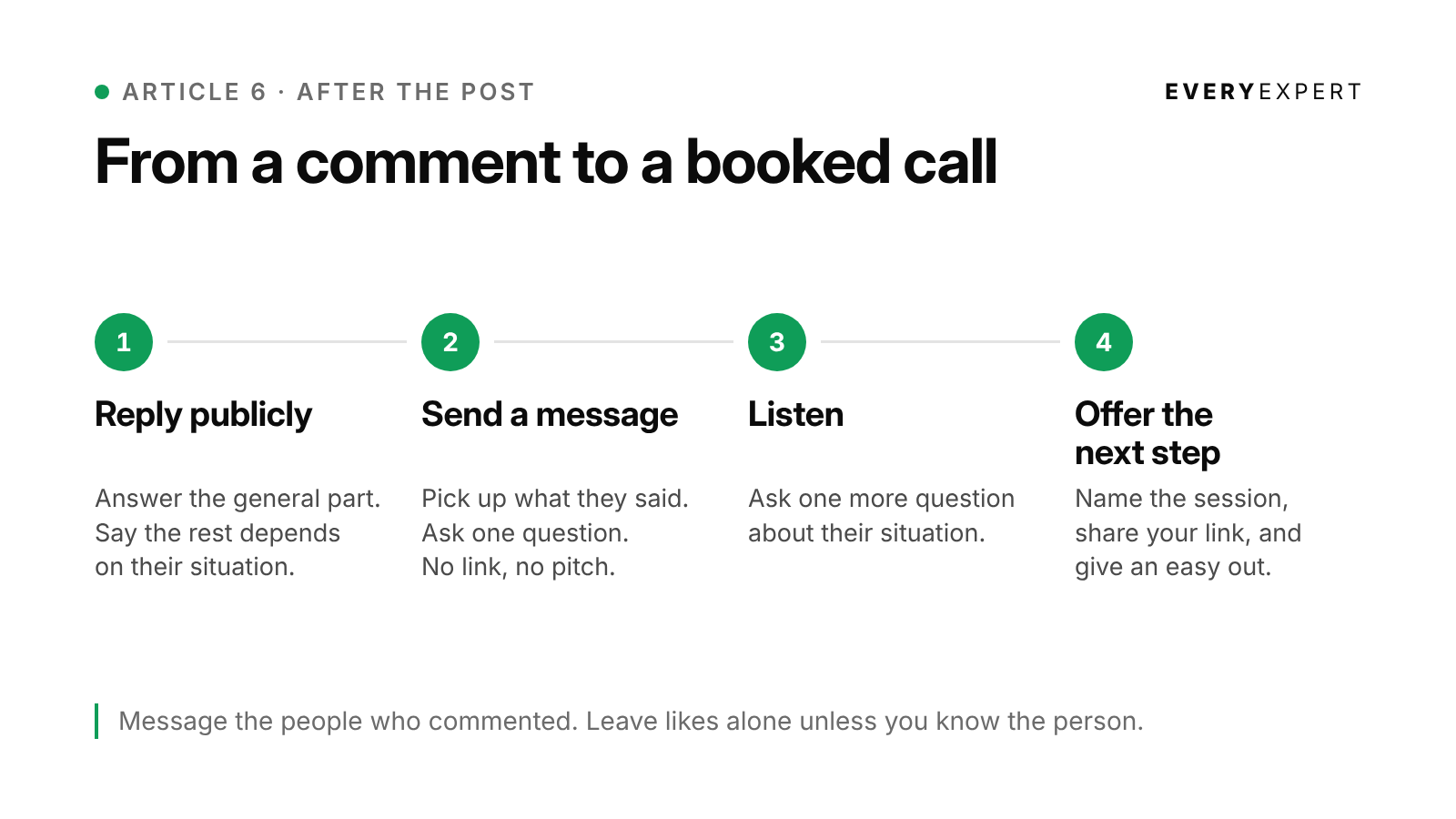
1. Reply to every comment like it's the start of a call
Reply to every genuine comment within a day. When someone describes their own version of the problem, answer the general part publicly and usefully. Then say, honestly, that the rest depends on their situation.
That reply does two jobs. It helps the person who commented, and everyone reading the thread watches you help. Don't drop your booking link in comment replies unless someone asks how to work with you.
Example: a reply to a comment
Their comment: "This is exactly my problem. I've rewritten my bio three times and it still sounds generic."
Your reply: "That's so common, and more rewriting rarely fixes it. Try opening with the problem you solve instead of your title. 'I help new managers stop doing their team's work' says more than 'Leadership Coach, ICF certified.' The exact wording depends on who you're trying to reach, but that swap alone tends to make it sound like you."
My post:
[paste post]

The comments:
[paste comments, with names removed]

Draft a reply to each comment, under 60 words. Be useful first:
answer what they asked or add one specific thing. When someone
describes their own version of the problem, answer the general
part publicly and say the rest depends on their situation. Don't
include my booking link unless someone asks how to work with me.
Write like a person, not a brand.

Use only what I've given you. Don't invent stories, facts,
numbers, quotes or credentials. If something is missing, ask me.
2. Continue the conversation with people who commented
This is the step most experts skip. When someone comments on your post with a real question or their own version of the problem, and they look like the kind of person you help, continue the conversation privately. A comment is someone telling you the post landed. A like is interest in the post, and not an invitation to message, so leave likes alone unless you already know the person.
Keep it short. No link. No pitch. Ask a question now, and save the offer for later.
Example: the first message
"Hi Maya, thanks for your comment on the pricing post. You mentioned a launch next month. What's the part you're least sure about?"
That's it. It's short, it picks up something they said, and it's easy to answer. Some people will reply and some won't. Send one message, and if there's no answer, leave it there.
If you're not connected with them yet, send a connection request with a short note that mentions their comment, then send the message once they accept.
Example: a connection request note
"Hi Maya, thanks for your comment on my pricing post. I write about this every week and would be glad to connect."
3. Listen, then offer a next step
When someone replies, they'll usually tell you whether the post touched something real. If it did, ask one more question about their situation, and actually listen to the answer. Don't rush to the link.
Example: the follow-up question
Their reply: "Honestly, we're launching a new package next month and I have no idea what to charge."
You: "That's a good moment to figure it out. Is the new package replacing something you already sell, or adding to it?"
Once you understand their situation, and it's something you help with, offer the next step with an easy way out.
Example: offering the next step
"That's exactly the kind of thing I help people work through. If a focused conversation would help before the launch, my 60-minute pricing session is built for exactly that: [your EveryExpert link]. And if not, happy to keep trading notes here."
The easy out matters. It tells the person you're not going to chase them, which is exactly what makes them comfortable saying yes.
Someone engaged with my post.
Their name and headline: [paste]
Their comment: [paste it]
My post was about: [topic]

Write three versions of a short first LinkedIn message, under 40
words each. Curious, not salesy. Reference something they said in
their comment and ask one question about their situation. No
link, no pitch.

Then write the message I'd send if they reply that it's something
they're dealing with: one follow-up question about their
situation. And a third message offering a session at
[your EveryExpert link] if a focused conversation would help,
with an easy out.

Use only what I've given you. Don't invent stories, facts,
numbers, quotes or credentials. If something is missing, ask me.
4. Know who to message, and who to leave alone
Not everyone who engages is a potential client, and that's fine. Message the people who fit who you help, or who clearly know people who do. Skip other experts in your field, obvious bots, and anyone whose engagement looks like a reflex. A few thoughtful messages a week beat thirty copy-pasted ones.
And if someone doesn't reply, let it go. One message is a conversation. Three unanswered messages is a sequence, and people can feel the difference.
5. Keep a simple list
A note on your phone is enough. For each conversation, write the name, what they said, the date, and the next step. The people who say "not right now" are often the ones who book two months later, and you'll only remember them if you wrote it down.
When you publish something that fits their situation later, a short "this made me think of what you said about your launch" message is the most natural follow-up there is.
Tasha's version. A manager named Chris comments on her post about a new manager still answering support tickets: "This is me. Promoted three months ago and still in the weeds." Tasha replies publicly with one practical tip, then sends a short message: "Hi Chris, thanks for your comment on the new-manager post. What's the one thing you're doing that you most wish you weren't?" She listens to the answer, and then offers her First 90 Days session with an easy out.
How this looks in practice
These are illustrations of the pattern, not case studies.
An accessibility consultant posts about a common website mistake. Most of the reaction is likes, which she leaves alone, but two people comment that they've spotted the same problem on their own sites. She replies to both publicly, then messages each with one question about their site. Each reply is a conversation that can lead to an audit, which is exactly the session on her page.
A personal stylist gets a comment from someone saying they have a big interview coming up and nothing to wear. She replies publicly with one practical tip for interview outfits, then messages the commenter to ask what the role is. The conversation is friendly and specific, and when she offers her wardrobe session with an easy out, it reads as help.
A fractional COO tends to avoid messaging people because it feels pushy. He starts with one rule: only message people who commented, and only ask a question. That rule gives him a short list of founders he's actually talking to, and their questions become his next posts.
Do this today
Open your last post, look at who commented, and send the first message to the two or three people who fit who you help. That's about ten minutes. Adapt the example message to what they actually said. Then add each person to your list. This is where a post turns into a person you can actually help.
Bring it back
Share the first message you sent, not the person's name, in the EveryExpert community and ask how it reads. If you're getting replies but not bookings, bring one conversation to office hours, with identifying details removed. The room can usually spot where the next step got lost.
Next: Article 7: Find the communities and pitch the organizer
Back to: The series hub