Somebody already gathered your buyers. Here's how to get invited in.
Associations, alumni networks and online communities already gathered the people you help, and their organizers need good workshops. You don't have to be a member to get invited.
Article 7 of 11 · Route 3: Events for other communities
The situation
Posting isn't really your thing. You're at your best in a room, live, answering questions and watching the moment something clicks for someone. You'd happily teach a workshop tomorrow. You just don't have a room full of the right people to teach.
Meanwhile, those people are already gathering somewhere. They're in a professional association, an alumni group, an online community, a local business network. Someone else organized the room, and they're looking for something good to put in front of it.
The complication
Most experts who try this send a cold email that leads with themselves: their bio, their credentials, their offer. Organizers get these often, and most go unanswered, because their job is to protect their members from exactly that kind of pitch.
The other mistake is aiming only at the biggest rooms. A community of fifty thousand has an organizer with a full inbox and a long approval process. A group of forty people who are exactly your buyers, run by someone who replies to messages, is worth far more.
The question
How do you find the communities where your buyers already gather, and get invited to teach there, without it feeling like a cold pitch?
The answer
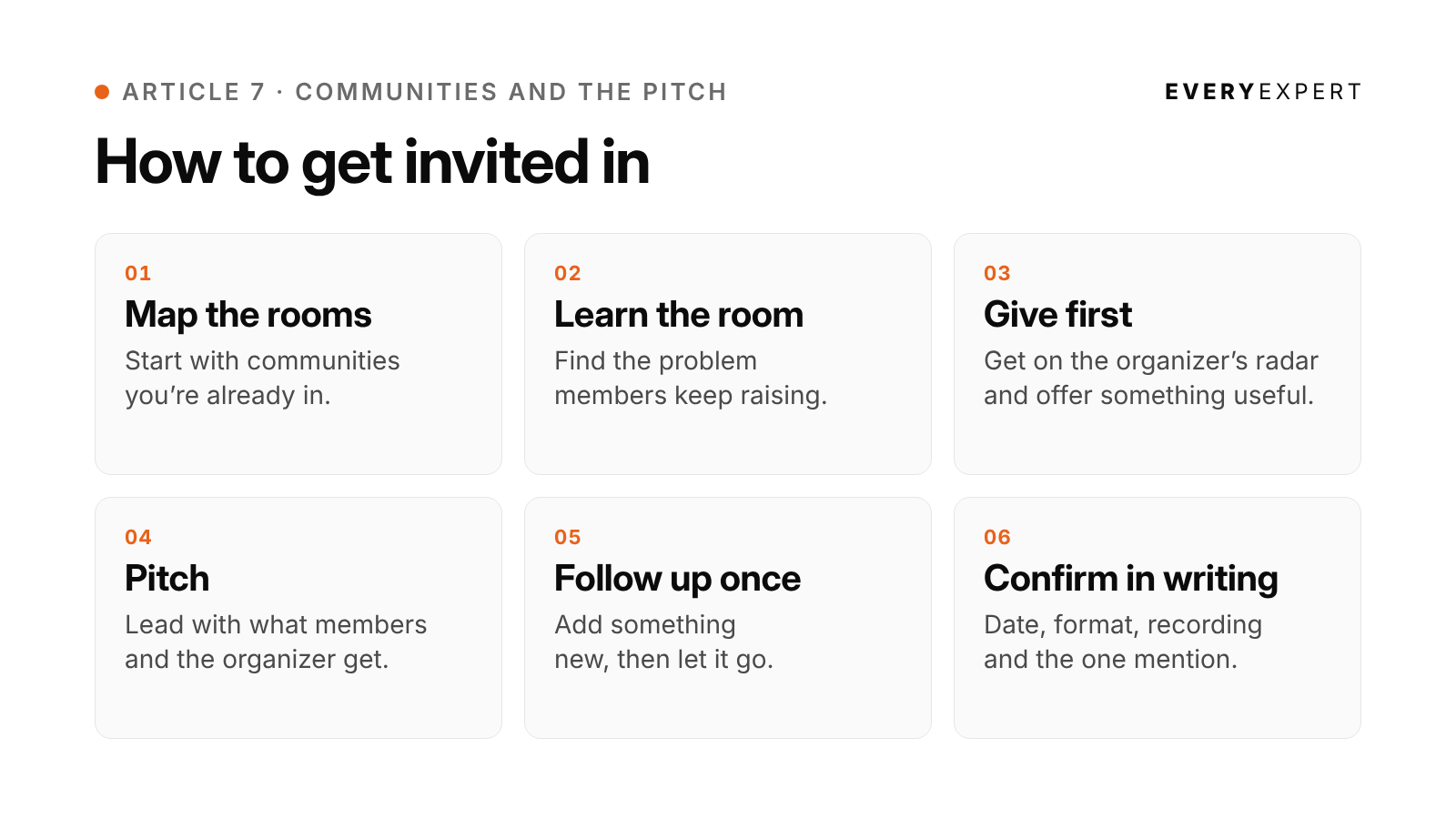
1. Start with rooms you're already in, then look further
The easiest yes comes from an organizer who already knows you. Before you look for new communities, list the ones you're already part of or connected to.
Professional associations and their local chapters
Alumni networks from your school, a former employer, or a program you completed
Online communities, forums and group chats you've been part of for a while
Employee resource groups at companies where you know someone
Local business groups, chambers of commerce and coworking spaces
Course cohorts, masterminds and peer groups you've joined
Then look one step out: communities your clients belong to, and groups where the people who refer you to others spend time.
You don't have to be a member. It helps if you are, because the organizer already knows your name. But plenty of experts teach for communities they've never belonged to. What matters is that you approach with respect. Organizers get asked all the time by people who want to get in front of their members, so the ask that stands out is the one that's clearly about what the members get, not what you get.
Paste your EveryExpert profile here:
[paste profile]

The people I help: [who you help, in your words]
Communities I'm already part of: [list anything you can think of]

List the types of communities, associations, groups and events
where the people I help already gather, online and in person. For
each type, tell me why it fits, who usually runs it, how to find
specific ones, and what workshop title would land there.

Put the ones I'm most likely already connected to first. Don't
name specific organizations or member counts unless you're
certain. Tell me how to look them up and verify instead.

Use only what I've given you. Don't invent stories, facts,
numbers, quotes or credentials. If something is missing, ask me.
Example: a small list, done right
A financial planner who works with public school teachers might end up with: her own alumni group from a teaching program, two local teachers' union chapters, a regional online group for new teachers, and the parent-teacher association at her kids' school. None of them is huge. Every one of them is full of her buyers.
Find the actual person. For any community on your list, look at the About page, the most recent event announcement, and whoever replies to members' posts. That's usually the organizer. Send your pitch to a named person, not a general inbox.
2. Pick the rooms that fit
You don't need many. Two or three good rooms beat twenty okay ones. A room is worth pitching when:
The members are your buyers, or people who can hire you, not just people in a related field.
The organizer runs regular events or workshops, so they're actively looking for content.
You can reach the organizer directly, through a mutual connection, a message, or a public contact.
Size matters less than fit. Forty of the right people in a room, live, can lead to more bookings than a thousand scrollers.
3. Learn the room before you pitch it
Spend fifteen minutes seeing what the community already cares about. Read their recent posts, their past event titles, and the questions members ask. You're looking for a problem members keep raising that you know how to solve.
Here's what I found about this community:
[paste their About page, recent event titles, and a few member
posts or questions, with names removed]

Paste your EveryExpert profile here:
[paste profile]

Tell me what their members seem to struggle with, what workshops
they've already run, what gap I could fill, and one specific thing
I could offer the organizer personally before I pitch anything.
Quote their own words back where you can.
4. Get on the organizer's radar, and give before you ask
Before you pitch a workshop, do something useful for the organizer or their community. It shows the quality of your thinking in a way no pitch can, and it means your first message isn't an ask.
If you're not in the community, get on the organizer's radar first. Most organizers are visible somewhere: on social media, in a newsletter, at their own events. Spend a couple of weeks paying genuine attention.
Follow them on social media and engage with their posts. Leave real comments, not "great post." Share something of theirs with your network when it fits.
Sign up for their newsletter, if they have one, and actually read it.
Reply to their newsletter when you're ready to ask. A reply goes straight to their inbox, from someone who's clearly paying attention, and newsletter writers tend to read their replies. It's a warmer way in than a cold email to a contact address.
Example: a newsletter reply that opens the door
"Hi Dana, loved this week's issue, especially the part about members feeling lost during open enrollment. I work with teachers on exactly that, and I'd be glad to run a free 45-minute workshop for your community on choosing a first retirement plan. Members would leave knowing which option fits them and the one question to ask HR. Happy to send a short outline if it's useful."
Notice what that reply does: it proves you read the newsletter, names the value for members in one sentence, and makes the next step small.
Whether you're a member or not, it also helps to give something before you ask. Good gifts are small and specific:
Answer a member's question in the community, thoroughly and without linking to yourself.
Send the organizer a short resource that fits a problem you saw members raise.
Offer a quick read of something the organizer is working on, using your framework.
Share one of their events or posts with your own network.
Example: a gift-first note
"Hi Dana, I've been in the group for a while and noticed a lot of new teachers asking about retirement plan choices this month. I put together a one-page guide that compares the two options in plain language. Happy for you to share it with members if it's useful, no strings. Thanks for running such a helpful group."
5. The pitch
When you do ask, lead with what the members get and what the organizer gets. Keep it short enough to read on a phone. Be clear that it's teaching, not a sales workshop.
Subject: A workshop for [community name] on [specific problem]

Hi [name],

I've been [in / following] [community] for [time], and I keep
seeing members ask about [specific problem, ideally a real
thread].

I [one line of relevant credibility]. I'd like to run a free
45-minute workshop for your members: "[title]." They'd leave with
[one concrete thing they can use].

I'll teach one thing properly and mention once, at the end,
where people can book time with me. You'd get the recording to
share with members, and I'm glad to promote the workshop to my
own network.

Open to it? Happy to work around your calendar.

[Your name]
Example: the pitch, filled in
Subject: A workshop for new teachers on choosing a retirement plan
Hi Dana,
Thanks again for sharing the guide last month. The questions haven't stopped, and I think there's room for a proper workshop on it.
I'm a financial planner who works only with public school teachers. I'd like to run a free 45-minute workshop for the group: "Your first retirement decision, in plain English." Members would leave knowing which plan fits their situation and the one question to ask HR before they sign anything.
I'll teach one thing properly and mention once, at the end, where people can book time with me. You'd get the recording to share with members, and I'd promote the workshop to my own network of teachers.
Would something in the next month work? Happy to fit your schedule.
Maria
Paste your EveryExpert profile here:
[paste profile]

The community: [name, what it's for]
The organizer: [name, anything I know about them]
How I know them or the community: [be honest, including "I don't
yet"]
The problem I keep seeing members raise: [quote a real thread if
you can]
Anything I've already given them: [the gift, if any]

Write a pitch email under 150 words, readable on a phone. Lead
with what members get and what the organizer gets. Propose a
free 45-minute workshop with a specific title and one concrete
takeaway. Say plainly that I'll teach one thing properly and
mention once, at the end, where people can book with me. Offer
the recording and to promote it to my network. Give me three
subject lines.

Use only what I've told you. Don't invent credentials, numbers
or history with the community.
6. Follow up once, then let it go
Organizers are busy, and silence is just silence. If you don't hear back in about a week, send one short follow-up that adds something new: a date option, a sharper title, or a quick note on why now is a good time.
Example: the follow-up
"Hi Dana, following up on the retirement plan workshop. Enrollment deadlines are coming up for a lot of new teachers, so late this month might be especially useful. I could do a Tuesday or Wednesday evening. Would either work?"
If there's still no reply, let it go and put the community on your list to revisit in a few months. One follow-up is persistence. Three is pressure.
7. When they say yes, confirm it in writing
A short confirmation email saves problems later. Cover the date and time, the format and platform, who handles registration, whether the workshop will be recorded and who can use the recording, whether you can send attendees a follow-up email with the replay and your booking link, and the fact that you'll mention your EveryExpert page once at the end.
Example: the confirmation
"Thanks, Dana. Confirming: Tuesday the 14th, 7pm Eastern, 45 minutes on Zoom. You'll handle registration through the group, and I'll send you a short description and a promo post by Friday. I'll record it, tell people at the start, and send you the file to share with members. At the end I'll mention once where people can book time with me. Could you send attendees my follow-up email with the replay afterward? Anything I've missed?"
Getting this in writing up front means nobody is surprised on the day, and it makes the organizer more likely to invite you back.
Is a free workshop worth it? It is when the room is full of your buyers, the organizer promotes it properly, and you can follow up with attendees. If two workshops for the same community lead to no conversations or bookings, try a different community, or ask for a speaker fee next time.
8. Turn one yes into the next one
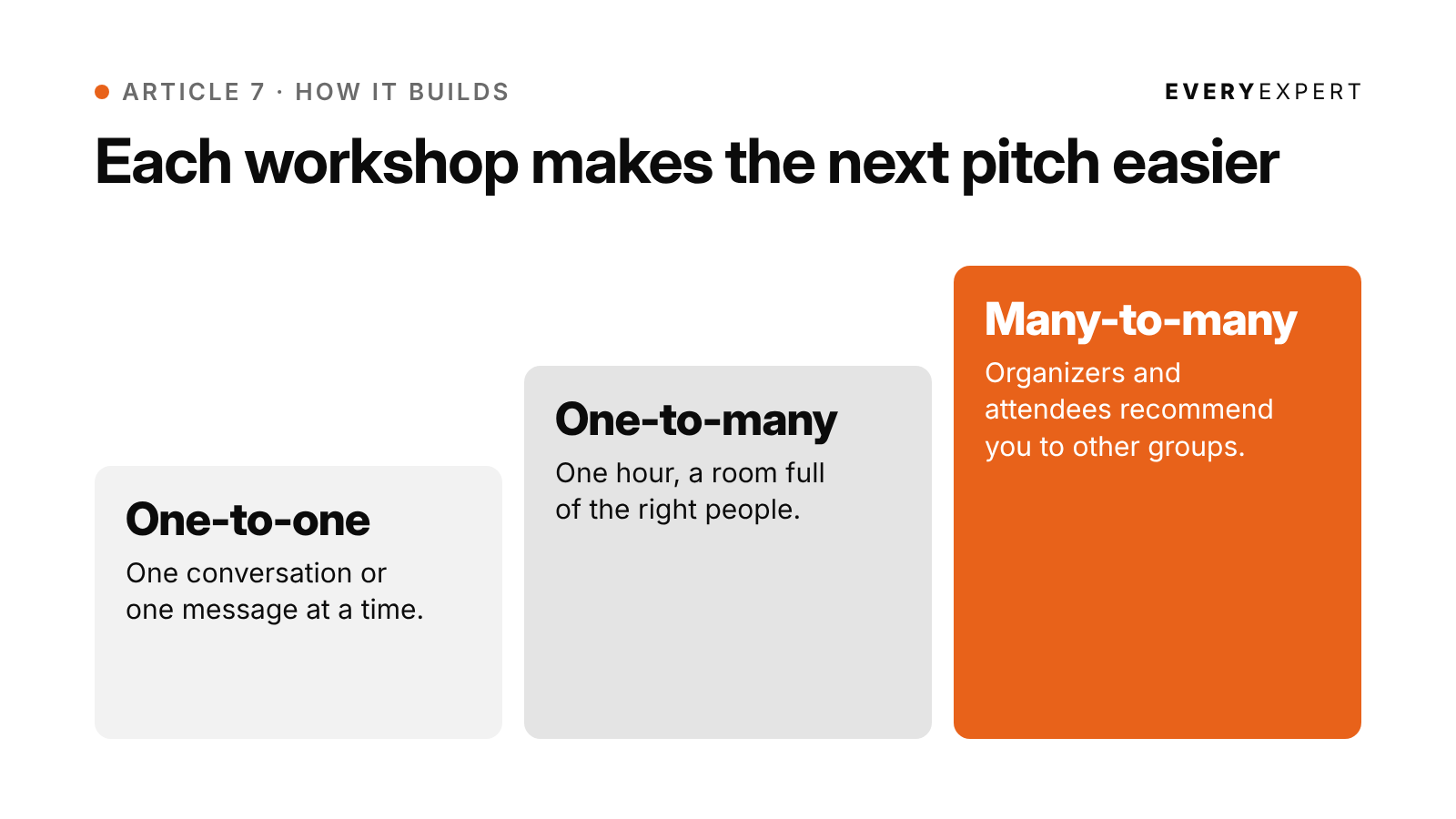
The first community usually takes the most effort. After that, each workshop makes the next pitch easier, because you're no longer asking a stranger to trust you. You have proof.
Ask for a testimonial from the organizer. A day or two after the workshop, thank them and ask for two or three sentences about how it went. Use it in your next pitch.
Example: asking the organizer for a testimonial
"Thanks again for having me, Dana. The questions at the end were great. If you're comfortable with it, would you write two or three sentences about how the workshop went for your members? I'd love to share it when I talk to other groups."
Ask attendees too. In your follow-up email, invite anyone who found it useful to reply with a sentence about what they took away. With permission, those replies become proof for the next organizer, and some of those attendees may book a session with you.
Then pitch the next room with proof attached.
"I recently ran a workshop on choosing a first retirement plan for [community]. Their organizer said: '[one line from the testimonial].' I'd be glad to run the same workshop for your members."
This is how the work builds on itself. At first you're working one-to-one, one conversation or one message at a time. A workshop for a community is one-to-many: one hour, forty people. And once organizers and attendees start recommending you to other groups, it becomes many-to-many. Many people are telling many other people about you, and some invitations may start arriving without a pitch. That's how an expert builds a name without becoming a marketer.
Tasha's version. Tasha's first room is her alumni network from a former employer, where she's already a member. Her second is an online community for people-leaders she's never been part of. For that one, she follows the organizer, subscribes to the newsletter for a few weeks, and then replies to an issue about first-time managers with her offer: a free 45-minute workshop, "The Handoff Method: your first 90 days as a manager," plus her one-page guide for members. After the first yes, she asks the organizer for two sentences she can quote in her next pitch.
How this looks in practice
These are illustrations of the pattern, not case studies.
A retirement transition coach assumes the big national associations are her only option. The room-mapping prompt points her to something closer: the retiree networks that large employers run for former staff. She already knows someone in one. A single introduction could put her in front of forty people who are exactly her buyers, and a network like that runs workshops every year.
A content strategist for nonprofits isn't a member of the biggest nonprofit leaders' community, so she starts by following its organizer, subscribing to the newsletter, and answering three questions in the community's public forum over two weeks, each one properly, with no links. When she finally pitches a workshop on turning annual reports into a year of content, the organizer already knows her name. She sends the ask as a reply to the newsletter, and it reads like a continuation of a conversation, which is exactly what it is.
A youth sports performance coach has been pitching gyms, with little luck. The room-mapping prompt suggests the people who actually gather his buyers: youth league boards and parent associations, which run preseason meetings every year. He offers the league a free workshop for parents on preventing common overuse injuries, gives the board a one-page checklist first, and pitches a spot in the preseason meeting, where every parent in the league is already in the room.
Do this today
Run the room-mapping prompt and write down three communities you're already connected to. That's about fifteen minutes. Pick one. If you're a member, find one thing you can give its organizer or members this week. If you're not, follow the organizer and sign up for their newsletter today.
Bring it back
Post your three communities in the EveryExpert community here and ask which one other experts would pitch first. If you've drafted a pitch, bring it to office hours before you send it. A second set of eyes on the first two lines makes a real difference.
Next: Article 8: Run the workshop: teach first, invite last
Back to: The series hub