
Swipe files for every kind of expert
A starting point for each of the eight EveryExpert categories: first lines, a framework pattern, communities to teach for and a workshop title. Borrow what fits and rewrite it in your voice.
Article 10 of 11 · Reference
How to use this article
This is a reference page, not a read-through. Find your category below and use it as raw material for the other articles in the series.
Everything here is an example. The first lines are illustrations of the pattern, not lines to copy word for word, and the framework names and titles show the shape rather than the answer. Your version should come from your own clients, your own opinions and your own words. Don't post these lines as they are. Replace every example with a real moment from your own work (article 1), and run anything you borrow through the voice prompt before you use it.
If your work spans two categories, read both. Many experts do.
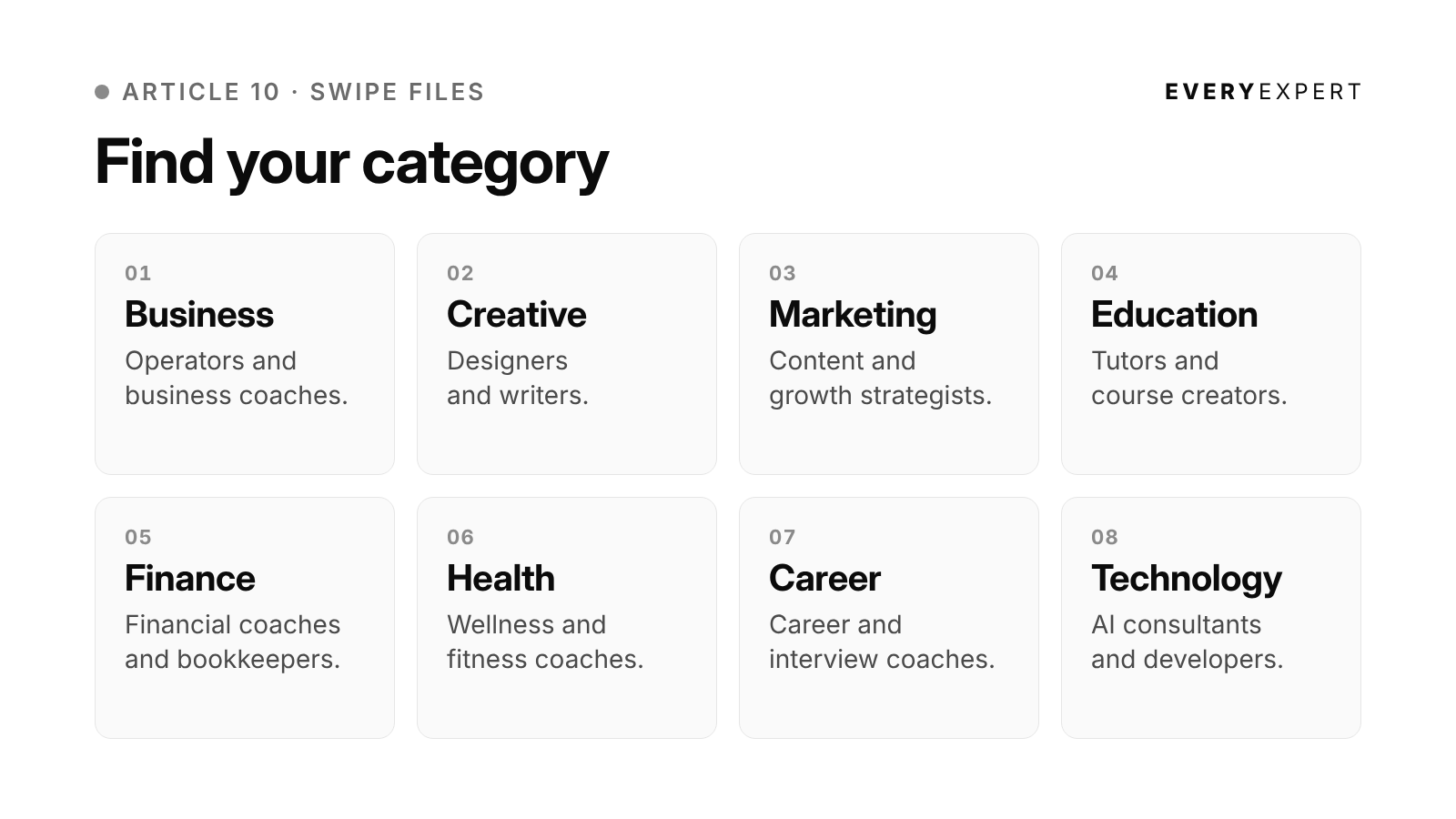
Each category includes:
Who it's for: the kinds of experts in that category
Example first lines: one each for a story post, an opinion post and a buyer question post (article 5)
A framework name pattern: a shape for naming your method (article 2)
A newsletter name idea: plain and specific (article 3)
Communities to teach for: where your buyers already gather (article 7)
A workshop title: built around one outcome (article 8)
Patterns to watch for: what to notice across your own clients (article 1)
Business
Who it's for: operators, founders, leadership and management coaches, business consultants, fractional executives.
Example first lines
Story: "The first week my client's business ran without her, she called me convinced something was broken."
Opinion: "Most 'delegation problems' I see are really unclear decision rights. Hiring another person won't fix that."
Buyer question: "A founder asked me last week: 'How do I know when it's time to hire my first manager?'"
Framework name pattern: name it after the decision it settles or the move it teaches. For example, a three-stage "Bottleneck Audit" that finds where the business still waits on the owner, or Tasha's "Handoff Method" from article 11: Notice, Hand off, Check in.
Newsletter name idea: "The Owner's Hour," one practical fix for running the business instead of being run by it.
Communities to teach for: founder groups, local chambers of commerce, industry associations, accelerator and incubator alumni networks, peer advisory groups.
Workshop title: "Where your business still waits on you, and how to find out in 20 minutes."
Patterns to watch for: what owners keep doing themselves long after they could hand it off, and which decisions still wait on them.
Creative
Who it's for: designers, podcasters, writers, photographers, brand and creative directors, musicians and creative coaches.
Example first lines
Story: "A client sent me her logo and asked why nobody remembered it. It took one look at her website to see why."
Opinion: "Before you rebrand, try keeping your first impression exactly the same for six months."
Buyer question: "Someone asked me: 'Do I really need professional photos, or is my phone good enough?'"
Framework name pattern: name it after the review you run on someone's work. For example, a "First Impression Check" that looks at what a brand says in its first ten seconds.
Newsletter name idea: "Ten Seconds," one small change a week that makes a brand easier to remember.
Communities to teach for: creative meetups, design and podcasting communities, maker and small-shop groups, founder communities that hire creative help.
Workshop title: "What your website says in the first ten seconds, and how to change it this week."
Patterns to watch for: what clients keep changing about their brand, and what people remember about their work.
Marketing
Who it's for: content, social, email and growth strategists, copywriters, brand strategists, PR consultants.
Example first lines
Story: "The campaign hit every number on the dashboard. It booked nothing. Here's what we measured next."
Opinion: "For most service businesses, follower count is the wrong number. Conversations started is the right one."
Buyer question: "A client asked me: 'Should I be on every platform, or just one?'"
Framework name pattern: name it after the test it applies. For example, "The Reply Test," which judges content by whether it starts conversations.
Newsletter name idea: "Worth Replying To," one piece of marketing a week that started real conversations, and why.
Communities to teach for: marketing associations, local business groups, founder and creator communities, agency peer groups, small business programs at libraries and colleges.
Workshop title: "Why your content gets likes and not clients, and the one change that helps."
Patterns to watch for: which content starts real conversations for your clients, and which gets likes and nothing else.
Education
Who it's for: tutors, test prep coaches, course creators, instructional designers, learning coaches, college and admissions advisors.
Example first lines
Story: "My student had decided she was bad at math. Twenty minutes into our first session, I knew she wasn't."
Opinion: "Most online courses are too long. People are paying for the outcome, and every extra hour gets in the way."
Buyer question: "A parent asked me: 'How do I know if my kid is stuck or just bored?'"
Framework name pattern: name it after the sequence you teach in. For example, the "Three-Session Unstick," a short program for students who've lost confidence in a subject.
Newsletter name idea: "Unstuck," one way a week to help a student who's lost confidence.
Communities to teach for: parent groups, school and PTA networks, homeschool communities, educator groups, course-creator communities, alumni associations.
Workshop title: "How to tell if your kid is stuck or just bored, and what to do about each."
Patterns to watch for: where students get stuck, and what parents ask in the first five minutes.
Finance
Who it's for: financial coaches and planners, bookkeepers, fractional CFOs, tax and money educators, pricing coaches.
Example first lines
Story: "My client earned more every year and felt poorer every year. The numbers explained why in about five minutes."
Opinion: "A budget someone won't look at is worse than no budget. Start with one number they'll check every week."
Buyer question: "A freelancer asked me: 'How much should I set aside for taxes, really?'"
Framework name pattern: name it after the routine it creates. For example, the "Monthly Money Hour": sort, check, decide.
Newsletter name idea: "One Number," the one figure worth checking this week, and what it tells you.
Communities to teach for: small-business associations, freelancer and self-employed groups, employee resource groups, teachers' and nurses' professional groups, first-time homebuyer programs.
Workshop title: "The three numbers every freelancer should check monthly."
Patterns to watch for: the numbers clients avoid looking at, and the money questions that come up in almost every first call. Keep posts educational and general. Specific advice belongs in a session, where you know the person's situation.
Health
Who it's for: wellness, nutrition and fitness coaches, registered dietitians, sleep consultants, grief and caregiving coaches, and other health-adjacent experts working within their scope of practice.
Example first lines
Story: "My client had tried every plan she could find. Each one fell apart in the same place: week three."
Opinion: "Most wellness plans are designed for day one. The hard part is week three, so design for that."
Buyer question: "Someone asked me: 'What do I do when I fall off the plan?'"
Framework name pattern: name it after the moment it's built for. For example, a "Week Three Plan" that expects the dip and plans around it.
Newsletter name idea: "Week Three," one way to keep going when the first burst of motivation wears off.
Communities to teach for: employee wellness programs, employee resource groups, parent and caregiver groups, gyms and studios, support communities, community health programs.
Workshop title: "What to do when the plan stops working, because it will."
Patterns to watch for: where clients fall off a plan, and what they ask about once the first burst of motivation fades. Stay inside your credentials. Avoid medical claims in posts, and point people to a clinician when a question needs one.
Career
Who it's for: career coaches, resume writers, interview and negotiation coaches, leadership development coaches, career transition and retirement coaches.
Example first lines
Story: "My client had better experience than the person who got the job. Here's what the other candidate did differently."
Opinion: "Most job seekers apply too much and ask too little. Five conversations beat fifty applications."
Buyer question: "A client asked me: 'Should I tell them my current salary?'"
Framework name pattern: name it after the method. For example, the "Five Conversations" approach to a job search.
Newsletter name idea: "The Next Role," one move a week for people changing jobs or careers.
Communities to teach for: university and bootcamp alumni networks, transition and layoff support communities, professional associations, employee resource groups, returning-to-work programs.
Workshop title: "Why good candidates lose to worse ones, and how to stop."
Patterns to watch for: what job seekers do right before they get stuck, and the questions they ask about offers and interviews.
Technology
Who it's for: AI and automation consultants, developers, IT and security advisors, data consultants, digital accessibility consultants.
Example first lines
Story: "The team paid for the tool six months ago. Nobody used it. One workflow changed that in a week."
Opinion: "Before you buy another AI tool, get one workflow running every single week."
Buyer question: "An owner asked me: 'Where should a small business actually start with AI?'"
Framework name pattern: name it after the test or build. For example, the "One-Workflow Test," which picks one weekly task and makes it work before adding anything else.
Newsletter name idea: "One Workflow," one practical automation a week that a small team can set up in an afternoon.
Communities to teach for: industry associations adopting new tools, founder and small-business communities, tech meetups, internal learning programs, nonprofit technology networks.
Workshop title: "Pick one workflow: getting your team to actually use AI."
Patterns to watch for: which tools clients pay for and don't use, and where a new workflow usually breaks.
Adapt any of this to your work
Your category is a starting point. The prompt below turns it into material that fits you.
Paste your EveryExpert profile here:
[paste profile]

Paste your voice rules from article 1 here:
[paste voice rules]

My category on EveryExpert: [category]
Who I help: [who you help, in your words]

Using my profile, give me:
1. Three first lines each for a story post, an opinion post and
   a buyer question post. Phrase story lines as prompts I finish
   with my own real example, since you don't know my clients.
2. Three framework name ideas, named after the check, the
   question or the outcome.
3. Three newsletter name ideas that say plainly who it's for.
4. Five types of communities where my buyers gather, and how to
   find specific ones.
5. Three workshop titles built around one clear outcome.
6. Five patterns I've probably seen across clients, phrased as
   questions for me to confirm.

Use only what's in my profile or what I tell you. Don't invent
client stories, numbers or credentials.
Do this today
Find your category, pick one example first line, and rewrite it with a real moment from your own work. That's about ten minutes, and it's your next post.
Bring it back
If your work doesn't fit neatly into one category, post your profile headline in the EveryExpert community and ask which examples other experts would borrow for you. If you'd like to see your category's examples expanded, say so at office hours. This page gets updated as members share what works.
Next: Article 11: Worked example: one expert, start to finish
Back to: The series hub