One expert, start to finish: the whole playbook in action
One fictional expert through every step of the series, from finding her material to the booking, so you can see what each step looks like when it's finished.
Article 11 of 11 · Reference
Tasha is fictional. This is an illustration of the process, not a case study or a results story.
Meet Tasha
Tasha Greene is a leadership coach who works with first-time managers. She's fictional, but her situation is one of the most common on EveryExpert: years of real experience, clients who love her, and very few people outside her network who know she exists.
Before coaching, Tasha spent twelve years in operations, the last five managing a team of her own. She remembers exactly how hard the first year was. Now she helps people who were just promoted stop doing their old job and start leading.
Her EveryExpert page has three sessions:
A free 15-minute intro call, used as a fit check
A 60-minute "First 90 Days" session for new managers
A three-session "New Manager Reset" package
Her free intro is a fit check, not a sample session. If she can help, she sends the link to the paid session before the call ends. She has a LinkedIn profile with about 800 connections, no newsletter, and has never pitched a community. Here's how she'd use each article in the series.
Step 1: Find the material (article 1)
Tasha runs the AI interview prompt and answers by voice on a walk. One walk gives her more than a month of material.
Stories: the client who was promoted on a Friday and was still answering support tickets the following Thursday. Her own first performance review as a manager, which she rewrote four times.
Opinions: most new managers never saw anyone delegate well, so they don't know what it looks like. Weekly one-on-ones matter more than any leadership book.
Buyer questions: "How do I manage people who used to be my peers?" and "How do I stop doing my old job?"
Patterns: almost every new manager she works with is still doing a big part of their old job three months in.
She also connects the note-taker she uses on client calls to her AI tool, after checking its data settings and telling clients how she uses her notes, so every session adds to her material bank.
Step 2: The framework (article 2)
When Tasha walks through what she actually does with clients, the same three moves come up every time. She names it the Handoff Method:
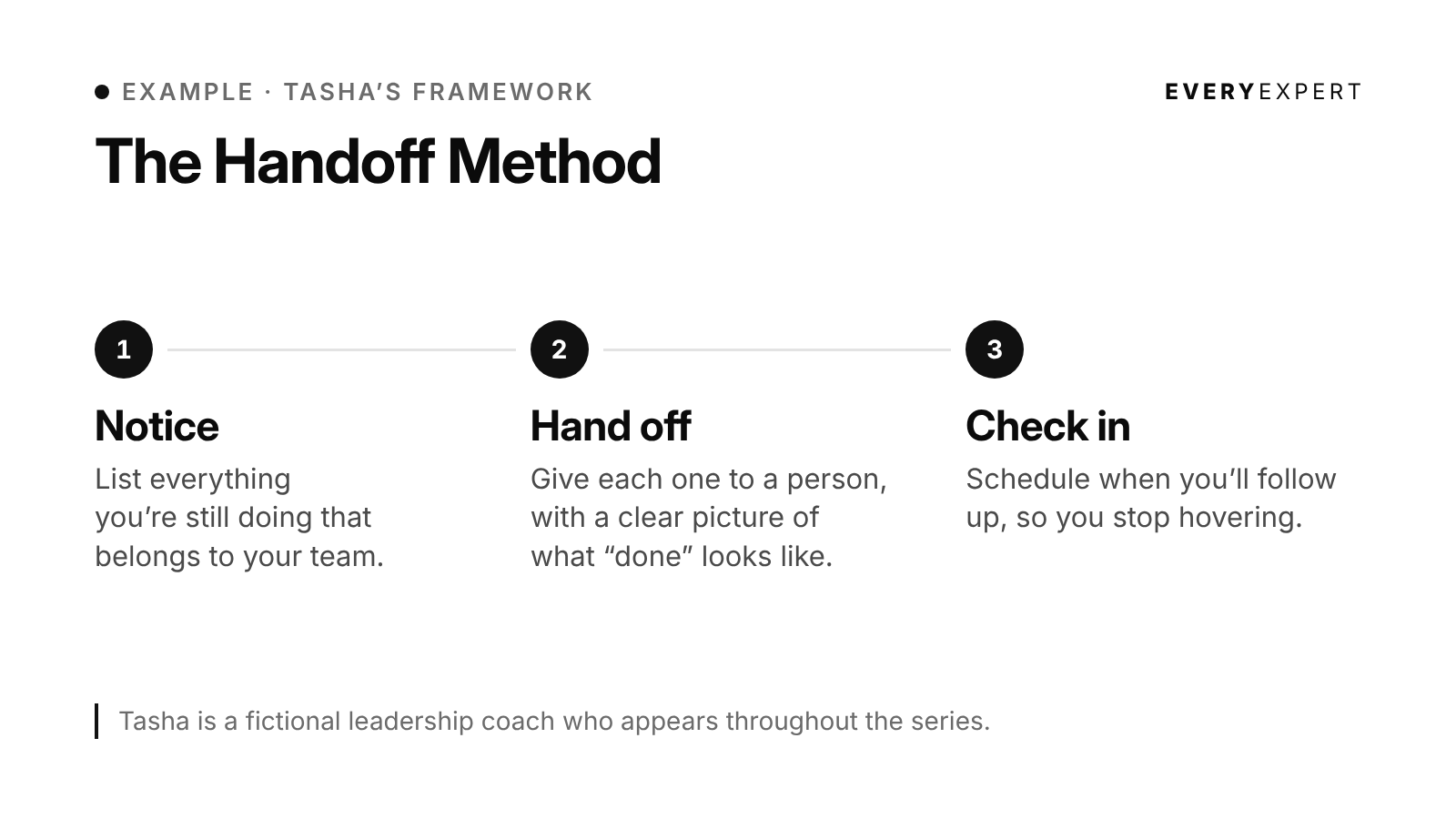
Notice: list everything you're still doing that belongs to your team.
Hand off: give each one to a person, with a clear picture of what "done" looks like.
Check in: schedule when you'll follow up, so you stop hovering.
It passes all four tests:
Index card: three words, three sentences. It fits.
Stranger: "It's how new managers stop doing their team's work." Anyone can repeat that.
Session: her 60-minute session covers Notice and Hand off. The three-session package covers all three stages.
Honesty: it's exactly what she does with clients.
Step 3: The newsletter (article 3)
Tasha doesn't have a newsletter, so she follows the "no" path.
Where: a LinkedIn newsletter, because her buyers are on LinkedIn during the workday and her 800 connections get an invitation when she publishes the first edition.
Name: "The First-Year Manager." It says exactly who it's for.
Description: "For people in their first year of managing a team. One practical fix, every other week."
A free guide to grow the list: "Seven things to hand off in your first month as a manager," a one-page PDF. The last line reads: "If you'd like help working out what to hand off on your team, book a session with me here," with her EveryExpert link.
The first issue: her best idea, not a welcome note. It's the story of the client still answering support tickets, the Handoff Method's first stage, and one step: list everything you did last week that someone on your team could have done.
Step 4: One idea, several issues (article 4)
Every Friday, Tasha pastes her call notes, with names removed, into the weekly idea prompt. One week produces:
Why new managers hold on to the work they're best at
The one-on-one question that surfaces problems early
What to say in your first team meeting as the new manager
Each becomes an issue. Each issue becomes two or three short posts.
Step 5: Posts (article 5)
Here are three of Tasha's posts, one in each of three shapes.
A story post
A client was promoted to manager on a Friday.
The next Thursday, she was still answering support tickets at 9pm.
She was great at her old job, and nobody had told her to stop doing it.
We made a list of everything she'd done that week. Most of the items on it belonged to someone on her team.
She handed off three the next day.
If you're new to managing, try it: write down everything you did last week, and circle what someone else could have done.
I help first-time managers make this shift. My First 90 Days session is built for it: [link]
A pattern post
Almost every new manager I work with is still doing a big part of their old job three months in.
Usually it's the work they were best at, and nobody told them to stop.
The habits that change it are small: a weekly one-on-one, clear expectations, and handing off one thing at a time.
One thing to try this week: book a 20-minute one-on-one with every person on your team, and ask, "What's one thing I could do that would make your week easier?"
If you'd like help working out what to hand off first, my First 90 Days session is built for it: [link]
A framework post
Most new managers start delegating before they've noticed what they're still holding on to.
I use a three-step approach with every client. I call it the Handoff Method.
Notice: list everything you're still doing that belongs to your team.
Hand off: give each one to a person, with a clear picture of what "done" looks like.
Check in: schedule when you'll follow up, so you stop hovering.
Most people skip the first step and wonder why nothing changes.
If you'd like to run it on your own team: [link]
These are example drafts for a fictional expert. Your own posts should come from your own clients and your own words.
Step 6: The conversation after the post (article 6)
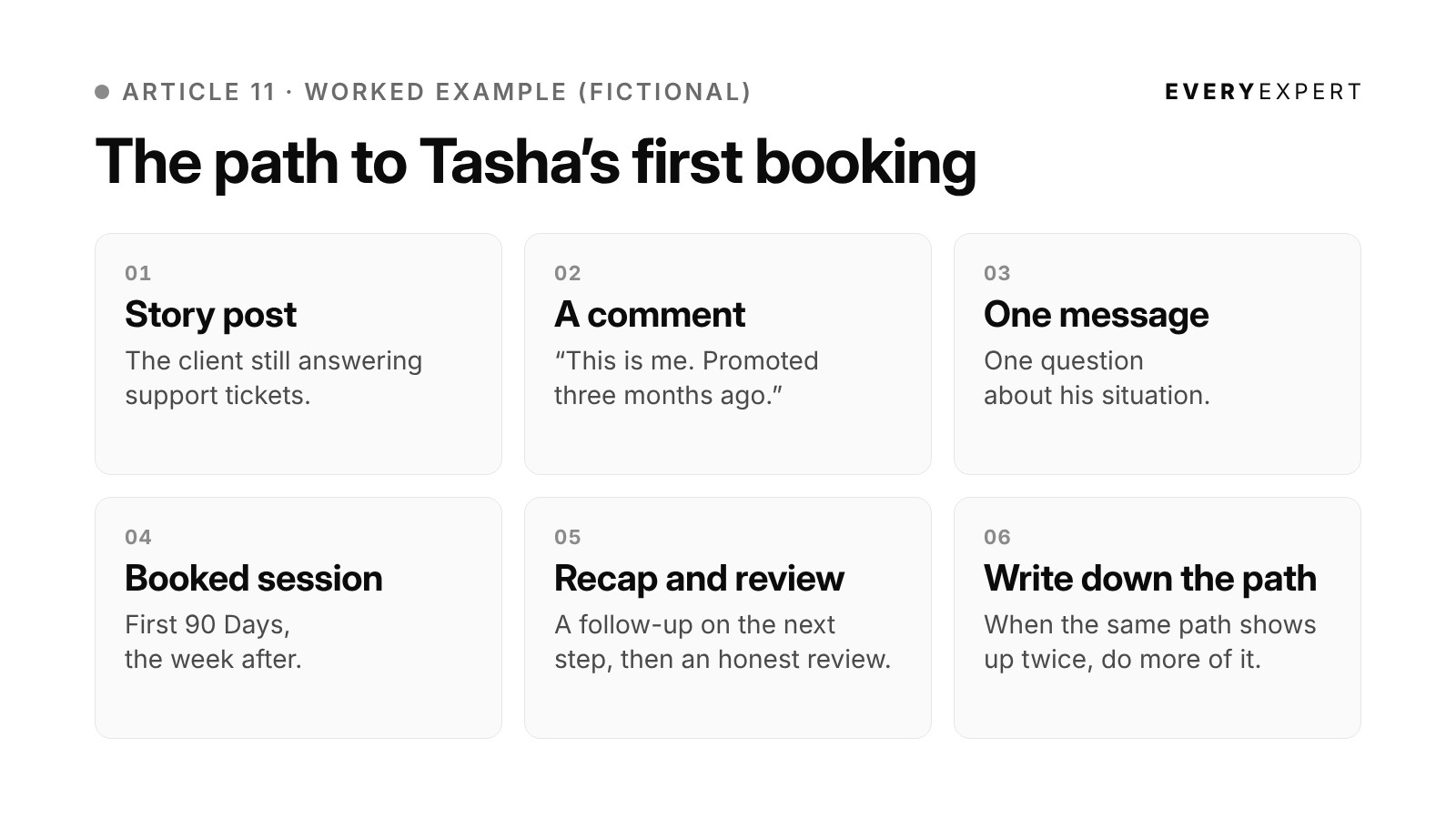
A manager named Chris comments on the story post: "This is me. Promoted three months ago and still in the weeds." Tasha replies publicly with one practical tip, then sends a short message.
"Hi Chris, thanks for your comment on the new-manager post. What's the one thing you're doing that you most wish you weren't?"
After he answers, she offers the next step with an easy out.
"That's exactly what we'd work on in a First 90 Days session. If a focused hour would help, it's here: [link]. And if not, happy to keep trading notes."
Step 7: Find the communities and pitch (article 7)
Where new managers already gather:
Her own alumni network from a former employer
Local chapters of professional associations
Online communities for people-leaders and team leads
Employee resource groups at companies where she knows someone
Internal learning programs at mid-sized companies
She's a member of her alumni network, so that's her first pitch. For an online people-leaders community she isn't in, she follows the organizer, subscribes to their newsletter for a few weeks, and sends her ask as a reply.
The gift before the ask: her "Seven things to hand off in your first month" guide, offered free to members.
The pitch
Subject: A workshop for new managers in the network
Hi Sam,
I keep seeing alumni post about being promoted into their first manager role, and a few have asked how to stop doing their old job.
I coach first-time managers, and I'd like to run a free 45-minute workshop for the network: "The Handoff Method: your first 90 days as a manager." People would leave with a list of what to hand off this week and how to do it without micromanaging.
I'll teach one thing properly and mention once, at the end, where people can book with me. You'd get the recording to share with the network, and I'll promote it to my own connections.
Open to it?
Tasha
After the first yes: she asks Sam for two sentences about how it went, and uses the quote when she pitches the next community.
Step 8: The workshop (article 8)
Tasha adapts the example template from article 8 to her style, which is more discussion than slides.
Workshop: "The Handoff Method: your first 90 days as a manager," for her alumni network.
Opening: "This is for anyone who's been managing for less than a year. By the end, you'll know three things to hand off this week, and how."
Teaching: the Handoff Method, one stage at a time.
Live example: a volunteer lists what they did last week. The group helps sort it into "mine" and "my team's."
The invite: one sentence and her link.
Questions: she writes them all down. They become next month's posts.
Step 9: The ask and the follow-up (article 9)
The invite
"Some of you will take this list and start handing things off tomorrow, which is the whole point. If you'd like help doing it on your own team, I do First 90 Days sessions, and the link is in the chat. That's the only time I'll mention it. And if you're not ready for that, my newsletter is linked there too."
The follow-up email, the next morning
Subject: The replay, and your one thing to hand off
Thanks for coming to "The Handoff Method: your first 90 days as a manager," or for signing up if you couldn't make it. Here's the replay: [link]
This week, pick one thing from your list and hand it off, with a clear picture of what "done" looks like.
If you'd like help with the rest, I do First 90 Days sessions here: [EveryExpert link]
Tasha
After every session, she asks out loud for an honest review, then sends the link the same day. Her first review turns on the rating on her page. Her fifth earns the Highly Rated badge.
The booking
Chris books a First 90 Days session the week after their conversation. That booking is the result the whole system is built for. After the session, Tasha reads the recap, sends Chris a short follow-up about the next thing on his list, and asks for an honest review.
She also writes down the path that led to the booking: story post, comment, one message, session. When she sees the same path twice, she knows what to do more of.
What this shows
Tasha didn't become a marketer. She told stories from her real work, named the method she already used, wrote down what clients asked her, and taught one thing well in someone else's room. Every step pointed back to the same place: her EveryExpert page.
Your profile holds the same raw material. The articles in this series show you how to pull it out.
Do this today
Pick the step that matches the route you chose in the hub, and do what Tasha did with your own profile. If you're not sure where to start, begin with step 1.
Bring it back
Post your own version of any step in the EveryExpert community and tag it with the article number. If you'd like your real profile to be the next worked example, say so at office hours.
Tasha Greene is a fictional composite created for this series.