Invite once, clearly, and then follow up well
Every route in this series ends in the same place: an honest invitation to book with you, and a follow-up that keeps the door open for people who aren't ready yet.
Article 9 of 11 · Closes all three routes
The situation
You've done the useful part. You taught a workshop, wrote an issue, or published a post that people clearly valued. Now comes the moment most experts dread: telling people how to work with you.
So you rush it. A mumbled line at the end, a link dropped in the chat as everyone's leaving, or no mention at all because it felt awkward. People leave helped, and they have no idea what to do next.
The complication
Skipping the ask feels polite, but it isn't. Some of the people in that room want more help. If you don't tell them where to get it, someone who wants more help has to work out the next step on their own.
Overdoing it backfires too. A five-minute sales segment, a countdown timer, or a "special offer for attendees only" undoes the trust you just built. Audiences remember how the workshop ended.
And most experts stop at the ask. They don't follow up, even though some of the people who registered never made it to the live workshop. Without a follow-up, those people never hear the invitation at all.
The question
How do you invite people to book with you in a way that feels like help, and follow up so the people who weren't ready today can still find you later?
The answer
1. Make the invitation once, clearly
If you taught well, the invitation is a service. It tells people who want more help exactly where to find it. Say it once, in one or two sentences, and then move on to questions.
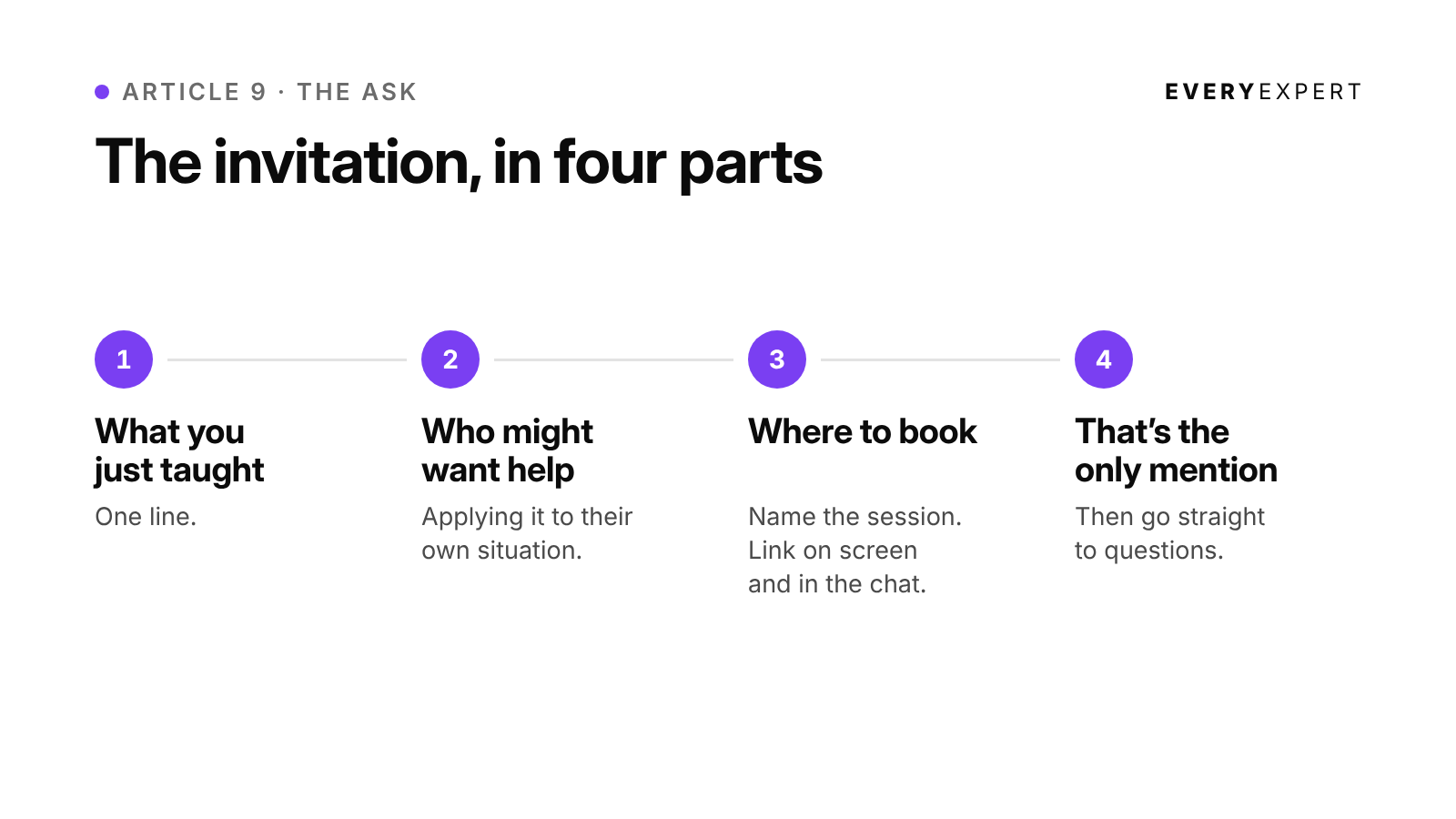
A simple pattern that works for most experts: what you just taught, who might want help applying it, where to book, and a clear signal that you won't mention it again. The wording below is an example. Say it the way you'd naturally say it.
Example: an end-of-workshop invite
On the slide: Your name, the problem you solve in one line, and your EveryExpert link in large type.
What you say: "Some of you will take this and run with it, which is the whole point. If you'd rather work through it on your own situation with me, I do one-hour sessions, and the link is on screen and in the chat. That's the only time I'll mention it. Now, questions."
Paste the link into the chat as you say it, so people can click without writing anything down.
Name the session, not just the page. "My one-hour planning session is built for exactly this" gives people a clear next step. "My sessions are on my page" makes them work out which one fits.
Offer a smaller step too. Not everyone is ready to book a session. Give them a way to stay in touch: your newsletter, or the free guide from article 3. That way the people who aren't ready today don't disappear.
"And if you're not ready for that, I send a short newsletter every other week on exactly this. The signup link is in the chat too."
My workshop, post or issue was about: [topic]
Who was in the room or reading: [audience]
Paste your EveryExpert profile here:
[paste profile]

Write the text for one final slide (my name, the problem I
solve, my EveryExpert link) and a 30-second invitation I can say
out loud. One invitation, said once, framed as help for people
who want to apply this to their own situation. Tell them it's the
only time I'll mention it. Add one sentence offering a smaller
next step: my newsletter or free guide. No urgency tricks, no
discounts. Give me two versions in different tones so I can pick
the one that sounds like me.

Use only what I've given you. Don't invent stories, facts,
numbers, quotes or credentials. If something is missing, ask me.
2. Send the follow-up within a day
Treat the follow-up email as part of the workshop. It reaches the people who attended and the people who registered but couldn't make it. Send it within a day, while the workshop is still fresh.
Keep it short: thank them, link the replay, restate the one step they can take, and include the same single link to book with you. If the organizer is sending it, write it for them and ask them to include your link.
Example: the follow-up email
Subject: The replay, and the one question to ask HR
Thanks for joining "Your first retirement decision, in plain English" yesterday, or for signing up if you couldn't make it live.
Here's the replay: [link]
If you only do one thing this week, ask your HR office one question: "What does the district contribute to each plan, and when does it vest?" The answer will tell you most of what you need to know.
If you'd like to work through your own situation, I do one-hour planning sessions for teachers here: [EveryExpert link]
Maria
Workshop: [title]
The one step I taught: [one sentence]
Replay link: [paste]
My EveryExpert link: [paste]

Write a follow-up email to everyone who registered, under 150
words. Thank them, link the replay (many will only watch the
replay), restate the one step, and include one link to book with
me. Warm and brief. Give me three subject lines.

Use only what I've given you. Don't invent stories, facts,
numbers, quotes or credentials. If something is missing, ask me.
3. Share your page everywhere, the right way
Your EveryExpert page should be one click away wherever people find you. Add it to:
Your LinkedIn featured section and your profile's website link
Your email signature
The end of your newsletter issues (article 3)
The last line of your free guide (article 3)
Your bio on any other platform you use
When you mention your page, lead with the problem you solve, then the link. "I joined EveryExpert" tells people what you did. "I help new teachers choose a retirement plan, and you can book a session here" tells them what they get.
Example: an email signature line
Maria Lopez · Financial planning for public school teachers · Book a session: [EveryExpert link]
Example: a short post sharing your page
"I help public school teachers make their first retirement decision without the jargon. If you're in your first few years and not sure which plan you're in or why, I do one-hour sessions here: [link]"
4. After a paid session, use the recap to map the next step
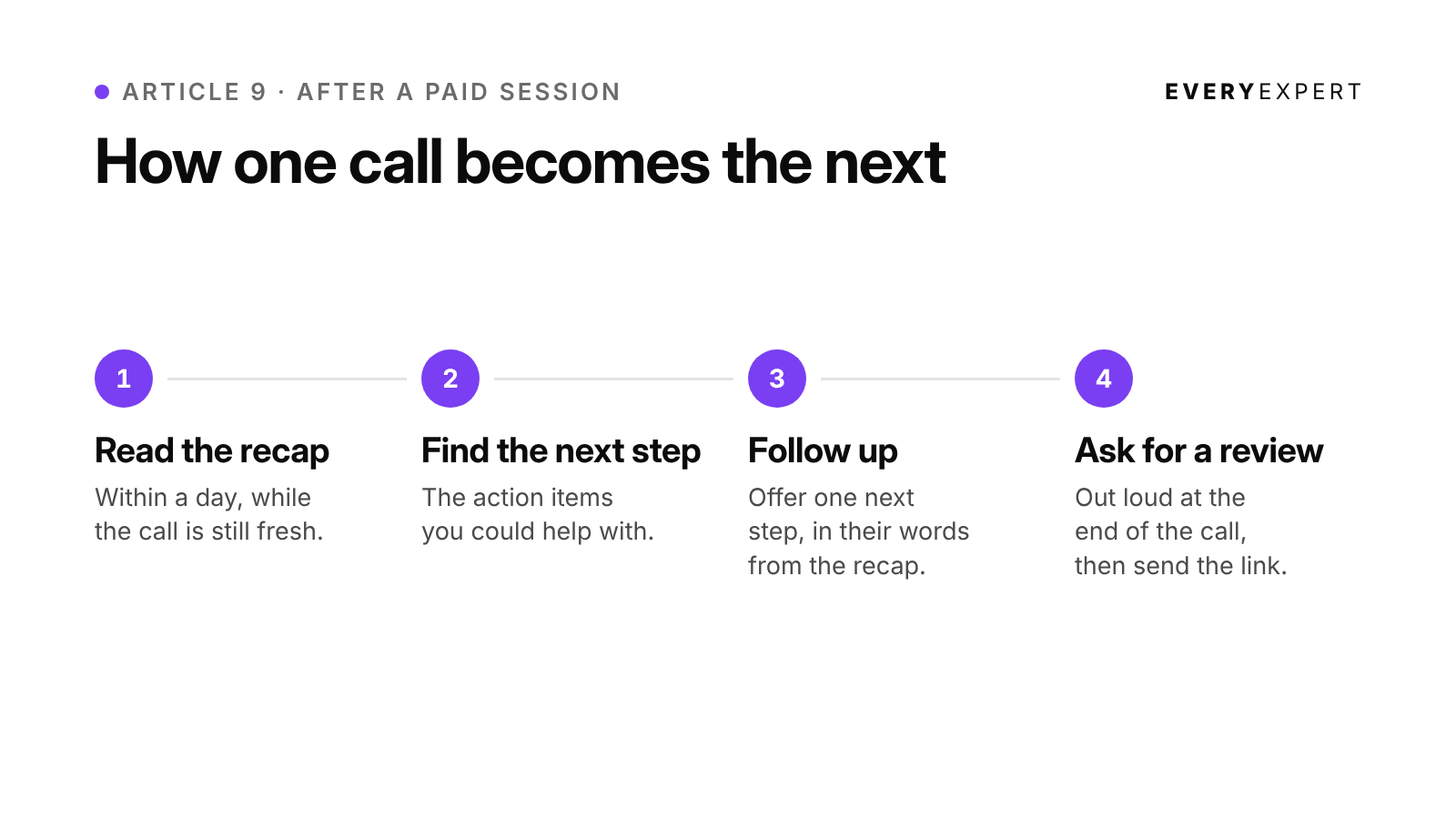
This is one of the most useful things EveryExpert does for you. After every session, you and your client both get the recording, a full transcript, and an AI-generated summary with the key topics and action items. The write-up you used to do late at night is already done, and your client leaves with something to come back to.
The recap is also a list of what this person needs next, which is where your next booking comes from.
Read it within a day, while the call is still fresh.
Look at the action items and ask which ones you could help with. The next problem they mentioned. The thing they'll need once this one is solved.
Send a short follow-up that offers one next step, in their own words from the recap, so it reads like you were listening. Because you were.
Example: a follow-up built from the recap
"Hi Chris, good talking today. Looking at the recap, the next thing on your list is handing off the weekly reporting. That's something I help new managers with a lot. If you'd like to work through it together, you can book a follow-up here: [link]. Either way, glad the call helped."
That's how one call becomes a second call, a package, or a bigger engagement, without finding anyone new.
5. If you offer a free intro, make it a fit check
Many experts offer a short free call before the first paid session. That can work, as long as you treat it as a fit check rather than a sample of the work. Use it to answer three questions: what they're stuck on, what they've already tried, and whether a paid session would help them this week.
If the answer is yes, send the booking link for that session before you hang up. If you find yourself giving the whole session away for free, drop the free call and put a clear paid first session at the top of your page instead.
6. After every call, ask for the review
For a page with no reviews yet, asking for one may do more than your next post. A review from a real client answers the question every new visitor has: did this help someone like me?
Reviews on EveryExpert only open up after a completed session, and nobody can buy one or leave one for themselves, which is exactly why buyers trust them. On EveryExpert today, a profile with zero reviews shows no rating at all. With one review, the full rating appears. With five, you earn a Highly Rated badge in Explore. Going from zero to one is the most visible change on the page, so your first few reviews are worth asking for directly.
The best time to ask is out loud, at the end of the session, while the value is fresh. Then follow up the same day with a short note.
Example: asking at the end of a call
"I'm glad this was useful. If you're comfortable with it, an honest review on my EveryExpert page would really help other people decide whether to book. I'll send you the link."
Example: the same-day follow-up
"Thanks again for today. It was great working through the plan options with you. If you have two minutes, an honest review here would mean a lot: [link]. Either way, good luck with the HR conversation."
Ask for honesty, not praise. A specific, honest review helps the next visitor more than a vague five-star one.
7. Keep the conversation going
Not everyone books right away, and that's normal. People who attended a workshop, read an issue, or replied to a post are warm. Keep them that way.
Add attendees who opted in to your newsletter.
When someone asked a question you didn't have time for, answer it in a short email or a post, and tag them if they're comfortable with it.
When you publish something relevant to someone you spoke with, send it to them with a line about why it made you think of them.
The people who say "not right now" often come back when the problem gets urgent. Your job is to still be in their inbox when it does.
Tasha's version. At the end of her workshop, Tasha says it once: "If you'd like help doing this on your own team, I do First 90 Days sessions, and the link is in the chat. That's the only time I'll mention it." The next morning, the follow-up email goes out with the replay and one step. After each paid session, she reads the EveryExpert recap within a day, picks the next action item she can help with, and sends a short follow-up offering one next step. Then she asks for an honest review.
How this looks in practice
These are illustrations of the pattern, not case studies.
An insurance advisor for small businesses used to end her webinars with ten minutes on her packages. She switches to one sentence and her link, then goes straight to questions. That gives the room ten more minutes to ask about their own situations, which is the part organizers and attendees remember, and the part most likely to get her invited back.
A songwriting coach runs a free workshop for his own newsletter readers. Many of the people who registered miss it live, so the follow-up email with the replay and the one exercise from the workshop does most of the work. His booking link sits at the bottom of that email, where people who watch the replay later in the week can find it.
A remote team facilitator has great sessions and no reviews, so her page shows no rating at all. She starts asking every client out loud at the end of each call, then sends the link the same day. Her first review turns on the full rating display, and she keeps asking until she reaches five.
Do this today
Write your one-sentence invitation, the way you'd actually say it, naming the session it points to, and add your EveryExpert link to your email signature. If you haven't yet, send the ten notes to people who already know you, from the hub. That's about ten minutes. If you've had a session with a client recently, send the same-day review request now, even if it's a few days late.
Bring it back
Share your invitation sentence in the EveryExpert community and ask whether it sounds like help or like a pitch. If people come to your workshops but don't book, bring your follow-up email to office hours. It's often the piece that needs the most work.
Next: Article 10: Swipe files for every kind of expert
Back to: The series hub