Five post shapes that work for experts, and the two lines that decide everything
You don't need to go viral or post daily. You need a few post shapes that fit how you talk about your work, and first lines that make the right person stop scrolling.
Article 5 of 11 · Route 2: Social media
The situation
You know you should be posting. You've probably tried. Maybe you shared an article with a sentence of commentary, or announced a milestone, or wrote something thoughtful that got eleven likes, mostly from people you already know.
So posting starts to feel like performing for nobody. You're not sure what to say, you're not sure anyone's reading, and you'd rather spend the time with clients.
The complication
Most social media advice is built for creators whose product is attention. It tells you to post daily, chase trends, and write hooks that sound like movie trailers. For an expert, that approach feels fake, and it attracts the wrong people: readers who enjoy content, not buyers who have your problem.
The quieter approach works because of how people choose an expert. Before most people book someone, they want a sample of how that person thinks. A useful post is that sample.
The catch is the word "consistently." That only happens when posting is easy, and it's only easy when you know what shape a post should take before you start.
The question
How do you post regularly, in a way that sounds like you and attracts people who might book you, without it taking over your week?
The answer
Start with the two lines that matter most
On LinkedIn, only the first few lines of your post show before the "see more" link. Those lines decide whether anyone reads the rest. Everything else in your post can be good, and if the opening doesn't make the right person stop, nobody sees it.
Write your first two lines last, after you know what the post is really about. Good first lines tend to do one of these things:
Start in the middle of a moment. "The client stopped me halfway through the proposal."
Name a situation your reader is in right now. "You've rewritten your bio three times this month."
State something specific and a little surprising. "Most new managers I work with are still doing their old job six months in."
Quote a real question. "A client asked me last week: should I raise my prices before or after I launch?"
Skip the tricks: no "here's what nobody tells you," no questions you answer in the next line, no all-caps. Your reader should feel recognized, not baited.
Here's my LinkedIn post:
[paste post]

My reader is: [who you help]

Write 10 alternative first two lines. Mix these approaches: a
specific moment, a situation my reader is in right now, a
specific fact from the post, and a real question someone might
ask. No clickbait, no "here's what nobody tells you," and no
questions answered by the next line. Then tell me which three
are strongest and why.

Use only what I've given you. Don't invent stories, facts,
numbers, quotes or credentials. If something is missing, ask me.
The five shapes
Each shape below comes with a template and then a finished example, so you can see what the template turns into. Every shape follows the same bones: a first line your buyer recognizes, the substance, one takeaway they can use without you, and at most one quiet line pointing to your page. Your reader is the hero of every post. You're the guide who has seen this before.
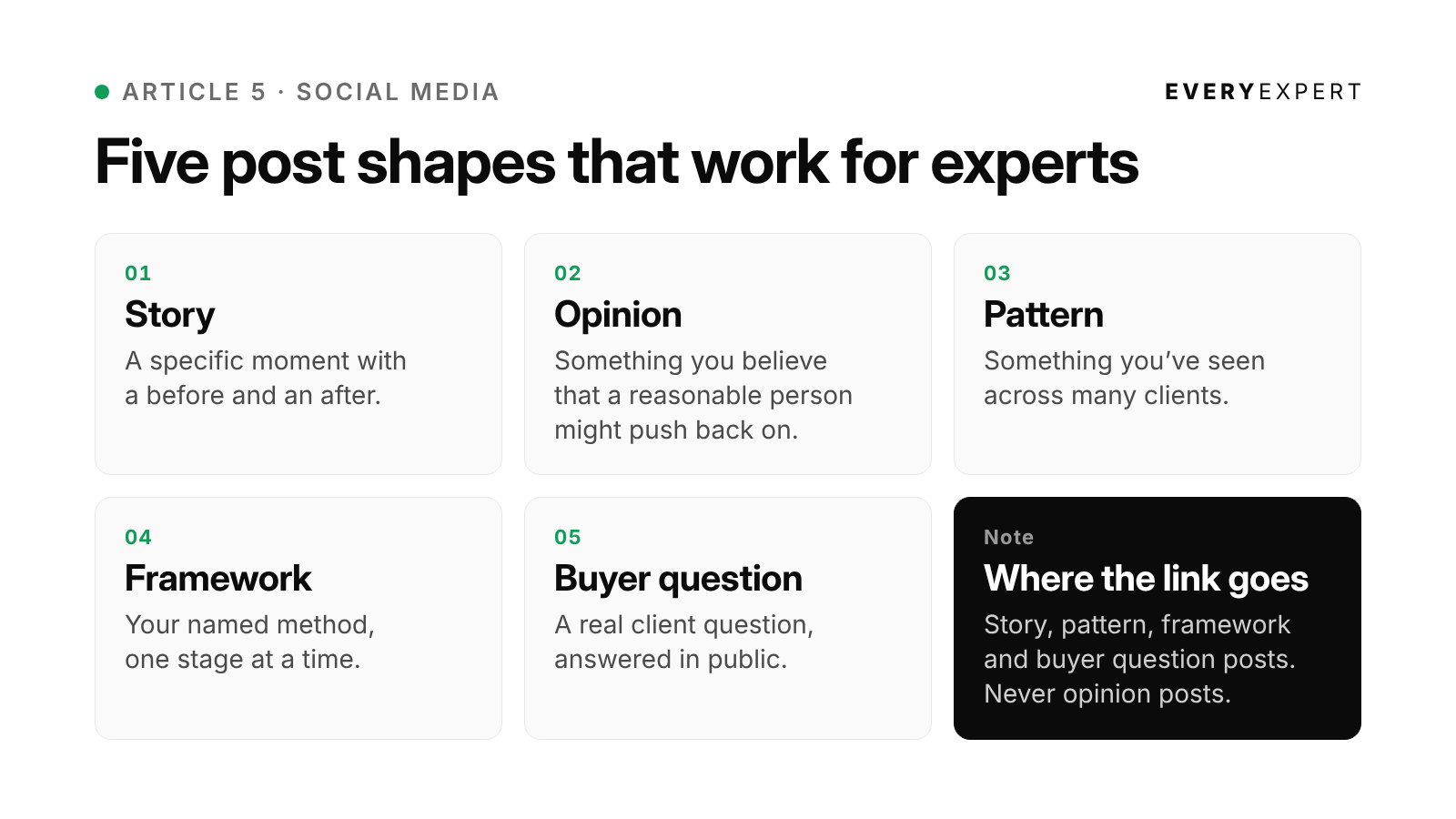
1. The story post. A specific moment with a before and an after. Your best stories come from the material you gathered in article 1.
[First line: the moment, in one sentence. Start in the middle.]
[Second line: why it mattered, or what you didn't know yet.]

[The story, three to six short lines. Specific: a time, a place,
a thing someone said.]

[The turn: what changed, or what you noticed.]

[The lesson, written for the reader's situation.]

[Optional: "I do this work with [who]. My sessions are here:
[your EveryExpert link]"]
Example: an e-commerce product photographer
A shop owner sent me photos of her best-selling candle and asked why it looked cheap online.
It took me about ten seconds to see it: the light.
She'd been shooting on her kitchen counter at noon. Hard sun from the side, harsh shadows, the label washed out.
We moved the same candle two feet. Turned it so the window was behind her, not beside the product. Hung a white bedsheet to soften the light.
Same phone. Same candle. Ten minutes.
The new photo looked like the price she was charging.
If your products look worse online than they do in your hand, check where the light is coming from before you buy any new gear.
I do photo reviews for small shops. Sessions here: [your EveryExpert link]
2. The opinion post. Something you believe that a reasonable person in your field might push back on. Disagree with a practice, never with a person. The goal is a respectful argument your buyer has already been having in their own head.
[The common advice, stated fairly.]
[Your position, in one plain sentence.]

[Why: one example from your work.]
[What happens when people follow the common advice.]
[What you'd do instead, specifically.]

[Invite disagreement: "Where does this break for you?"]
Example: a negotiation coach (no link, on purpose)
"Always anchor high" is the salary advice I hear more than any other.
I think it's incomplete, and it costs people offers.
Anchoring high works when you can explain the number. Without a reason, a high anchor reads as a guess, and a recruiter who thinks you're guessing starts negotiating against you.
I've seen clients open with a strong number and no reasoning, then spend the rest of the call defending it.
What I'd do instead: anchor with a reason attached. "Based on the scope of this role and what I'm seeing for similar positions, I'm looking at X." Same number. Very different conversation.
Where has anchoring high backfired for you?
3. The pattern post. Something you've seen across many clients, described honestly. It's your own observation, so you never need to cite anyone else.
[The pattern, in one line.]
[How often you see it, described honestly: "most," "almost every."]

[One example from your work that makes it real.]
[Why it tends to happen.]
[The one thing to do about it this week.]
Example: a virtual events consultant
Most teams I work with spend three weeks on the live webinar and ten minutes on the replay email.
That's backwards. A lot of people who register never make it live, and the replay email is the only part of the event they see.
It happens because the live session feels like the event, and the email feels like admin.
This week, before your next event, write the replay email first. Subject line, a one-sentence summary, the one takeaway, and the link. Then build the live session.
If you'd like help planning the whole event around that email, my event review session is here: [your EveryExpert link]
4. The framework post. Your named method from article 2, one stage at a time or all at once.
[The problem your framework solves, as the reader feels it.]
[The name of your framework, and one line on where it came from.]

[Stage 1: name and one sentence]
[Stage 2: name and one sentence]
[Stage 3: name and one sentence]

[Where people usually get stuck.]
[If you'd like to run this on your own situation: [link]]
Example: a bookkeeper for creative businesses
Most creative business owners look at their numbers once a year. In April. In a panic.
I ask my clients for one hour a month instead. I call it the Monthly Money Hour.
Sort. Every transaction gets a real category. Nothing goes in "miscellaneous."
Check. Compare this month to the same month last year, not to last month.
Decide. One conversation about what the numbers mean for next month.
Most people get stuck on the third step. They sort, they check, and they close the laptop without deciding anything.
If you'd like to run your first Money Hour with me: [your EveryExpert link]
5. The buyer question post. Every good question a client asks is a post. Answer it in public, and you've answered it for everyone who was too shy to ask.
"[The question, exactly as a client asked it.]"
[Someone asked me this recently. Here's my honest answer.]

[The answer, short.]
[The part that depends on their situation.]

[That second part is what a session is for: [link]]
Example: a pricing coach for small businesses
"Should I raise my prices before or after I launch the new offer?"
A client asked me this last week. Here's my honest answer.
Before, if your current clients are already getting more than they pay for. Raising prices first makes the new offer's price feel normal instead of like a jump.
After, if the new offer changes what you deliver. Then the higher price has a reason people can see.
The part that depends on you is how full your calendar is and how your current clients would react. That part is what a session is for: [your EveryExpert link]
Never include anything that could identify a client. Change the details, or ask their permission.
Write them in your voice
Paste your voice rules from article 1 at the top of every writing prompt. Then give the AI your raw material and pick a shape.
Paste your EveryExpert profile here:
[paste profile]

Paste your voice rules from article 1 here:
[paste voice rules]

The shape I want: [story / opinion / pattern / framework /
buyer question]
My raw material: [the story, opinion, pattern, framework, or
client question, in rough notes]
My reader: [who you help]

Write a LinkedIn post under 220 words using that shape. Short
lines. First two lines must make my reader stop scrolling
without clickbait. Make the reader the hero and me the guide.
End with one takeaway they can use without me. Only add my link
([your EveryExpert link]) if the shape is story, pattern,
framework or buyer question.

Give me two versions. Use only what I've given you. If you need
a fact or detail I haven't provided, ask me instead of inventing
it.
Always rewrite the output before posting. Change any line you wouldn't say out loud to a client. The AI gives you a draft. The post is yours.
Where your link goes, and how often to post
Links: put your EveryExpert link at the end of story, pattern, framework and buyer question posts, and name the session it leads to. Leave it off opinion posts and let the conversation happen in the comments. Article 6 covers what to do with those conversations. Also add your EveryExpert page to your LinkedIn featured section, so anyone who visits your profile after reading a post has somewhere to go.
Frequency: one post a week that you actually keep up beats five posts a week that stop after a fortnight. Rotate the shapes so you're not repeating yourself. If you write a newsletter, each issue can become two or three posts, as article 4 shows.
Here's my material bank from article 1:
[paste stories, opinions, questions and patterns]

My framework from article 2:
[paste it]

Plan four weeks of LinkedIn posts at [one / two] a week. Rotate
between the five shapes: story, opinion, pattern, framework and
buyer question. For each post, give me the shape, a working first
line, the one point, and whether it carries my EveryExpert link.
Opinion posts don't carry the link.

Use only what I've given you. Don't invent stories, facts,
numbers, quotes or credentials. If something is missing, ask me.
No following yet? It still works
A small, relevant network beats a large, random one. Two hundred connections who are your kind of buyer, or who know them, is a real audience. The posts in this article are designed to be useful to the right few people, not to impress everyone. Post consistently for a month, reply to every comment, and connect with people who engage. That's how the right audience grows.
And if LinkedIn isn't where your buyers spend time, the same five shapes work on other platforms. Adjust the length, keep the bones.
How this looks in practice
These are illustrations of the pattern, not case studies.
A trademark attorney assumes her work is too technical for social media. Buyer question posts change that. "Can I use a name if nobody's registered it?" is the kind of question founders search for before they ever call a lawyer. A short, plain answer, plus the part that depends on their situation, gives her a steady supply of posts with an obvious next step: a name check session.
A registered dietitian avoids opinion posts because she worries about sounding preachy. She tries one on a common piece of advice she disagrees with, framed around what she sees with clients and ending with a real question for readers. If the comments turn into a real discussion, with people describing their own situation, each one is the start of a conversation she can continue.
A wedding planner rotates through all five shapes in a month: a story about a rain plan that saved a reception, an opinion on over-scheduled timelines, one pattern she sees every season, her three-stage planning method, and a question couples always ask. Five posts, one month, and every one of them leads back to the same planning consultation on her page.
Do this today
Pick one shape and write one post using the voice prompt. That's about twenty minutes. Rewrite the first two lines with the hook prompt, then post it. One real post teaches you more than a month of planning, and every post that lands is one more person who knows where to book you.
Bring it back
Share the first two lines of your post in the EveryExpert community before you publish, and ask whether they'd make someone in your audience stop. If you're not sure which shape fits your material, bring the raw material to office hours. The room can usually tell you which shape it wants to be in under a minute.
Next: Article 6: The conversation after the post
Back to: The series hub