Should you repost your old LinkedIn posts?
Yes. Take the posts that already worked, wait about three months, skip anything seasonal, and post them again until they stop working.
The situation
You post a few times a week because you know you should. Every post starts from a blank page. Some land, most don't, and you can't quite say why.
Meanwhile you have a handful of posts from months ago that did really well. A story people commented on, a lesson that got shared, a post that brought in a couple of good conversations. They are sitting in your feed doing nothing.
The thought crosses your mind to post one again. Then you picture someone noticing, and you go back to the blank page.
The complication
The blank page is the expensive part. Coming up with new ideas over and over again is exhausting, and the exhaustion shows: the posts get thinner, you skip a week, then two.
The usual fix is a bigger idea list or a content calendar. That just gives you more blank pages. And the fear behind it doesn't hold up. Very few people will call you out for reposting. When someone does, it is usually a friend joking around, or someone saying they love that story. Plenty of the people who see a post have never seen your earlier ones.
The question
So how do you keep posting things that work without inventing a new idea every time, and without wearing out the people who follow you?
The answer
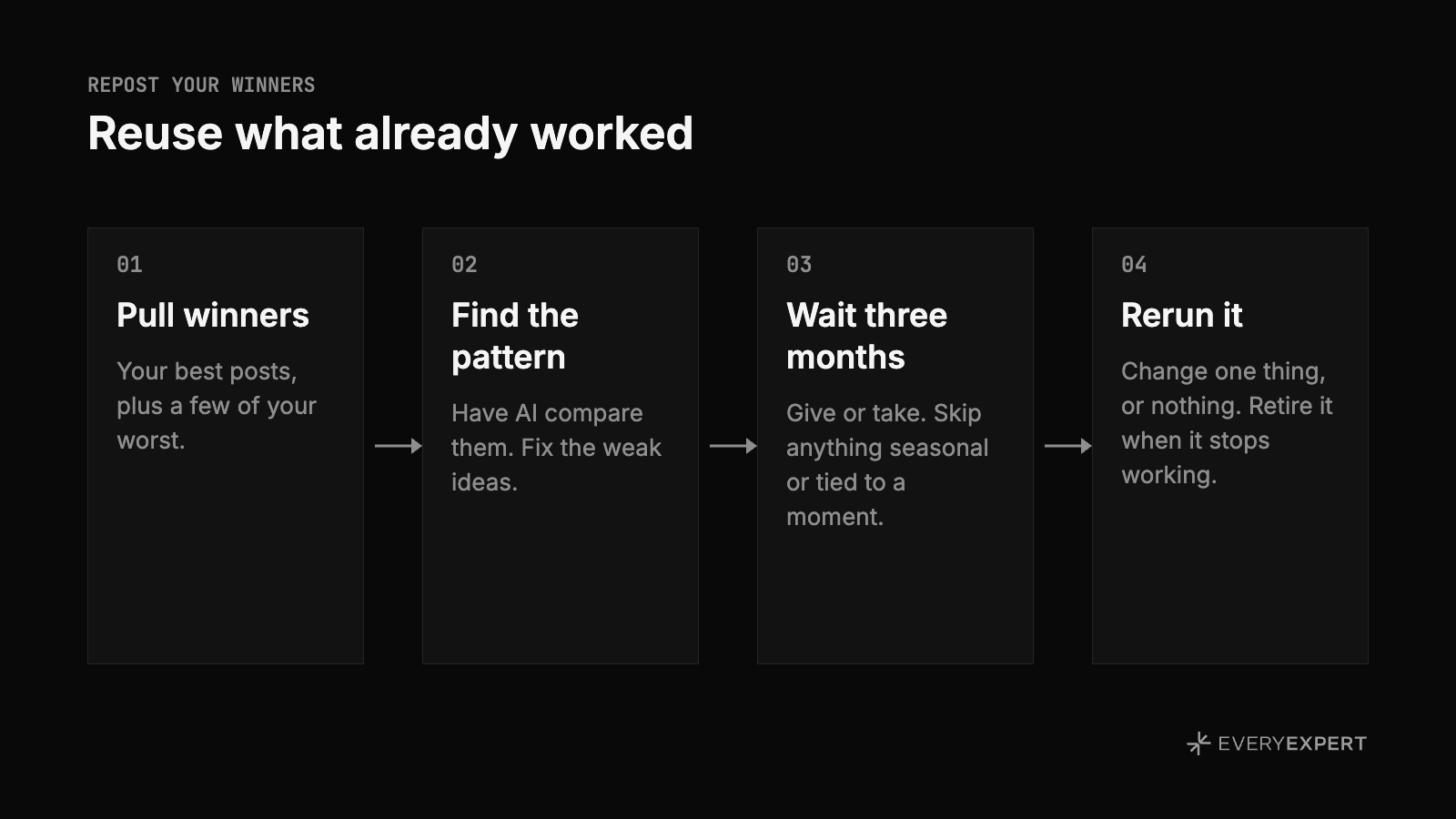
Justin Welsh, a popular LinkedIn creator, used to take his top five performing posts and repurpose them until they stopped performing well. That is the whole idea. The rule that keeps it working is not reposting anything too recent, which step 2 covers. Your best ideas are already written. Your job is to find them, space them out, and keep using them while they still work.
1. Pull your winners, and your losers
Open your post analytics and pull your best performing posts. Then pull a few of your worst ones too.
Put both sets into Claude or another AI tool and ask: what do the winners have in common that the losers don't? You might find your stories beat your how-to posts, or that one topic always outperforms the rest. Use what you learn to improve the weaker ideas. Leave the winners as they are and repost them.
2. Space them out and skip the seasonal ones
Don't repost something too recent. Wait about three months, especially if the post was really good. If someone does remember it, they tend to tell you they liked it.
Skip anything tied to a season or a moment. A post about how excited you are for summer reads strangely in January. The ones worth rerunning are the stories and lessons that are true any month of the year.
You may feel tired of telling the same story long before your audience does. That is normal. Most of the people seeing a post that spreads are outside your network and have no idea who you are. (Reading that split is covered in Run LinkedIn on the out-of-network number.)
3. Rerun them until they stop working
Post the winner again. Change one thing if you feel like it, such as the opening line or a detail, but don't rewrite a good idea into a different one. Then keep using it.
My post about having a crappy apartment? I've done it four times, and it always gets over 100,000 views.
Over time you end up with a short list of canon stories, a few moments from your life or work that you can bring back every three months or so, knowing they will land. Retire a story when it stops performing, and keep it as long as it doesn't.
How this looks in practice
A pilates studio owner posts about once a week and struggles to keep it up. Looking back, the post that did best was about a client who came in with back pain and couldn't tie her shoes, and the class that changed that. She checks with an AI tool and sees her client stories beat her exercise tips every time. She reruns that story with a new first line. Posting stops feeling like homework, and the studio's inbox gets the same kind of questions the first version got.
A personal chef had one post that took off: the dinner party where everything went wrong and how he saved it. He nearly reposted his holiday menu post too, then left it, since it only makes sense in December. The dinner party story goes out again three months later and draws new comments from people who had never seen it.
A wine educator keeps a short list of three stories, including the tasting where a skeptical guest finally got it. She rotates them every few months between new posts. When one stops getting a response, she drops it and promotes a newer post that did well.
None of them came up with a new idea for those posts. They used the ones that had already worked.
Do this today
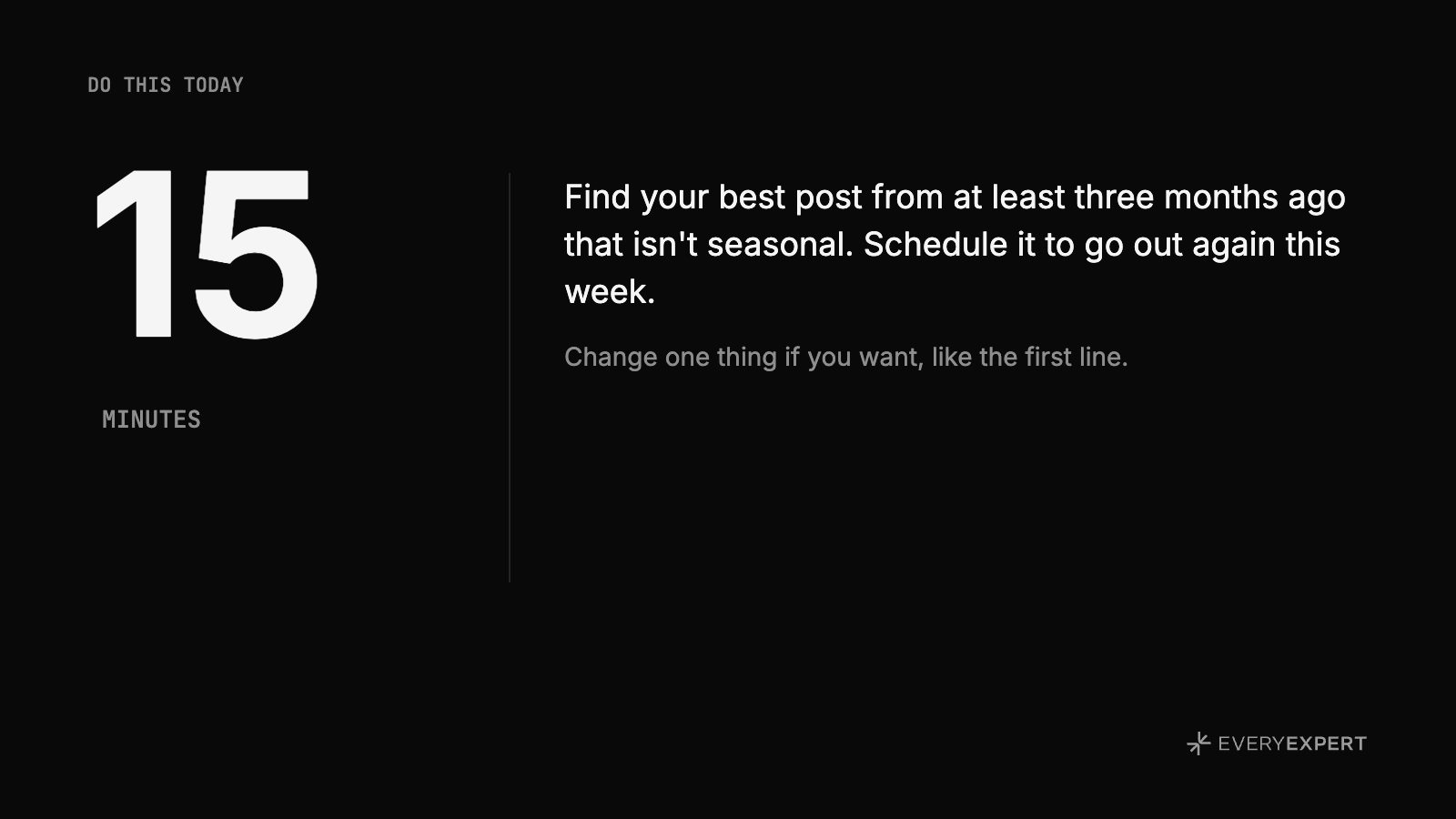
Open your analytics and find your best performing post from at least three months ago that isn't seasonal. Change one thing if you want, like the first line, and schedule it to go out again this week.
Fifteen minutes.
Bring it back
Post the original and the rerun side by side in the community, with how each one did. If the rerun flopped, bring both to office hours along with your other top posts. The room can usually tell whether it was the idea, the timing, or the one thing you changed.
Office hours
This came out of a live EveryExpert office hours session, when a member asked whether reposting old content was a good idea or a bad one. That is what office hours is for: bring a real question and leave with the next move.
Next session: [HOLD: date, time and registration link]
Not on EveryExpert yet?
EveryExpert is where people book paid calls with experts like you. Set up your page at everyexpert.com so the people your best posts reach have somewhere to book.