Sell the workshop before you build the course
Borrowing a designer's process to test an offer before you spend three months building it
Designers do not pick what to build and then hope it lands. They put a small, cheap version in front of real people first, and what comes back decides what gets built next.
You already know what you want to sell
You have the idea. A course, a cohort, a retainer, a membership. You have known roughly what it should be for months, and the only reason it is not finished is time.
So you find the time. Six weeks of evenings on the curriculum. A sales page. A launch week. A few people buy and most do not, and from the outside you cannot tell whether the problem was the offer, the price, the timing, or the list.
Then the next idea arrives and the same six weeks start over.
Building first is the expensive way to be wrong
The obvious fix is better marketing. Rewrite the sales page, post more, build the list, put a webinar in front of it. Any of that can work, and none of it saves an offer aimed at a problem nobody is currently trying to solve.
The real cost is not the money. It is that you spent six weeks building the thing that would have answered the question in an afternoon. By then you have six weeks in it, which is exactly the point where people stop asking whether it was the right thing to build.
This is where hard and wrong get confused. Hard means keep going. Wrong means stop. Only evidence settles it, and six weeks of building is a slow, expensive way to collect any.
So how do you find out whether an offer will sell before you build it?
Run it the way a designer runs it.
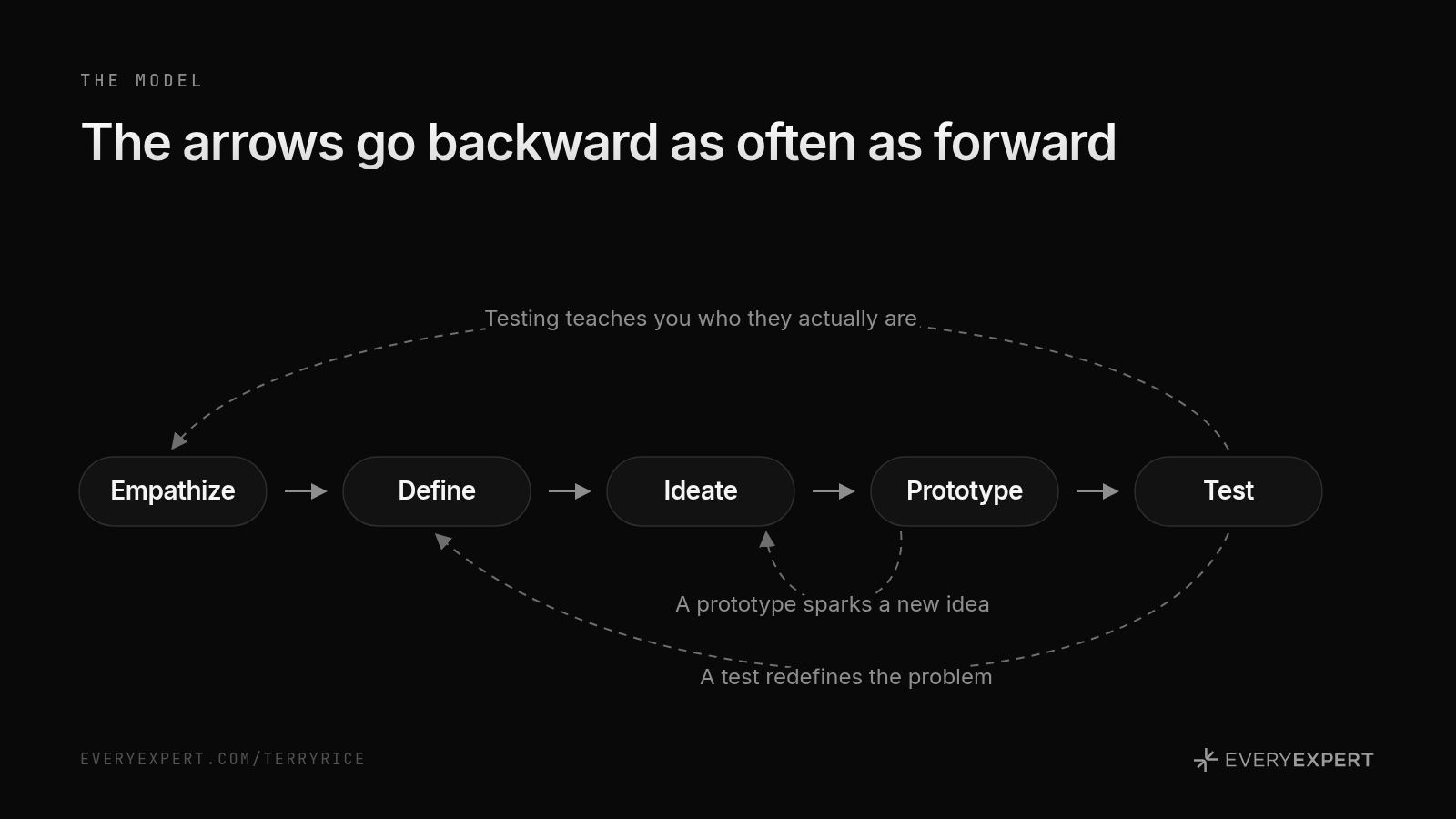
Design thinking gives you five modes: empathize, define, ideate, prototype, test. The Hasso Plattner Institute of Design at Stanford defined them. The d.school is explicit that these are modes, so they run in parallel and repeat rather than forming a line you walk once (source).
There is no shortage of models for building a business. This one is worth borrowing because it did not come from marketing. It came from product design, where the job is to answer one question before anyone spends money: is this thing worth making? Three moves get you there.
1. Learn what your audience consumes before you decide what they need
Here is the question I use as a gut check. If you cannot name the books, newsletters or podcasts your audience is working through right now, you do not know enough about your audience yet.
That sounds harsh. It is also fast to fix, and it tells you more than a demographic ever will. What someone reads is a record of what they are actively trying to solve.
Four places to get it without running a survey. Ask at the end of your next call. Look at what they have shared or commented on in the last month. Read the review they left somebody else, which is usually more honest than anything they tell you. Check which communities they post questions in.
Then build an empathy map. Dave Gray designed it at XPLANE as part of the Gamestorming toolkit, and his updated canvas runs from the outside in. What they see, what they say, what they do, what they hear. Only then the middle, what they think and feel. Pains and gains last.
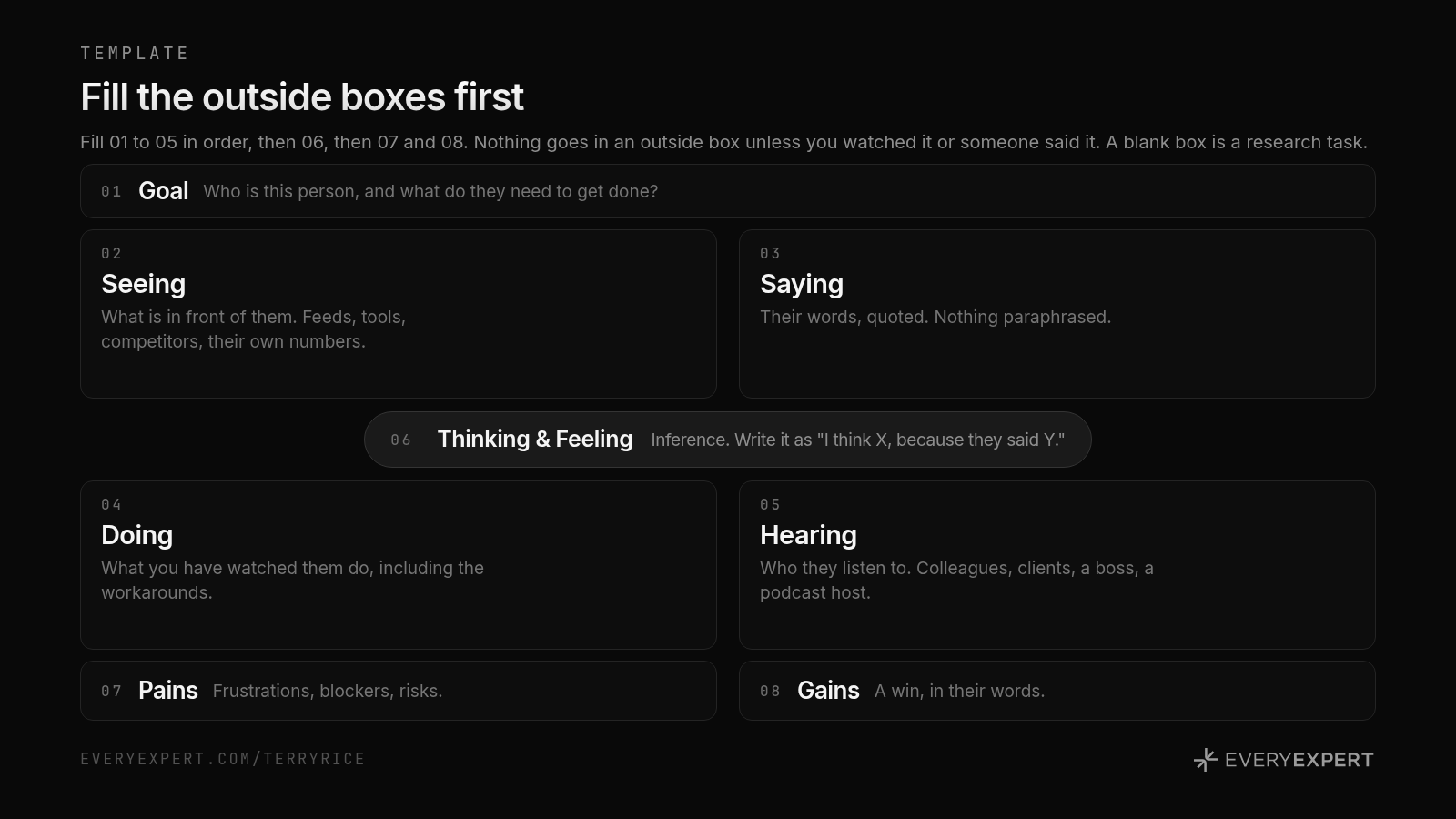
The order is the whole point. You fill the observable boxes with things you have actually witnessed, so the interior boxes become an inference you can check rather than a guess you fall in love with.
2. Write the problem as one sentence you could be proven wrong about
Your audience has several problems. You do not have to solve all of them, and trying to is how offers get vague.
Pick one. Write it as a claim, not a theme. "Mid-career operators lose two hours a week rebuilding the same report" is a claim. "Productivity" is a theme.
Then go wide on how you could solve it before you narrow. A course, a cohort, a community, a template pack, a done-for-you service, a coaching engagement that pulls the answer out of them instead of handing it over. The Design Council built the Double Diamond around this rhythm in 2003 and 2004: open up, then close down, twice (history of the model). Most people skip the opening and go straight to the format they already sell.
3. Sell the smallest version that could disappoint someone
This is the prototype, and it is the step people skip because it feels like less.
The course becomes a two-hour workshop. The retainer becomes a paid audit. The membership becomes four people on one call. Frank Robinson named this the minimum viable product in 2001, and Eric Ries's definition is the useful one: the version that collects the most validated learning for the least effort (background).
One adjustment worth making. Charge something. A free workshop that nobody attends tells you your promotion failed. A $25 workshop that nobody buys tells you the problem is not urgent enough to pay for, which is the thing you actually needed to know. Money is the cheapest evidence you can buy.
Decide what counts as a yes before you run it. Six seats, four seats, whatever you pick. Deciding afterward is how people talk themselves into building anyway.
What the loop looks like when it runs
The arrows go backward as often as forward. That is the part the tidy five-box diagram hides.
A grant writer runs a paid one-hour session on writing a strong needs statement. Most of the people who register ask about budget narratives instead. The test rewrote the problem definition. The next session is on budgets, and the course that eventually gets built has a different table of contents than the one she was six weeks from finishing.
A supply chain consultant prototypes a diagnostic call for small manufacturers. Halfway through the third one he realizes he is drawing the same map on the whiteboard every time. The prototype sparked the product. The map becomes a paid template with a walkthrough attached, which takes a week to make instead of a quarter.
A podcast producer offers a paid teardown of one episode. Everyone who books sends the same apologetic note about their audio setup. Nobody mentioned equipment on the empathy map, because nobody says it out loud until money is involved. Testing sent her back to the empathize box with something she could not have guessed.
None of those three wasted a quarter. Each of them bought a real answer for about a week of work.
Do this today
Write down the 3 most recent things your best client read, watched or listened to about the problem you solve. 10 minutes, from memory.
If you cannot fill all three, that gap is the finding, and one message to that client closes it.
Bring it back
Post your three in the community, and say what surprised you about the list.
If you want to go further, bring your one-sentence problem claim from step 2 to office hours. Ask the room this:
"Would you pay $25 for a two-hour session on this? If not, what would you pay for instead?"
People can answer that. Nobody can do much with "what do you think of my idea?"