Lesson 4 recap: turn one call into ongoing work, and grow by design
What to do after the first call, how to sell a VIP day, biz dev you can run every week, and why your first review matters most.
Lesson 4 was the last session of the first Expert Accelerator cohort, and it was about what happens after someone books you. Getting the first call is hard. But as I said on the call, once the leads come in, you still have to work. So the goal is to set up your business so the work coming in feels like something you want to do, and so new people keep finding you without a desperate push every month.
I call that growing by design. Below are the moves from the session, each with the steps to run it yourself, then Matthew's walkthrough of why reviews matter so much.
Prefer to watch? The edited session runs about 61 minutes: https://share.descript.com/view/EXBBBN4c4tP
What's in the session
0:04 Grow by design
2:30 What we're covering
2:57 Lesson 3 in three moves
7:03 Why true stories make comments work
9:32 From the room: an AI agent that finds the conversations
12:32 Consistency is what compounds
14:55 Make it worth it for them
17:34 After the call
19:12 Name the next step, then use the recap
20:50 The VIP day
26:46 Warm people up before you sell
27:44 Run webinars with hot seats
30:48 Coach without live calls: Asks
32:33 Never another revenue drought
33:51 Borrow a room: the golden link
36:08 Host your own room
38:08 Your warm 100
41:32 Protect your network
43:52 Set up an Ask with AI, live
46:46 Matthew: why reviews matter
52:03 The psychology of a review
57:20 What changes at one review and at five
59:59 Your plan, by design
1. Live and grow by design.
My goal is to help people live their life by design. A lot of the time we live by drift instead, floating around and trying to figure out what we're doing. Or we live by drive, working really hard and grinding every day with no end in sight. Design is when you decide how you want your day to look and what work you want to do, then put standards in place to protect it.
Business works the same way. You can watch every video about going viral, but if you're not clear on who you are and what you want out of it, you'll be hit or miss, or you'll succeed as the wrong version of yourself. Clarity comes first. Momentum comes after.
2. Make your comments true.
Quick recap of Lesson 3: ask for a small yes in your outreach, give people an easy reason to comment on your posts, and comment more than you post.
On that last one, I use an AI prompt to find conversations I should be in, based on the rooms I want to be in and the relationships I want to form. It suggests a response. I don't always take it, because I have my own brain.
What makes the comments land is that they're true. I'm reaching out to non-alcoholic spirits brands for my events, so when I comment on their posts I say I've been sober since 2015, and how much easier corporate events would have been with a product like theirs. Nobody makes that up. People in that space have started sending me connection requests, and I don't pitch them. I say thanks, great to know you. When you live by drive, you jump straight to "can we hop on a call?" and you project scarcity.
A member shared a version of this from the week: she asked an AI agent what she posts about, had it find someone writing on the same topics, read his posts, talked her own take through with ChatGPT, and wrote her own comment. The author sent her a connection request and asked to continue the conversation.
3. Consistency is what compounds.
At a mastermind this week, friends told me something hard to hear: I have good ideas, but I jump from one to the next, so nothing compounds. Every friend of mine with a brand that's winning has been doing the same thing consistently.
My friend Dorie Clark, the best-selling author, told us she started this year at 22,000 Instagram followers and is now at 600,000. It took her about 95 reels of experimenting with hooks before it clicked. When we don't see results right away, we quit the plan and drift to the next idea. Get clear on who you are, push through, and get your reps in.
4. Make it worth it for them.
A member asked if this works over email, for example reaching out to publishers. It does. I'm running an event in Washington, D.C. with AARP next week with about 100 creators and influencers, and I've emailed companies that serve authors and thought leaders to ask if they want to present. In that case I'm asking for money. You can do the same just to form partnerships.
The key is having something real to bring them to. If you want a yes, make it worth it for them, and know that "worth it" changes based on who they are and how busy they are. Most of the brands I'm emailing say the event is too soon and ask me to tell them next time. Fine. I'm already talking with them about 2027. That's strategic patience.
The same goes for my Brooklyn wellness events. I fill the room with people first. Once it's almost full, I invite brands: there are five spots left, you can see I'm not making this up, want one? That's real scarcity, not false urgency.
5. After the call, name the next step.
This is where I mess up all the time. A friend of mine who's an executive coach told me she's a beast at follow-up, and that's how she wins. I'm not. I recently reached out to an organization I do AI trainings for and asked if they had anything coming up. They had a training in January I'd be great for. I only found out because I asked.
Jim Rohn has a line about this: if you're not hearing yes enough, you're not asking enough. So I'm making more asks, and making them systematically.
Here's how to turn one call into ongoing work:
Name the next step on the call. "We worked through this problem. If I were to support you going forward, what would that look like?" Set up the next date on the first date.
Use the recap. EveryExpert sends both of you a recap with next steps. Run it through your own process: "Of these five next steps, here are two I can help you with."
Have packages ready. If you sell an hour to help someone tie their shoe, have a package that helps them get dressed. People sometimes want the next step, and we haven't laid the tracks in front of them.
When they go quiet, ask once. I don't chase or send more information. I say: "I sent you some information. Is this something you want to move forward with or not?" It saves me from wondering what to write, and it usually gets a response.
6. The VIP day.
I used to run six-month coaching programs and things dragged out. Now I concentrate it into one day. You come to Brooklyn, meet me at my co-working space, and we walk through everything together.
My first one happened by accident. A coaching call on EveryExpert was going well, and the other person wasn't ready for it to end. I asked if there was anything else I could help with. She asked how else I help people, and I offered to run my old program with her in one day.
What makes it work:
Give pre-work. A form, an assessment, feedback from their people. I don't like building things live. I'd rather review their work before we meet.
Design the day. We walk and grab coffee instead of sitting in a conference room, because conversations go better when you walk in the same direction. A nice lunch, a nice dinner. I'm probably spending about a thousand dollars on it, and that's the margin.
Lock in a 30-day commitment. Set the goal for the next 30 days, then have a check-in call to see if it makes sense to keep going, maybe monthly coaching or a visit every quarter.
I've also tried a VIP day followed by weekly calls for 30 days. I didn't like it. I have five kids, and I can't hold everyone else's business in my head. That's my limitation, and I design around it.
Two members added their own versions: one runs a two-day VIP day that covers a six-module framework, three modules a day. Another gives clients 90 days of text access after setup, which calms their nerves up front and trains them to use the system she built.
7. Warm people up before you sell.
The people I'll sell VIP days to are already coming to my free or 30-dollar events in Brooklyn. They get the experience for three hours, and then I can say: if you enjoyed this, you can have a day like it with me. A small percentage say yes, and with enough people in the room, that's a living.
Webinars work the same way when you do them right. Teach for a bit, then put people in hot seats, take their questions and prove you can answer them. I once brought people on stage at a conference to work through their problems live. Everyone said it was risky. People pay me for this. Why would I be afraid to do it on a stage? When people see proof that you can deliver, the yes comes easier.
8. Coach without live calls.
If you want people to feel supported between sessions, you don't have to be on call. On EveryExpert you can offer an Ask: someone submits a question and you reply with a video. I'll answer at 3 in the morning if that's when I have time. If you have a 9-to-5 or a full house, Asks let you coach on your own schedule. One expert on the platform has only ever done Asks, never a live call, and he's getting paid.
A member set one up during the session. He asked Muse, Meta's AI agent, to set up a 50-dollar Ask on his EveryExpert page, and it was live before we finished the segment.
This is the bigger idea: expect the calamities. Build workflows and systems that work no matter how your day is going.
9. Run biz dev every week.
Earlier this year I looked at my revenue for the month and it was close to nothing. Then I asked myself why that was a surprise. I hadn't done enough biz dev three months earlier. So I decided I'd never have another drought, and I'd do biz dev consistently.
Here's what that looks like:
Find rooms and stages. Offer a free workshop to a community next to your audience. In the session, offer the deck: "If you give me your email address, you can download my deck right now. Stay present."
Use the golden link. That's how I first grew my business. I asked the Brooklyn Chamber of Commerce if I could run a free event for entrepreneurs. They promoted it to their list, and about 60 people were waiting for me. Find the communities your audience already belongs to, provide value, and absorb the attention.
Pick small podcasts on purpose. If you're trying to reach L&D buyers at fintech companies and five people listen, and they're those buyers, that's your audience.
Join the conversation. Leaving five, ten or 20 thoughtful comments a day is easy, to the point where you barely have to post. Just look credible when people click through.
Host your own room. In person or as a webinar. Then ask someone to speak at it: "I'd love to have you there, and would you like to speak?" Now they're your partner. The people I know who are crushing it don't do this alone.
10. Stay close to your warm 100.
A member said he spends a lot of time attracting strangers, but most of his business comes from the 100 people who already know him, and really from about 20 of them.
A few ways to stay close:
Send a yearly update. I email my warm 100 once a year: what's going on with my family, my business and my life, and how can I help you?
Invite people to lunch. Lindsey Pollak shared at the mastermind that she grows her business by inviting people out to lunch.
Send a gift every year. Lindsey also sends every person who ever booked or hired her a gift every year, even if they hired her ten years ago. I've used Thnks to send small gifts by email or text, and if someone declines, they can donate the value to a nonprofit instead.
Protect your network. I don't make intros between people unless both agree first.
Make giving back public. A friend posts on LinkedIn asking people to nominate a millennial in her industry she can take to lunch. She meets them, it's a way for her to give back, and those posts get a lot of comments.
How much of this you need depends on how much business you need and what you're willing to do. If you only sell a service, you may not need ads at all. If you sell a 7-dollar PDF, maybe you do.
11. Matthew's walkthrough: why reviews matter.
Matthew Casteel from the EveryExpert team covered reviews: credibility is earned, not claimed, and reviews are how one booking turns into the next ten.
Why they matter. Everyone who lands on your page is deciding one thing: can I trust this person with my problem and my money? Your profile is the claim. A review backs it up. On EveryExpert, reviews only come from clients who booked and completed a session with you, from a verified identity, so they can't be imported or faked. Your rating travels with you, on your profile and on your card as people browse. Posts and links get you seen. Reviews get you picked.
The psychology.
Zero to one is the biggest jump. Research from Northwestern's Spiegel Research Center found a product with five reviews is 270% more likely to be bought than one with none, and most of that lift comes from the first five. Your first review is the most valuable one you'll ever get.
Higher prices need reviews more. The same research found the lift roughly doubles for pricier items. A 250-dollar session needs a review more than a free consultation does.
Credible beats perfect. Buyers tend to trust a rating in the 4.0 to 4.7 range slightly more than a flawless 5.0. Aim for five stars, but don't be discouraged by a four.
Review requests have a shelf life. Ask while the win is fresh, right after the session. A week later, most people won't come back to leave one. EveryExpert prompts your client to review when they open the completed session.
What changes at one and at five. At zero reviews, your card shows your name, location and services, and you look like every other profile. At one review, your rating and review count appear, and you show up when buyers filter by rating. At five, you get the highly rated badge and you're more likely to be featured on the homepage. One review makes you visible. Five make you established.
Your plan, by design.
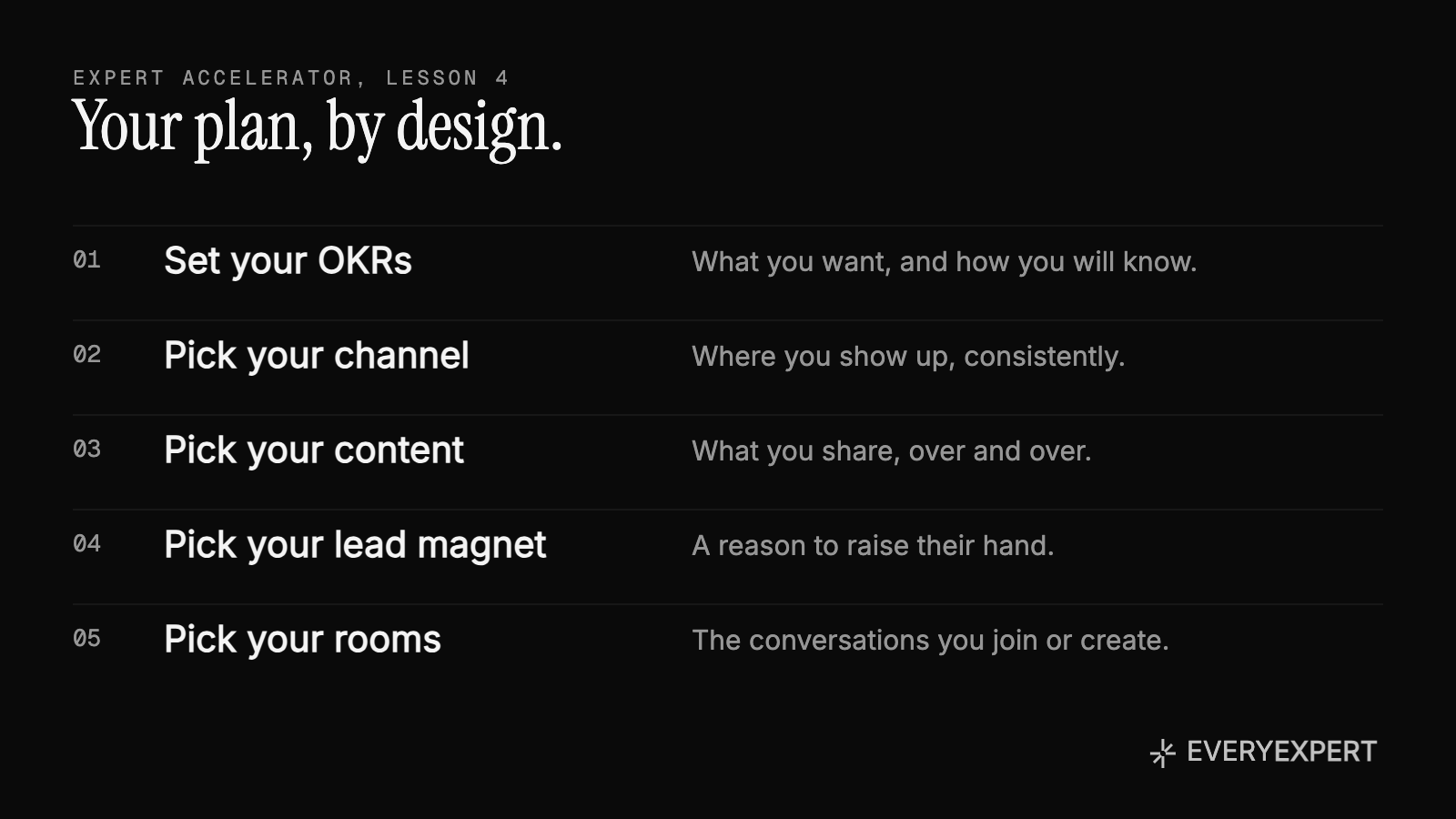
Answer these five, and write them down where you'll see them:
Set your OKRs. What do you want to achieve, and how will you know you're getting there?
Pick your channel. Where will you show up consistently?
Pick your content. What will you share over and over that answers your audience's questions?
Pick your lead magnet. A PDF or guide for people who want more help, ending with a way to book a call with you.
Pick your rooms. The conversations, comments, podcasts and partnerships that make biz dev part of your life instead of an interruption.
You still have to put in work. But you'll see the impact of it, and you'll be building a business that supports you, not one or two yeses here and there.
Go deeper
Each of these moves has its own short article:
What's next
That's a wrap on the first Expert Accelerator cohort. Thanks to everyone who showed up, asked questions and shared what's working. We're not going anywhere.
I run office hours every week. Check the #best-practices channel in the EveryExpert Slack community for the latest schedule and to sign up. Bring your plan.
If you're not on EveryExpert yet, join the waitlist at https://www.everyexpert.com/get-started.
Talk soon,
Terry Rice
EveryExpert