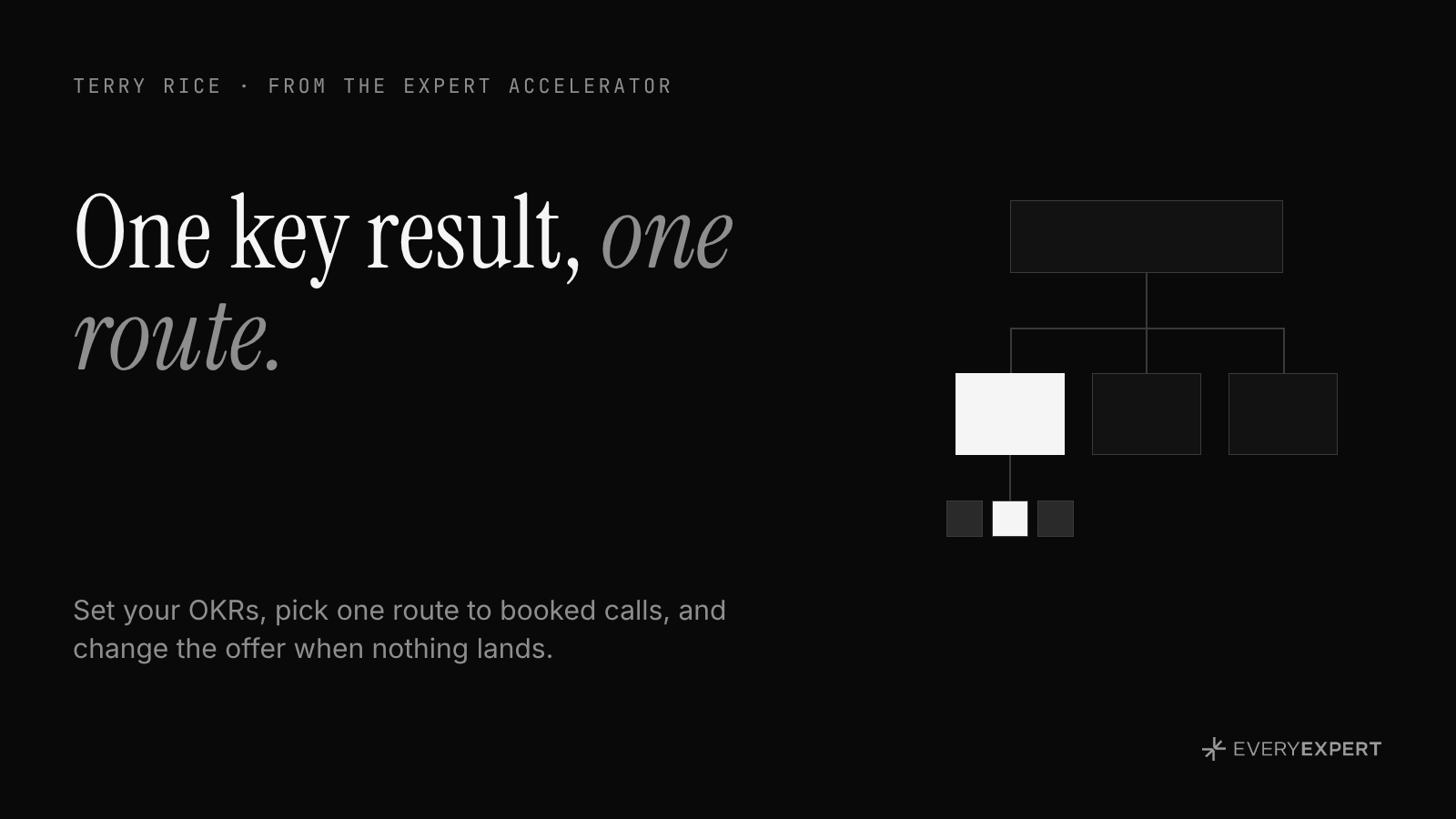
Lesson 2 recap: one key result, one route
Set your OKRs, pick one route to booked calls, and change the offer when nothing lands.
Lesson 2 of the Expert Accelerator started with a bigger question than usual. Before you pick a tactic, decide what you're actually building. Then pick one route to paid calls and stay with it long enough to learn something.
Below are the moves from the session, each with the steps to run it yourself, then Matthew's walkthrough of two EveryExpert features most people skip during setup.
Prefer to watch? The edited session runs about 55 minutes: https://share.descript.com/view/aawoqQJKGzj
What's in the session
1:47 Lesson 1 in three moves
3:16 Away messages, and using AI to find conversations worth joining
8:13 Automation, and how to comment without getting locked out
11:26 Growing a newsletter: lead magnets and collaborations
15:23 When nothing works, change the offer
18:45 LinkedIn collaborative posts
22:36 The OKR model
27:23 Objective, key results and the three routes
29:30 Route 1: newsletter
30:46 Route 2: social
33:17 Route 3: events and podcasts
38:32 Matthew: published, private and draft services
48:27 Ask: paid questions, answered by video
53:07 Homework
1. Write your OKRs before you pick a tactic.
OKRs sound like a corporate exercise. I use them for my business, my fitness and my life, because they make the boring work make sense.
Objective: where you're going. One clear goal, usually for the next 90 days.
Key results: how you'll know you got there. Each one is measurable.
Tactics: the daily moves that push a key result forward.
Here's mine. I want to put on a conference at Kings Theatre in Brooklyn. One key result is packing five smaller rooms first, because that proves I can fill a bigger one. Another is landing sponsors. A third is getting the logistics locked in. The tactics are things like sending emails to get on those smaller stages. On their own they feel tedious. Tied to the objective, they're part of the plan.
For your business, the objective might be building a successful consulting business: $500K next year, or $50K, whatever is real for you. That revenue comes through lanes like coaching, consulting, speaking and team deals. The key results cover how the business runs: sales and marketing, operations and delivery.
Most experts have delivery covered. Sales and marketing is where it stalls, so that's the key result we focused on: paid calls booked on EveryExpert.
How to run it:
Write one objective for the next 90 days. Use the focusing question from The One Thing: what's the one thing I can do such that by doing it, everything else becomes easier or unnecessary?
Add three key results across sales and marketing, operations and delivery. Make one of them paid calls booked.
Put them somewhere your LLM can see them. Mine flags it when I drift.
2. Pick one route to booked calls.
There are three routes. Pick the one where your people already pay attention, and that you could keep doing every week without dread.
Newsletter. If you already have one, you have a huge advantage. Tell a story about a problem you solve, then end with your booking link: if you want help with this, book a call with me on EveryExpert. A friend of mine added one more step. Talk about what happens if they don't take action, not only what they gain.
Social. Post about the problem, then put your link at the end or in a pinned comment. Comment on other people's posts, too. I use an LLM to find conversations I should be part of. It suggests a comment, and I usually keep one sentence and add my own experience. Keep it human. I once got locked out of commenting for 24 hours for overdoing it, so now it's about ten a day, by hand. Make sure your EveryExpert page is in your Featured section, so the people you meet can find it.
Events. This is my favorite: borrow a room that's already full. When I started my company, I asked the Brooklyn Chamber of Commerce if I could run a free community event, and 60 people showed up. At the end, say: if you want help applying this to your business, here's where to book a call. Podcasts work the same way. I have an LLM looking for shows my buyers listen to, and I don't care if 20 people are listening, because those 20 are my audience.
Whatever you pick should feel like sharing what you know, not performing. I actually enjoy posting on LinkedIn, and people can tell.
How to run it:
Pick one route.
Ship your first piece with your booking link in it: your next issue with the PS, one post, or a pitch note to a group that hosts speakers.
Track who responds, including the no's.
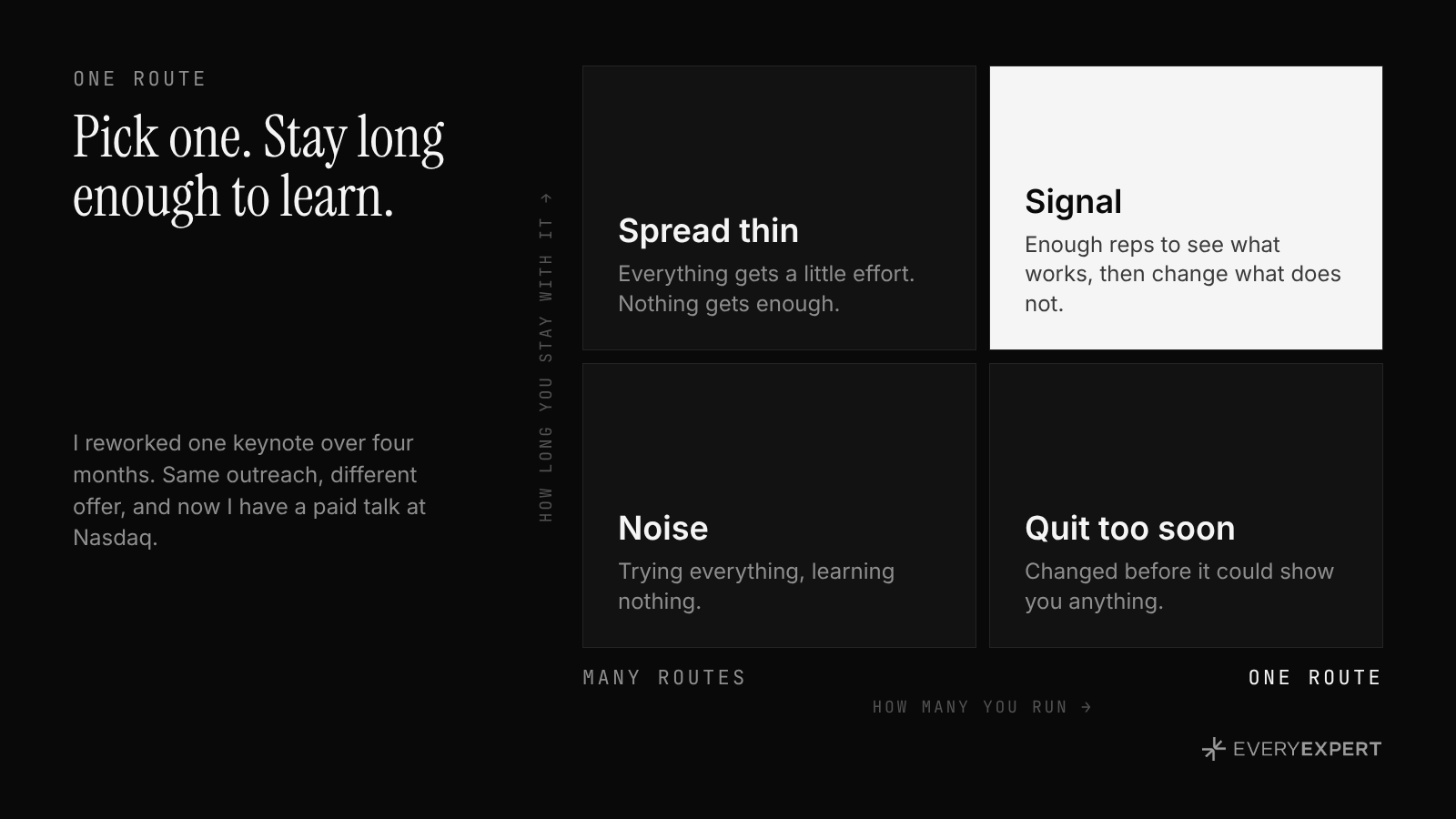
3. If it isn't working, change the offer.
Six months ago I pitched one of my keynotes to about 50 organizations. I even asked an LLM to estimate how much I'd make from it. The only answers I got were no.
At first I thought the system was broken. It wasn't. It was telling me, quickly, that nobody wanted that talk. So I reworked it over four months and delivered it live a few times. Then I ran the same kind of outreach. Now I have a paid talk at Nasdaq. Same person, same tools, different offer.
If a good offer reaches the right people, a lot of the other stuff matters less. If you're in front of plenty of people and nobody is booking, look at what you're saying before you look for a new channel.
How to run it:
List what you've tried and what came back.
Decide what to stop, start, continue and change.
Give each change enough time to show you something before you change it again.
4. Matthew's walkthrough: private services and Ask.
Matthew Casteel from the EveryExpert team covered two features most people skip during setup.
Published, private and draft. Published services show on your public profile, and anyone can book them. Private services stay off your profile. Matthew uses one for a photo book consultation he only offers after a discovery call, and sends the link directly to people who are a good fit. You can also build a private service for one person, priced and tailored to them. A member asked about offering work that would muddy her public positioning, and this is the answer. Draft is where a service sits while you build it.
Ask. A paid, asynchronous question. The client writes up their situation using intake questions you define, pays up front, and you reply with a recorded video, screen share included, by a deadline you set. The deadline can be anywhere from 24 hours to two weeks. If you miss it, they're refunded in full automatically. No scheduling and no live call. Matthew uses it for a lower-priced portfolio review for people who'd find a live critique intimidating. As he put it, sell your judgment, not your calendar.
Your homework before Lesson 3.
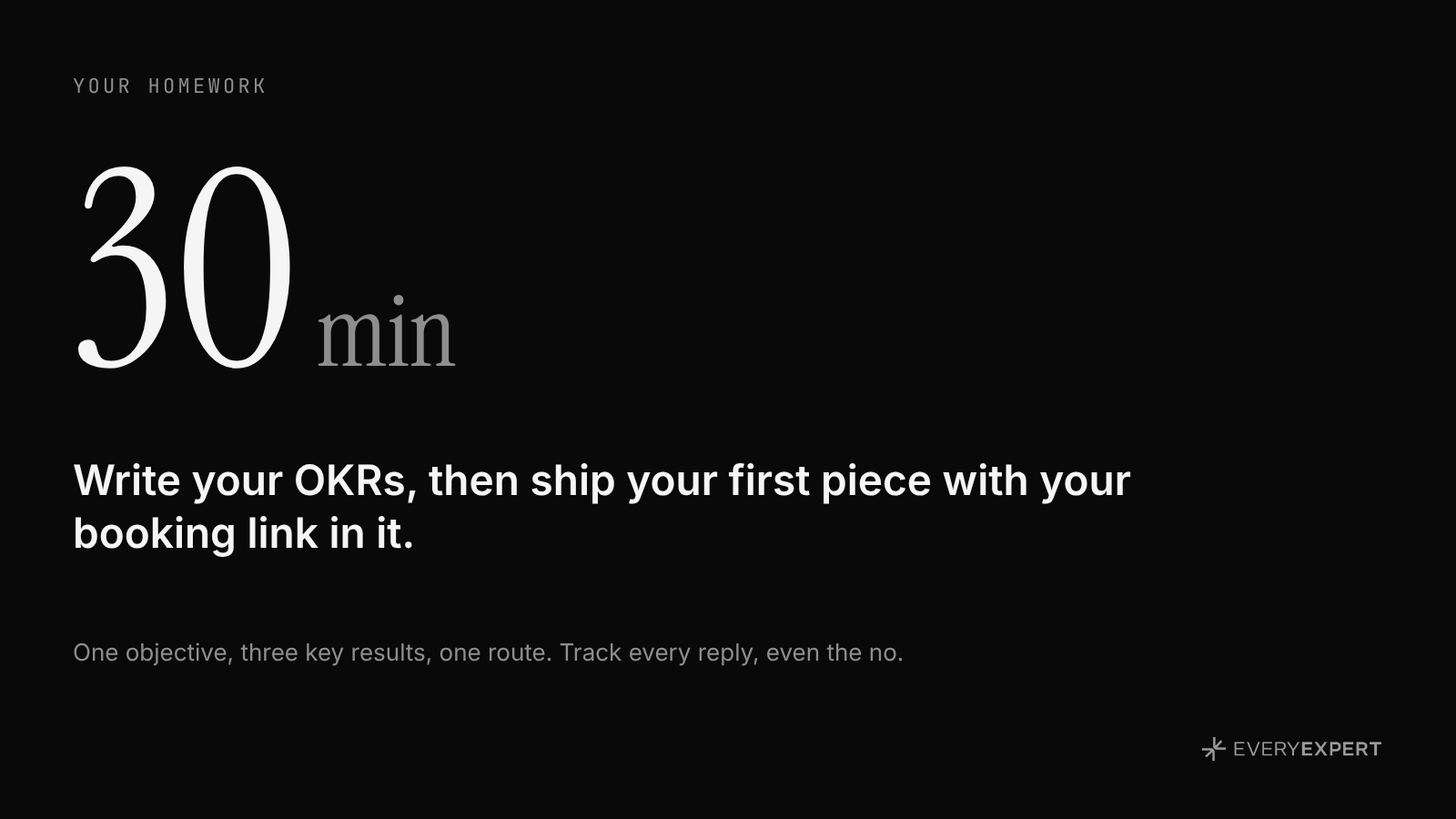
Write your OKRs: one objective and three key results, with one key result on paid calls booked on EveryExpert.
Ship your first piece on your route, with your booking link in it. Then share it with us here so we can feature you: share your post.
Track who responds. Even "not right now" is a reply you can follow up on.
Lesson 3: Thursday, November 5.
How to turn replies and comments into conversations, and conversations into booked sessions. Matthew joins again, then we open it up for Q&A.
It's free, open to every member, and you can join any week.
Save your seat: https://www.everyexpert.com/events/accelerator
I run office hours every week. Check the best-practices channel for the latest schedule and to sign up.
Not on EveryExpert yet? Join at https://www.everyexpert.com and set up your page so people can book you.
Talk soon,
Terry Rice
EveryExpert