Learn it when you need it
The case for learning less, later, and only when the work asks for it
Most experts who feel stuck are not short on information.
The tabs multiply. The saved threads pile up. A video ends and it feels like something got done, while the task that mattered on Monday sits exactly where it was left.
There is more good material available now than any previous generation of experts had access to. Every framework, every playbook, every teardown of someone else's funnel, plus an AI that will explain any of it at two in the morning. Which makes it worth asking why so many capable people feel stuck while taking in more than they ever have.
The tell
When something is not working, the usual read is a knowledge gap. So more information gets acquired... which is the same move that produced the gap.
A different test works better here. Ask whether the thing in front of you is hard, or whether it is wrong.
Hard is fine. Hard is most of the work and it usually deserves persistence. Wrong is when the effort was never going to produce the outcome, no matter how much of it gets spent.
Studying a ninth approach to pricing before quoting anybody is not hard. It is wrong. It feels productive, it looks like work, and it will not book a call.
What Walmart did instead of guessing
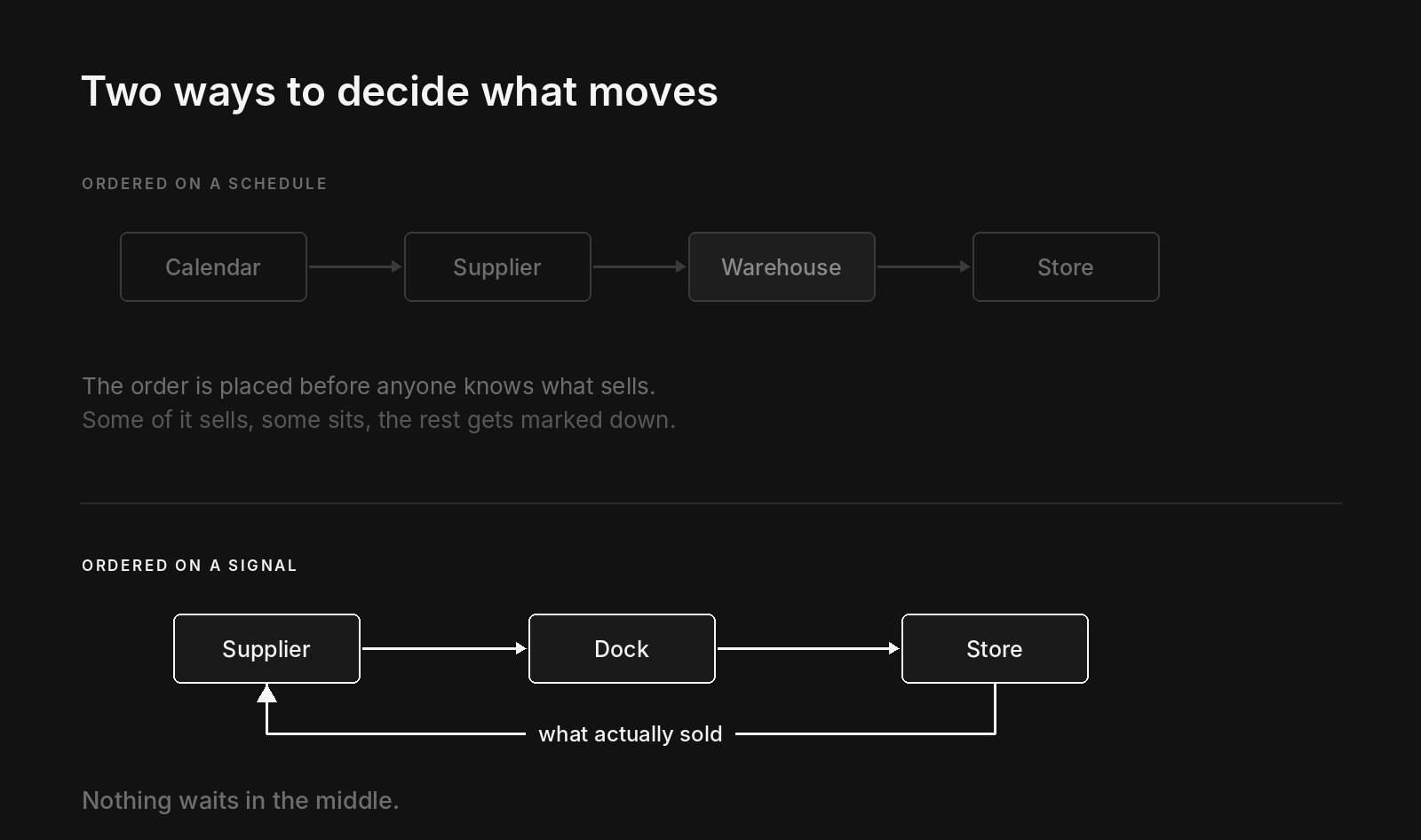
Most retailers used to reorder on a schedule. Every two weeks a truck arrives carrying whatever the calendar said to send, ordered before anyone knew what customers would actually want. The costs stacked up quietly:
Stock piled in the back that nobody asked for
Capital sitting in boxes instead of working
Markdowns and write-offs at the end of the season
No fast way to respond when demand moved
Walmart built its distribution around cross-docking instead. Goods come off the supplier's truck and go straight onto the store truck, with little or nothing sitting in a warehouse between them. What moves is decided by what sold.
Then they went further. Suppliers were given direct access to Walmart's sales and inventory data, and handed the restocking decision. The supplier watches the shelf and decides when to ship.
Walmart gave outsiders the keys because being right about demand mattered more than owning the information.
The shelf tells the truck what to carry.
Attention is inventory, and it spoils
Most people stock theirs the way the old retailers did. Subscribe to the newsletter, block Sunday for the course, take whatever the algorithm sends. Then the shelves are full and the register is quiet.
Just in case is a schedule. Just in time is a signal.
The reversal is small. Start with the task, and let the task decide what gets learned. Not in advance, and not because something looked interesting when it went by.
The question that sorts it
Is this next thing being learned for the task in front of me, or is it a nicer-feeling way to avoid starting it?
That one stings a little, which is roughly the point. It also settles in about four seconds, which is faster than any reading list.
An audit worth running before Friday
Paste this into whatever AI you already use. It works better than trying to be honest unassisted, because it forces the task to get named before the learning can be justified.
Here is everything I saved or consumed this week:
[paste saved links, courses started, videos watched, threads bookmarked]

Here is the one outcome I said I wanted by Friday:
[one sentence]

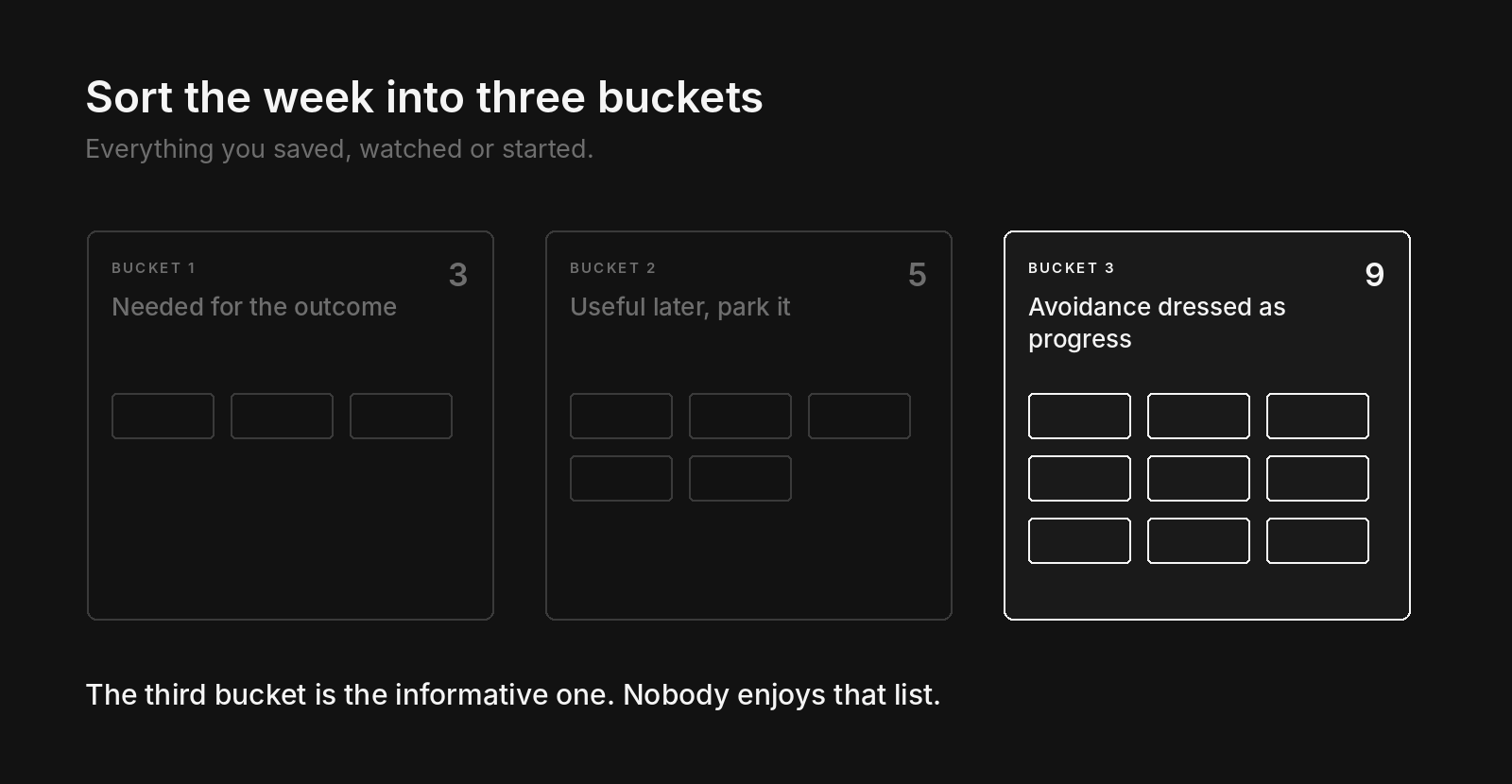
Sort each item into one of three buckets:
1. Needed for that outcome
2. Useful later, park it
3. Avoidance dressed as progress

Then name the smallest thing I could ship tomorrow using only
what I already know.
The third bucket is the one to look at. Nobody enjoys that list. It is also the shortest route to a week that produces something.
What the task usually turns out to be
For an expert trying to get booked, the real task is almost always smaller than the amount of learning being poured into it. It tends to look like one of these:
Writing down what you help people with, in the words a client would actually use
Putting a real price on it and then leaving it alone for thirty days
Sending your link to one person who already trusts you
Answering the question someone already asked you, in public, where the next person can find it
None of that needs another course. It needs an afternoon.
Less, but better
Greg McKeown built Essentialism on a phrase borrowed from the designer Dieter Rams.
"Less, but better."
Rams was describing products. It holds up on a calendar.
The ambition can stay exactly where it is. What shrinks is the number of things in flight, so each one gets the attention it deserves, in the order the work is actually asking for.
Take stock of what got accumulated this week. Some of it is for a task in front of you. The rest is a warehouse.
The best-practices channel in the EveryExpert community runs one of these most days. One idea, and one thing to try before the week is out.