How do you build a network when you have no community to join?
You do not need a venue, sponsors or an audience to become the person who brings people together. Invite a few people you want to know to a free lunch, ask nothing of them, and at the end ask to be invited the next time one of them hosts.
The situation
You know the people you want to be in a room with. Maybe they are potential clients, maybe they are the people your clients already trust. You follow them, you like their posts, and every so often you go to an event hoping one of them shows up.
Sometimes they do. You get five minutes, a business card, and a promise to grab coffee that neither of you keeps.
Meanwhile you watch other people seem to know everyone. They get invited to things. Their names come up when someone needs a referral. You are good at your work, and almost nobody who could hire you has spent real time with you.
The complication
The obvious fix is to host something yourself. So you start planning a real event: a venue, a long guest list, maybe a sponsor to cover drinks, a topic, a slide or two to make it worth the trip.
That plan stalls. It costs money you have not made back yet, it takes weeks, and it puts you on a stage you did not ask for. If only a handful of people come, it feels like a failure. If you pitch at the end, it feels like a bait and switch. So the event stays in a notes file, and you go back to attending other people's rooms, which is where you started.
The question
So how do you become the person who brings people together, without the cost, the scale or the pitch that a real event seems to require?
The answer
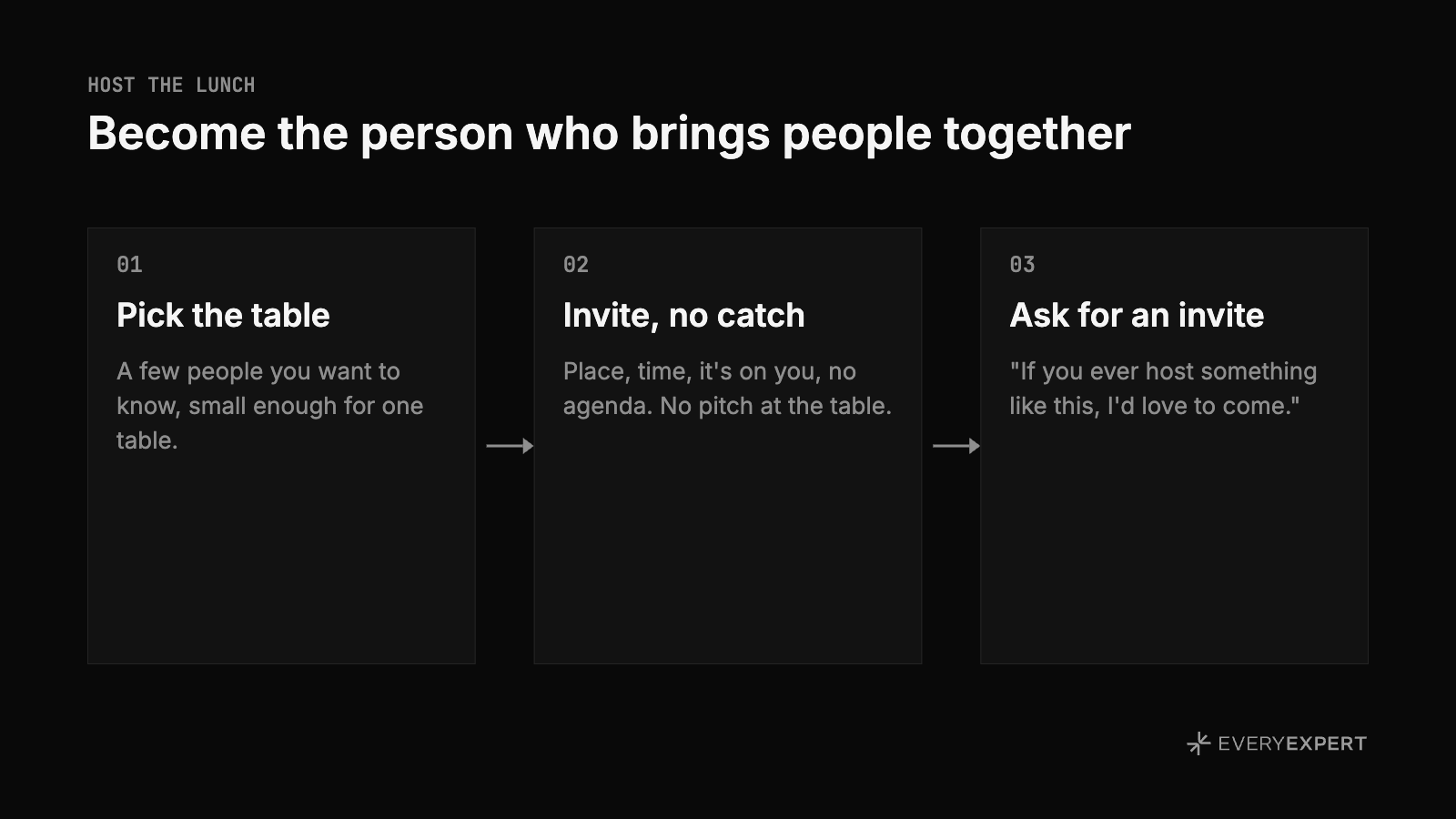
Go small enough that it fits in a lunch booking. The version I have run in New York was lunch at a place in Union Square for a few people I wanted to meet, no drinks, and the lunch cost roughly $150 to $200. Nobody presented anything. People came because they also wanted community, and community needs someone to build it.
1. Pick the table
Write down a handful of people in your area you would like to know better. Not your whole list. Keep it small enough that everyone at the table can talk to everyone else.
Mix them on purpose. A couple of people who could hire you, one or two who serve the same clients you do, and someone who simply seems interesting. The guests should get something out of meeting each other, not just out of meeting you. That is what makes it a gathering instead of a sales lunch.
2. Invite them with no catch
Keep the invite plain: where, when, that it is on you, and that the point is a good conversation. Something like: "I'm getting a few people together for lunch at this place on Thursday. It's on me. No agenda, I just think you'd enjoy each other."
Then hold to it at the table. No pitch, no deck, no "so let me tell you what I do." If someone asks about your work, answer, and move the conversation back to the group.
3. Ask to be invited next time
At the end, say one thing: "You don't owe me anything, but if you ever put together something like this, I'd love to be invited."
That line is the whole return. No referral request, no follow-up meeting, just a standing place in the circle. If one of your guests hosts their own version, you are in a room you never had to plan. Either way, you are now the person who brought them together, and that puts eyes on you without a stage.
If in-person does not fit where you live, the same move works as a small virtual mastermind. A few people, a regular time, and you as the one who sent the invite. Afterward, keep in touch the low-effort way described in Two emails a year is the whole networking system.
How this looks in practice
An event planner spends her weekends producing other people's gatherings and rarely meets the people who book them. She invites a few office managers and executive assistants from nearby companies to lunch, the people who usually get handed the holiday party. Nobody talks about events until one of them brings up a planning headache. Some of the guests now trade vendor tips in a group text she started, and her name is the one they pass along.
A chiropractor wants referrals but feels awkward asking other clinicians for them. Instead of dropping off brochures, he takes a personal trainer, a massage therapist and a running coach from his neighborhood to lunch. They spend the hour comparing notes on the same clients with the same sore backs. The massage therapist hosts the next one, and he is invited.
An independent insurance broker is competing with ads from big carriers for the attention of local owners. She invites a few local owners she has met once or twice to lunch, with no policy talk. The owners spend most of it swapping notes on landlords and hiring. A month later one of them calls her before renewing, because she is the person they now know.
Each of them stopped waiting for an invitation and sent one, at the size of a lunch table.
Do this today
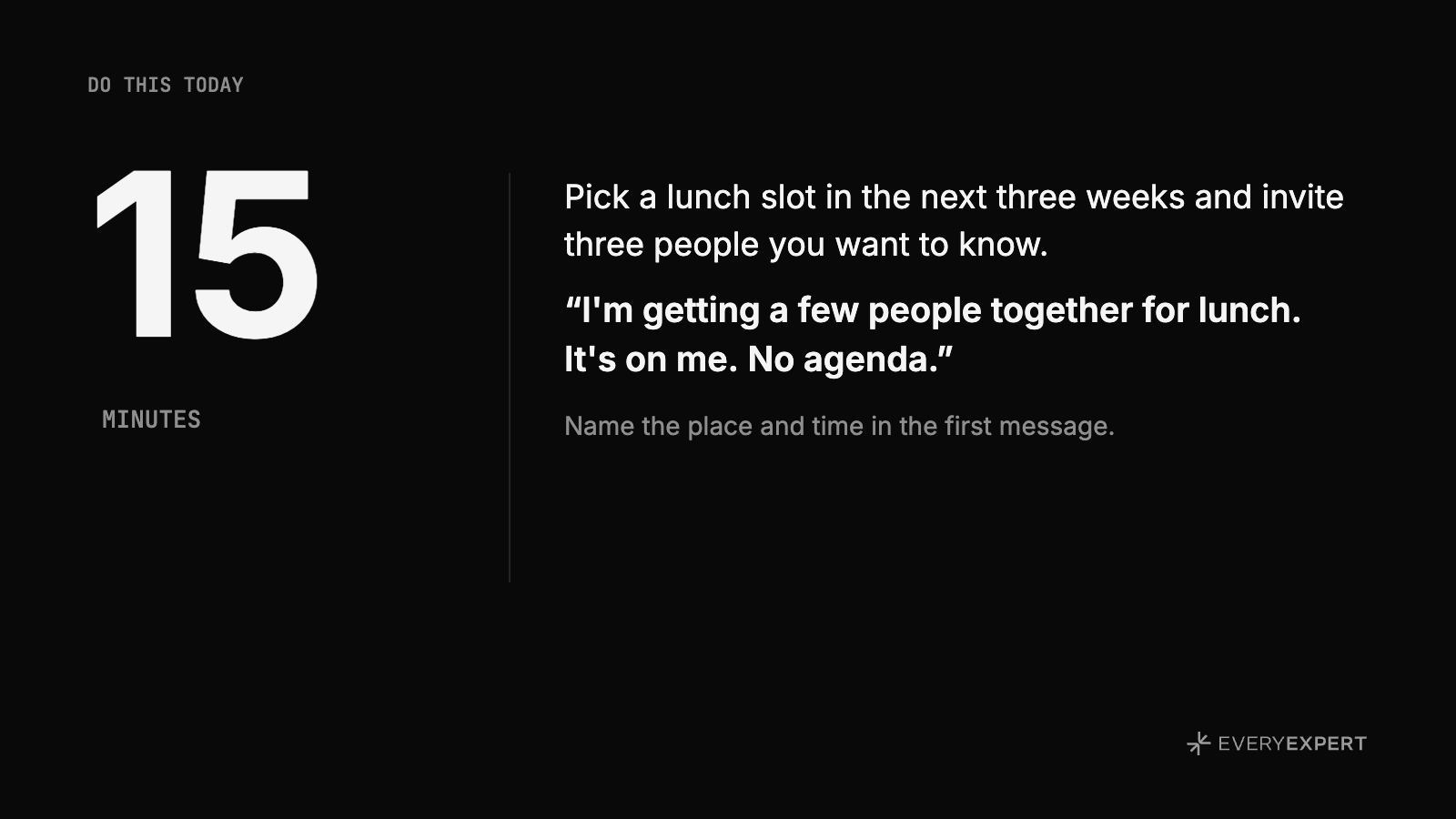
Open your calendar, pick a lunch slot in the next three weeks, and send the invite to three people you want to know. Name the place and the time, say it is on you, and say there is no agenda.
Fifteen minutes, including picking the restaurant.
Bring it back
Post in the community who you invited and why you picked that mix of people, before the lunch happens. If nobody bites or the table feels off, bring your guest list and your exact invite to office hours. The room can usually tell you whether the problem is who you asked or how you asked them.
Office hours
This came out of a live EveryExpert office hours session, right after a conversation about hosting bigger events with venues and sponsors, when the smaller version came up: one anyone can run next week. That is what office hours is for: bring a real situation and leave with the next move.
Next session: [HOLD: date, time and registration link]
Not on EveryExpert yet?
EveryExpert is where people book paid calls with experts like you. Set up your page at everyexpert.com so the people you meet at that lunch have somewhere to book.