The thing you keep fixing
It's the most valuable part of your work and you've been treating it as a nuisance.
Before we get into today's newsletter, I want to make you aware of a new opportunity to do community spotlights, the first one is above.
It's from Mary O'Donohue, breaking down how to nail a media interview so you can get on more stages, land more clients, and grow your impact.
Want one of your own? Reply and tell me what you'd teach.
Mary's profile: everyexpert.com/maryodonohue
Getting paid for who you are, not what you do
Last time we covered the offer ladder.
This one is about what goes on it.
You've probably noticed AI got good at your work. Not everything, but enough that the first draft comes back usable. That's unsettling in a way people don't say out loud, because if the first draft is fine, what exactly are you charging for?
Here's the thing I'd point at. Every time you take AI's output and change it, you're leaving a receipt. Most people never read them.
Below, how to find the corrections that actually matter, and why that short list is the thing someone will pay you for.
The receipt you've been throwing away.
I use AI to help write keynotes. It structures an argument, sharpens a flat line, cuts a paragraph that's doing nothing. Good at all of it.
Every talk has a passage that lands heavy. When I come off mine, the room is carrying something, and every model I've worked with wants to go straight into the next teaching point. Structurally that's correct. The argument continues.
In the room it fails. The next thing has to lift, slowly, before anybody can take in another idea.
I fix that every single time. And I can't prompt my way out of it, because it takes standing in a room and reading what just happened to the people in it.
That's the talent. Writing the keynote isn't. Knowing what an audience is carrying, and what has to come next, is.
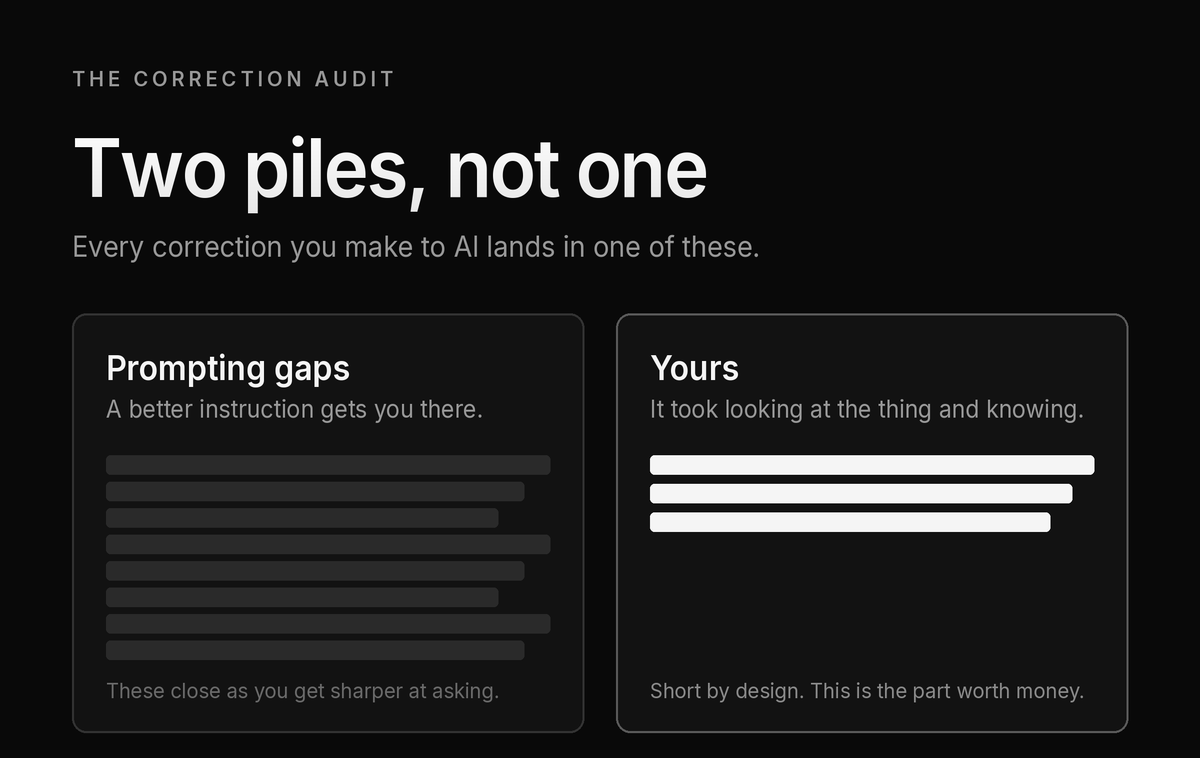
Two piles, not one.
Your corrections split into two kinds and they look identical while you're making them.
Some are prompting gaps. A better instruction would have got you there, and those close as you get sharper at asking.
The rest took looking at the thing and knowing. Nothing you could have written into a prompt would have produced it.
The second pile is short. That's the point. It's supposed to be short, and it's the part that's still yours.
Why it's worth money.
The thing you keep correcting is the thing everybody else is shipping.
They don't know it's wrong. The output looked fine to them, because it does look fine, and you're the only one who can see otherwise.
That's your job now, and staying quiet about it doesn't read as modesty. It reads as unavailable.
Everything you stopped correcting is everything that just became available to everyone.
This week.
Open the last three things you made with AI for work that mattered. Something you shipped, not a draft tweet.
Read your version against what the model gave you. Every place you changed it, write down what you changed and why, in one line.
Then split the list into prompting gaps and yours.
Most of the first pass will be prompting gaps. That's expected. What's left is the short list, and it's what belongs on your profile.
Reply and tell me what's on your short list. I read every one.
Talk soon,
Terry Rice
EveryExpert
P.S. The best-practices channel in the EveryExpert community runs one of these most days. One idea, and one thing to try before the week is out.