Lead generation for people who hate lead generation
Fifteen moves from October office hours, starting with the people who already follow you.
Most lead generation advice assumes you enjoy it. The people in my last office hours did not, and neither do I, which turned out to make the hour more useful.
When you dislike the pitch, you look for the places where a pitch is not needed: a room where people are already talking, a partner who already has your audience, a list of people who already know your name. Those places exist, and most of us walk past them while we work on a better elevator speech.
I ran office hours for the EveryExpert community on exactly this. The full video is here: https://share.descript.com/view/r13u1UyUyaF. Below is a walk-through with the timecode for each section, so you can jump to the part you need, plus the takeaway and one thing to do about it.
Grab a notebook. Every section ends with a key takeaway and one thing to do, so you finish with a short list of moves you can start this week.
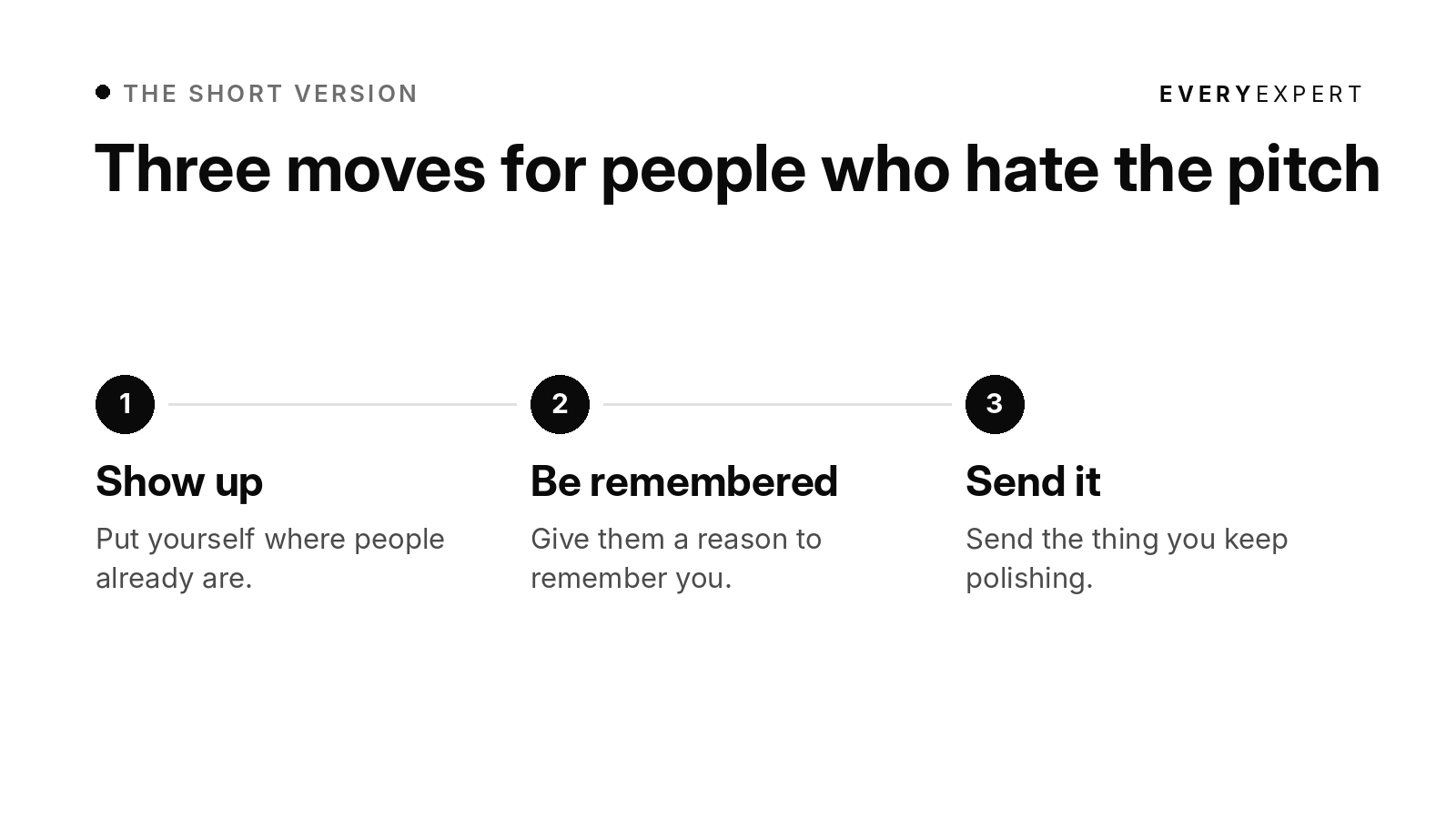
If you want the short version: put yourself where people already are, give them a reason to remember you, and send the thing you keep polishing, because the fastest way to learn what works is to find out.
Publish your profile and set your price at www.everyexpert.com
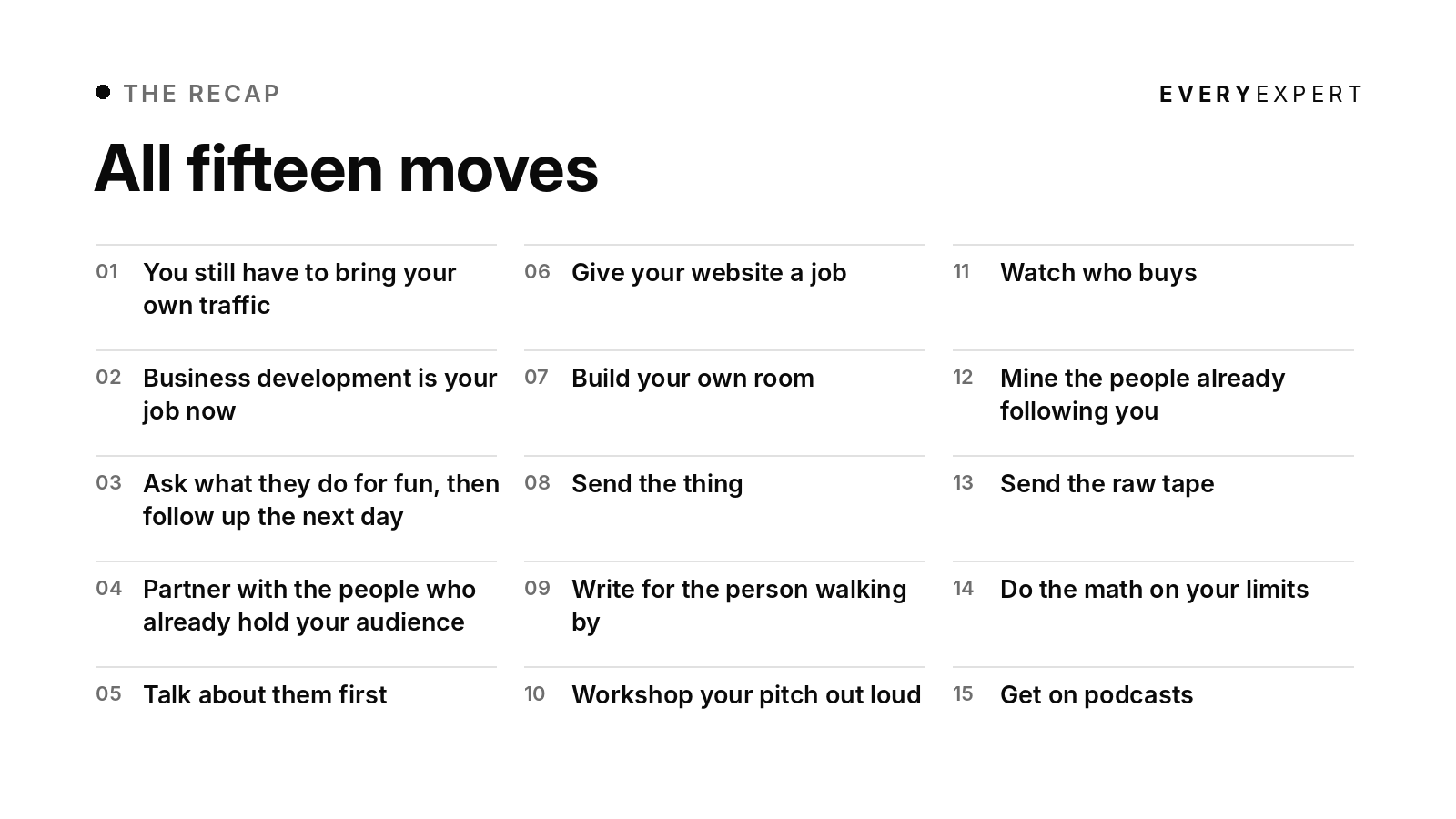
Section 1. You still have to bring your own traffic (00:52)
What this section covers. I opened with the objection I hear most. EveryExpert sends traffic to your profile, so why should you promote yourself too?
Think about an online store with a handful of products. One of them might be excellent, but if it has no reviews and no proof anyone has bought it, most visitors hesitate. Your profile works the same way. Traffic arriving at a profile with no proof and no sign that a real person stands behind it will mostly leave again.
You can wait for people to book you at random, and I love it when that happens. What I have found is that someone has to go first to get the proof started.
Key takeaway. Platform traffic helps, and your own promotion is what makes a stranger willing to act on it.
Do this. Open your own profile as if you were a stranger and write down the one thing that would make you hesitate. Then fix that one thing first: add a review from a past client, record a short intro video, or offer a free or low-cost first session so a stranger has an easy way to start.
Section 2. Business development is your job now (02:26)
What this section covers. The first expert to answer runs a consulting company and a design studio in New York. Her design work is easy to sell, because people know when they need a website or a book designed. Her consulting is harder, because what she does is unusual and the right client is a needle in a haystack.
Her answer was events, as many as she can get to, online and in person, along with regular posting. Her rule is that business development is her job now, even while she is running two companies. She counts time on a call like this one as part of the job.
Key takeaway. When what you do is hard to describe in a search bar, conversations beat content, and you get more conversations by showing up more often.
Do this. Put two events on your calendar this month, one online and one in person if you can, and decide in advance who you want to meet there.
Section 3. Ask what they do for fun, then follow up the next day (04:51)
What this section covers. I used to be a digital marketing consultant in Brooklyn, and the best thing I did was join the new member welcome committee at my local chamber of commerce. It hands you every new business owner in the room, with a reason to say hello.
At events I do not ask what someone does for work. I ask what they do for fun. It interrupts the pattern, it puts them in a good mood, and it gives me something real to ask a second question about.
If you are shy, give yourself a rule so you have an excuse to start: say hi to everyone in a blue shirt, or everyone wearing glasses. Then get a digital business card so people can scan it on the spot, and follow up the next day. I have gone home with a stack of paper cards and no plan more than once.
Key takeaway. Luck surface area is something you can design, by putting yourself in a position where meeting people is part of the job.
Do this. Write the follow-up message you would send tomorrow morning to someone you meet this week, and save it as a template.
Keep it short and specific: "Good to meet you at Tuesday's mixer. I'm still thinking about your pottery class. Here's the article I mentioned. Want to grab twenty minutes next week?"
Section 4. Partner with the people who already hold your audience (07:22)
What this section covers. A founder in the room launched a professional coach-education company this summer. She got a lot of interest early, plenty of shares and congratulations, and about forty-five days in she realized nobody could tell her what to refer her for. Interest was not turning into leads.
She changed course. Instead of selling to individuals one at a time, she partners with nonprofits that have members and events but no certification pathway, with women-owned coaching businesses that want another service to offer, and this week with a local university that approved both of her programs for graduate credit. She told us a mentor had warned her the end goal might not look like the beginning, and that being willing to pivot was the best advice she was given.
She also said it is tiring. When it is quiet it is quiet, and then everything happens at once.
Key takeaway. If you cannot afford to wait for a following, sell to the organizations that already have one.
Do this. List five organizations that have members you want to reach and a gap you could fill for them. Then send one of them an offer to teach a free session for their members, with a single line at the end on how to work with you.
Section 5. Talk about them first (16:27)
What this section covers. An expert in mortgage banking and real estate told us he rebuilt his approach on LinkedIn. He used to walk into every conversation with his software and his value proposition. When he flipped his comments to be about what the other person does, he said the past week had been outrageously powerful for making connections.
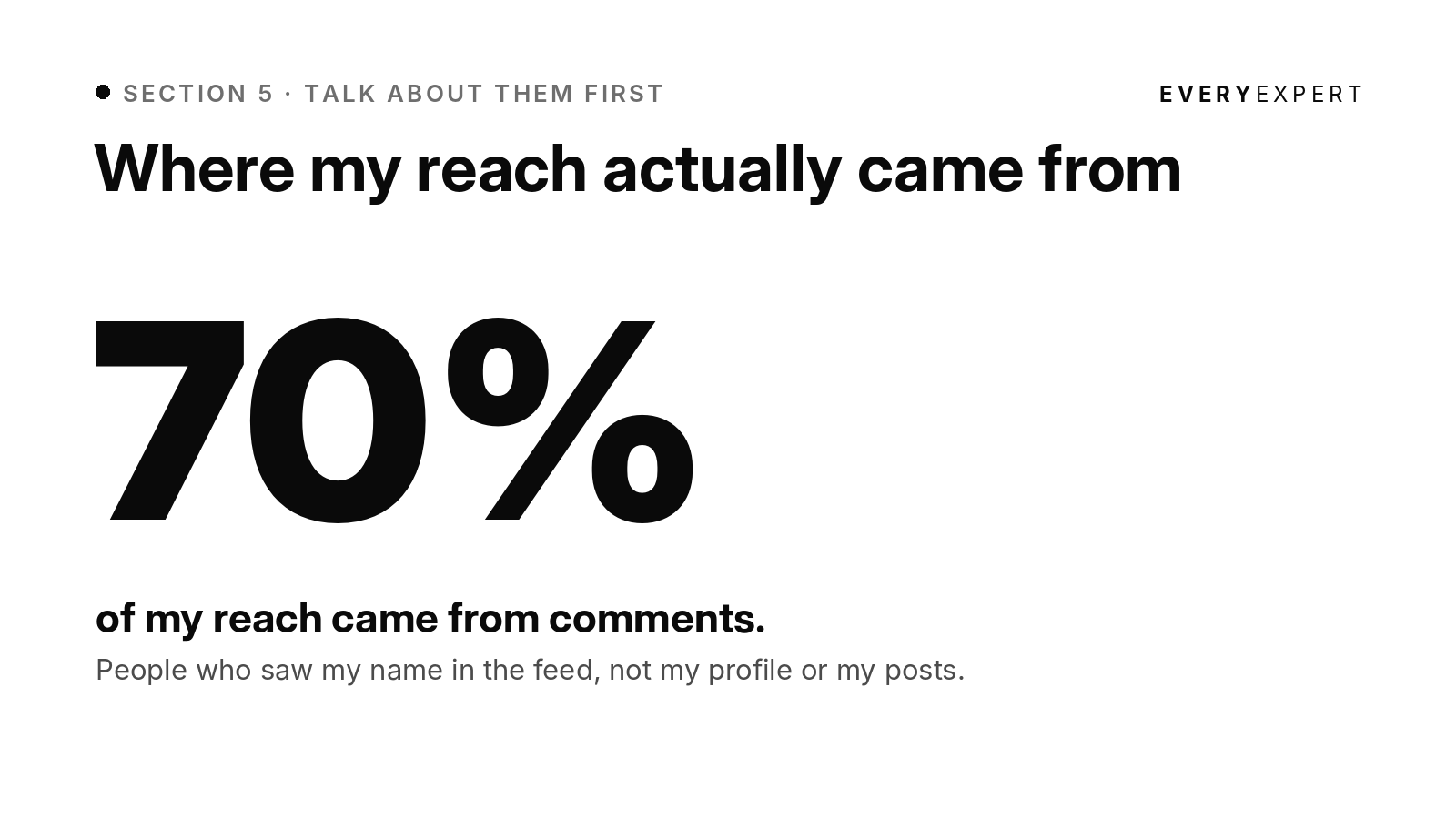
I told the room what I found when I looked at my own analytics. About seventy percent of my reach came from comments, meaning people who saw my name in the feed, not my profile or my posts. Folks can follow you from a comment, and a thoughtful one sometimes gives you the idea for your next post.
A related move is to make a show of your own, a video series or a podcast where you interview people in your target audience or next to it. A friend of mine runs one that almost nobody watches, and she uses it to meet people she wants to know, who then introduce her to their audiences. Even if the person says no, you have started a connection.
Key takeaway. Attention goes to the person who is interested in them, and a comment is a small post on someone else's page.
Do this. Leave three comments today that would stand alone as posts. A quick test: if the original post disappeared, would your comment still teach something?
Section 6. Give your website a job (21:32)
What this section covers. On a webinar the day before, one of the panelists I was interviewing told the audience that she had visited my website to prepare, found my Send It cards, and was moved to act. I never asked her to mention it. It happened because the site lets you play the game, so the offer is something you try instead of something you read about.
I do the same thing with LinkedIn away messages. When someone messages me, whether they are selling something or telling me they liked a post, they get an automatic reply inviting them to play Send It for free. Away messages need LinkedIn Premium, which one of the experts pointed out, and you can try it free for thirty days to see whether it earns its keep.
Key takeaway. Anything passive that points at something interactive keeps working while you are busy doing other things.
Do this. Write the one-sentence auto reply you would want a stranger to get when they message you. Something like: "Thanks for reaching out. I'll reply within a day. While you wait, here's the free checklist most of my clients start with."
Section 7. Build your own room (27:11)
What this section covers. I am hosting events in Brooklyn this year. Three local venues next to where I live have agreed to partner with me, and I am inviting community builders who already have access to my people to send their members. I invite the potential clients I want too, the ones who might hire me for B2B consulting or bring me in to speak at a conference.
You do not have to go that big. What I have also done is invite a few people in my city to a free lunch, so I get a small group together who also want community. At the end I tell them they owe me nothing, but if they ever host something similar I would love to be invited. A small virtual mastermind works the same way.
Key takeaway. People want community and there are never enough people building it, so anyone who hosts gets noticed.
Do this. Choose three people you want to meet and invite them to a lunch or a thirty-minute virtual conversation.
Section 8. Send the thing (32:34)
What this section covers. One of the experts builds chatbots for businesses. She had a funnel built and had not yet asked anyone to join it. I know that feeling. Last week I had a newsletter ready to announce Send It, and I sat there deciding the idea was dumb and nobody had asked for it. Then I told myself I should probably send it.
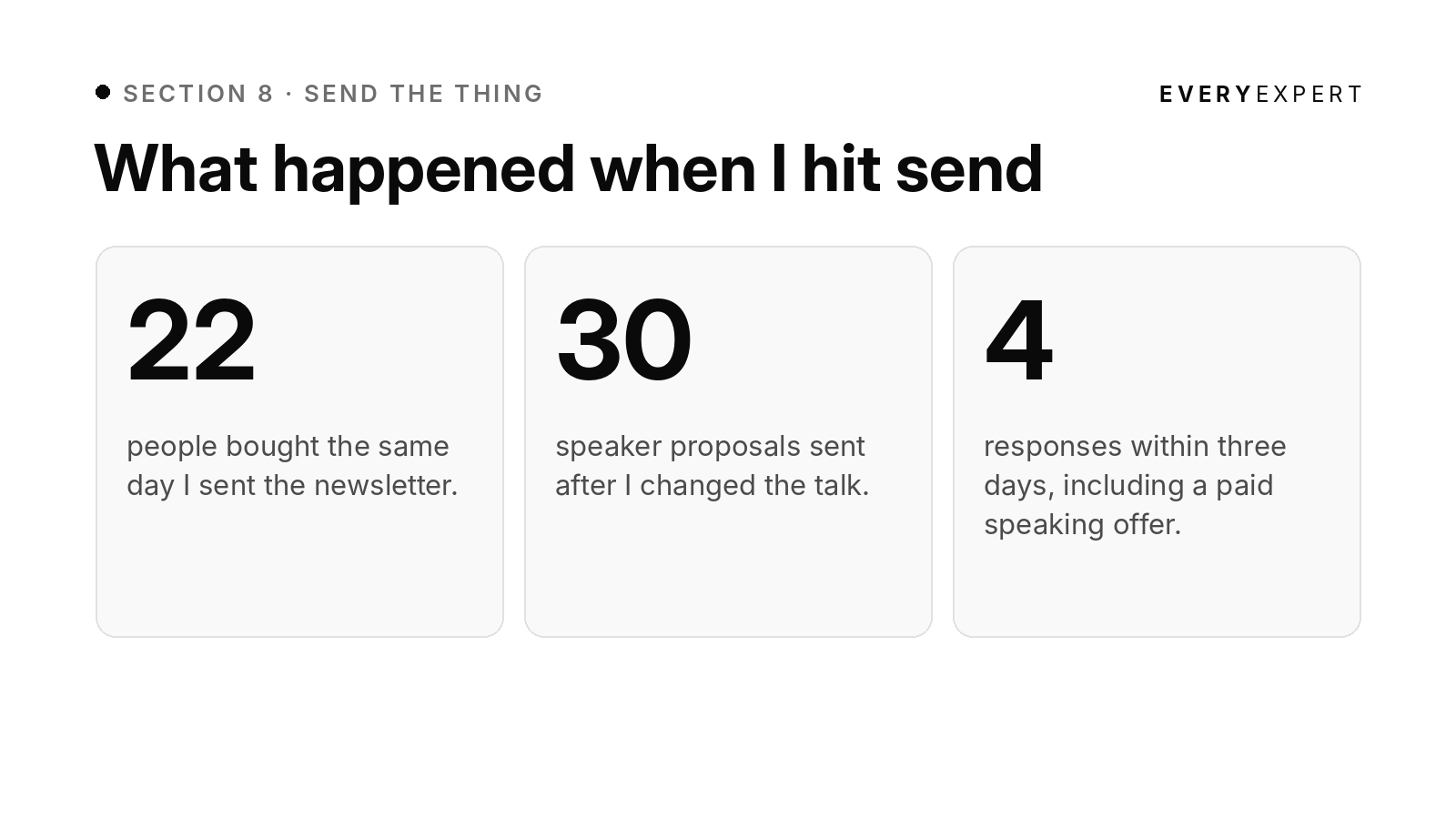
Twenty-two people bought that same day, and one upgraded to a custom deck, which I am building through EveryExpert from an interview with her. I sold the decks through Kajabi and upsold through EveryExpert, which is the wrong way round on paper, and it worked.
Speaker proposals went the same way. I had applied to a pile of organizations with an AI-assisted process and got rejections, and those rejections were data: the talk was not good. I changed the talk, sent about thirty proposals a couple of weeks ago, and got four responses within three days, including an offer for a paid speaking engagement.
Key takeaway. An unsent idea gives you no feedback, and a fast test gives you an answer either way.
Do this. Find the one thing sitting in your drafts and send it by Friday.
Section 9. Write for the person walking by (36:57)
What this section covers. The founder from section 4 had a newsletter drafted for two weeks and kept adding to it. She has a list of about fifteen hundred people and had not talked to most of them. She was worried that strangers would not care about the details of her work.
I write for the reader who is hurrying to their next meeting. Imagine a New Yorker, late for work, in the rain, walking past a magazine rack. What would have to be on the cover to stop them? I use AI for the drafting, and I prompt it with that picture.
A story helps, too. A friend of mine sells cybersecurity and runs it like a heist movie in a carousel: day one, here is what is happening and you do not know it yet; day two, it has been compromised. The founder from section 4 tried the same idea with a movie quote, using a line from Tommy Boy as a post, and got two discovery calls from it. She also asked a question I wrote down: in a field with a stiff, academic tone, who says that is the tone you have to use?
Key takeaway. The topic can be dry as long as the packaging gives a hurried stranger a reason to stop.
Do this. Rewrite the first line of your next newsletter as if it were a magazine cover.
Section 10. Workshop your pitch out loud (41:00)
What this section covers. The designer and consultant from section 2 added something to the same conversation. She sees people spend months perfecting a website and never sell. Her advice is to fake it until you make it: go out and talk, because you improve with every event. She calls it workshopping, trying a version, noticing it came out wrong, and doing something different the next time.
I agree, and I would add one move. Do not recite your offer. Ask a question that makes the other person curious, such as whether they have any entrepreneurs in their family or network, and then say that you help people like them make money online. Now they are part of the conversation, because they get to ask how. People support what they help create.
Key takeaway. Explaining your offer many times makes you better at it, and a question makes the other person lean in.
Do this. Say your offer out loud to three people this week, and change one thing each time.
Section 11. Watch who buys (44:00)
What this section covers. I have a habit with any new product. Every time a sale comes in, I look up who bought it. Recently one of the buyers worked at a university where I have spoken several times, including the kickoff for their school of management every year.
I asked the room what I should do with that. One expert suggested running a group session so her colleagues could see the cards and meet me. Another suggested offering a bulk order for her group, which gets feedback and testimonials from many people instead of one. Both pointed toward a custom deck, and I plan to offer her a version built for college students, plus a session to go with it.
I am also making physical copies this year, and I want to sell them in bulk to organizations that already know me from events or television. One small purchase is a reason to start a larger conversation.
Key takeaway. A small purchase from the right organization is an introduction.
Do this. Look at your last ten buyers or subscribers and mark the ones who work somewhere you would like to be hired.
Section 12. Mine the people already following you (48:41)
What this section covers. If you have a newsletter, look at the email domains on your list. You may find that your next client already follows you. If your tool shows engagement, look at who opens most often, then ask how you could bring what you do to their team.
You can do the same with LinkedIn. Free or premium, you can download your connections as a CSV. Upload it to ChatGPT or Claude and ask who might be a prospect, who has a network worth tapping, or who you should simply connect with. I do this on weekends while watching Netflix with my wife, and by Monday I have a list ready.
Here is a prompt to start with: "Here are my LinkedIn connections. Who is most likely to be a client for [your offer]? Who has a network that includes people I should meet? Give me the top 20 with a reason for each."
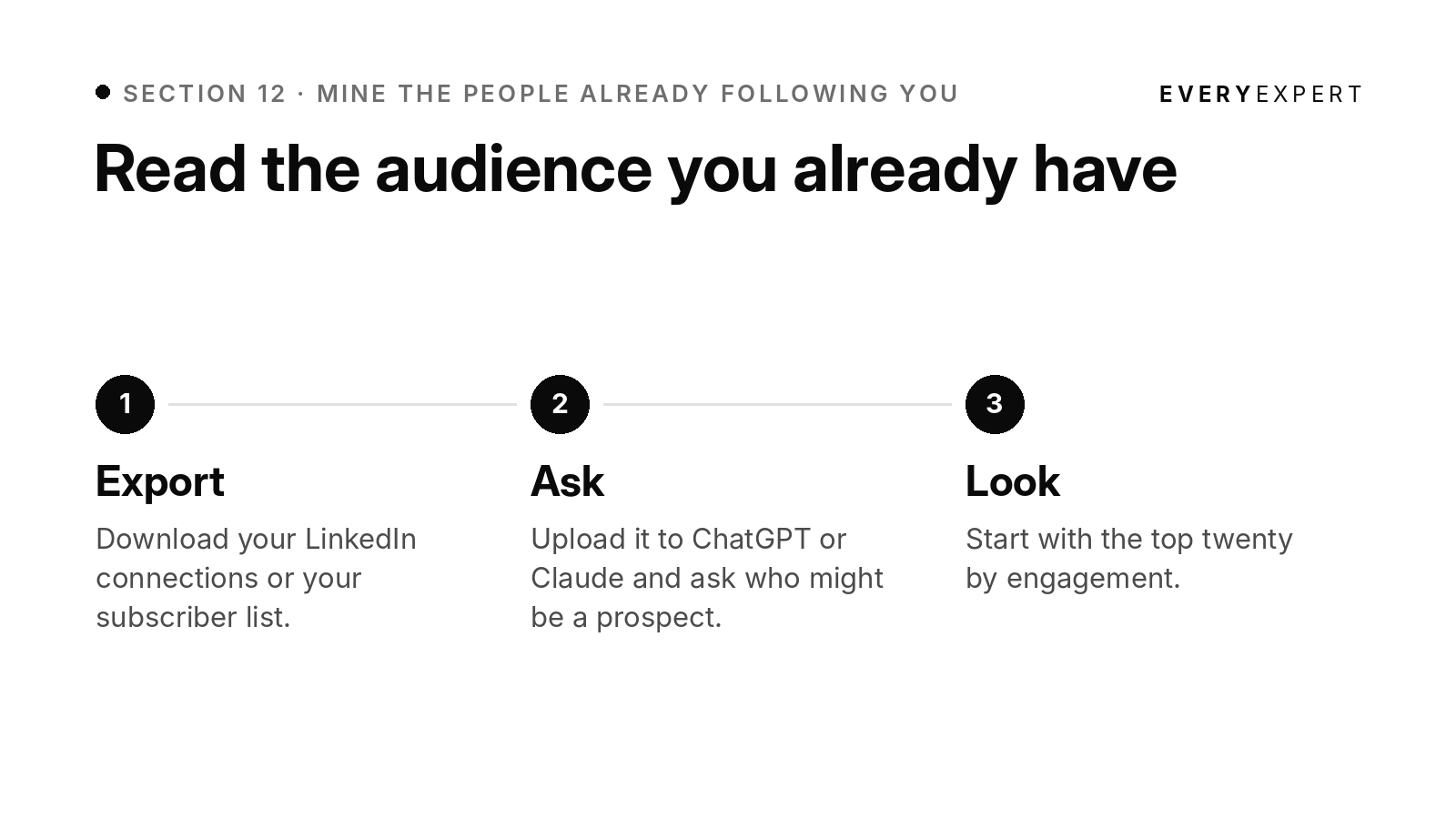
Key takeaway. Most of us have an audience we have never read closely.
Do this. Export your connections or your subscriber list this week and look at the top twenty by engagement.
Section 13. Send the raw tape (50:16)
What this section covers. One expert is starting with Apollo, a tool that finds contact information for people in your target audience, and was careful about credits running up. She had not sent anything yet, so there were no replies to learn from. I told her I have mostly failed at cold outreach and described what changed for me.
I used Muse, Meta's assistant, to find speaking engagements and help me apply. What I think tipped the scales was what I attached. Speakers normally send a highlight reel, the best two minutes of their life, and organizers know it is edited. I sent a full-length keynote I gave at Adobe in San Francisco with no slides, raw, and I left in the places where I messed up. Organizers replied because I had sent the whole thing.
Key takeaway. In outreach, an unedited sample earns more trust than a polished one.
Do this. Find the longest, least edited example of your work and use that as your sample.
Section 14. Do the math on your limits (54:03)
What this section covers. When someone in the room worried that outreach at volume could not work, I told them about the first time I started coaching. I had a newborn at home and I was charging so little that, once I did the arithmetic, I would have had to work forever to pay rent. I was getting yeses and still going backwards.
That is when I learned to tether my thinking to reality and find freedom inside it. It is why I am taking Send It toward organizations. Selling cards one at a time to individuals would never work for me. I want massive impact more than massive volume, and I have no time for volume, no ad budget and no million-person list.
When I looked at my limits and what I enjoy, the answer was to play cards all day.
Key takeaway. Your limits are part of the plan, so work out the numbers before you pick the tactic.
Do this. Write down how many clients you need this quarter, then work out how many conversations that takes. If one in five conversations turns into a client, five clients means twenty-five conversations, or about two a week.
Section 15. Get on podcasts (55:05)
What this section covers. If I had no audience and no email list, I would do two things: the video series from section 5, and as many podcasts as I could get on. A podcast lets you show your personality, your perspective and how you think, which sets you apart from everyone with the same credentials.
I was a guest on a show and thought I did a bad job, because I was trying out a framework I had just invented with AI. Someone at a large company heard it and hired me. You also end up with video you can cut up for social.
You can ask an AI tool to find podcasts that fit your audience size and the host's. Someone in the room at the very end said he started using Hark, which acts as an agent for podcast outreach, working from your ideal customer profile and your Google account. It contacted ten podcasts for him that morning, and it is free right now. I opened it while we were still on the call.
Key takeaway. Podcasts get you remembered for how you think as well as what you do.
Do this. Ask an AI tool for twenty podcasts that fit your size, and pitch the first three. Lead each pitch with one specific story you would tell their audience.
Your next three moves
Publish your profile and set a price on an entry call. You can change it later. www.everyexpert.com
Send the one thing sitting in your drafts, a newsletter, an offer email or a DM, by Friday.
Come to office hours and bring the thing you are stuck on. It is free, it is weekly, and the room is small enough that you will get real time.
And when you get a win, tell me. I want to highlight it in the community and on the site.
Next office hours
Thursday, October 15, 12:00 PM ET. Open office hours.
Bring your profile, your offer, or the thing you are stuck on, and we will work on it live. It is free, and the room is small enough that you get real time.
Register: https://kajabi.zoom.us/meeting/register/CZ6HQ5EKTceMAsKPXp0KrQ