I paid $9,000 for a funnel I never turned on
Friction in selling is usually information about the offer, not a verdict on your marketing. Mapping what you love, what you are good at, what people need and what someone will pay for shows you which
The funnel I never turned on
A few years ago I built an online course teaching people how to market themselves on LinkedIn.
I had a decent following at the time. I was ranked as a creator on a few platforms. People liked the content. On paper I was exactly the right person to sell that course, so I hired someone to write the sales page and build the whole funnel, and I paid them nine thousand dollars.
Then it was time to turn it on, and I could not do it.
I found reasons. The copy did not sound quite like me. The platform kept changing and the course might date. What if I promoted it and the post flopped, while selling a course about LinkedIn marketing?
That last one is the tell. I was inventing risks because I did not want to do the thing.
Eventually I worked out what was actually going on. I like creating content. I do not especially like teaching other people how to create content, and I did not want to spend the next two years making gimmicky posts chasing reach so that a course about reach would keep selling.
So I ate the nine thousand dollars and never sold it.
It had happened before, and I kept missing it
That was not the first offer I built that quietly went nowhere. There were others. Each one made sense written down. The plan was there, the funnel was there, the pricing was defensible. Any video on the internet would have told me it was set up correctly.
What none of them had was a good answer to whether this was what I wanted to spend my time and talent on.
I did not have language for that at the time, so I read every stall as a marketing problem and tried to fix it with more marketing.
When I did get clear, the difference was not dramatic. Things just stopped dragging. The work got easier to talk about, and meetings got interesting again, which is a strange thing to notice about meetings.
What I use now
The exercise that got me unstuck is ikigai. You map four things and look at how they overlap: what you love, what you are good at, what the world needs, and what someone will pay for.
Here is the part most people skip. The middle is not where the useful information is. The near-misses are.
Good at it, paid for it, you do not love it. Comfortable and hollow. This is where experienced people get stuck, and it is where my LinkedIn course was sitting the whole time.
Love it, good at it, nobody pays. Delightful and broke.
Loved, needed, paid, but you are not good at it yet. Exciting and unreliable, and the fix is reps rather than repositioning.
Read your current offer against those three. The one you recognize tells you which circle you are missing, which tells you whether you have a marketing problem or an offer problem. Those need completely different responses and they feel identical from the inside.
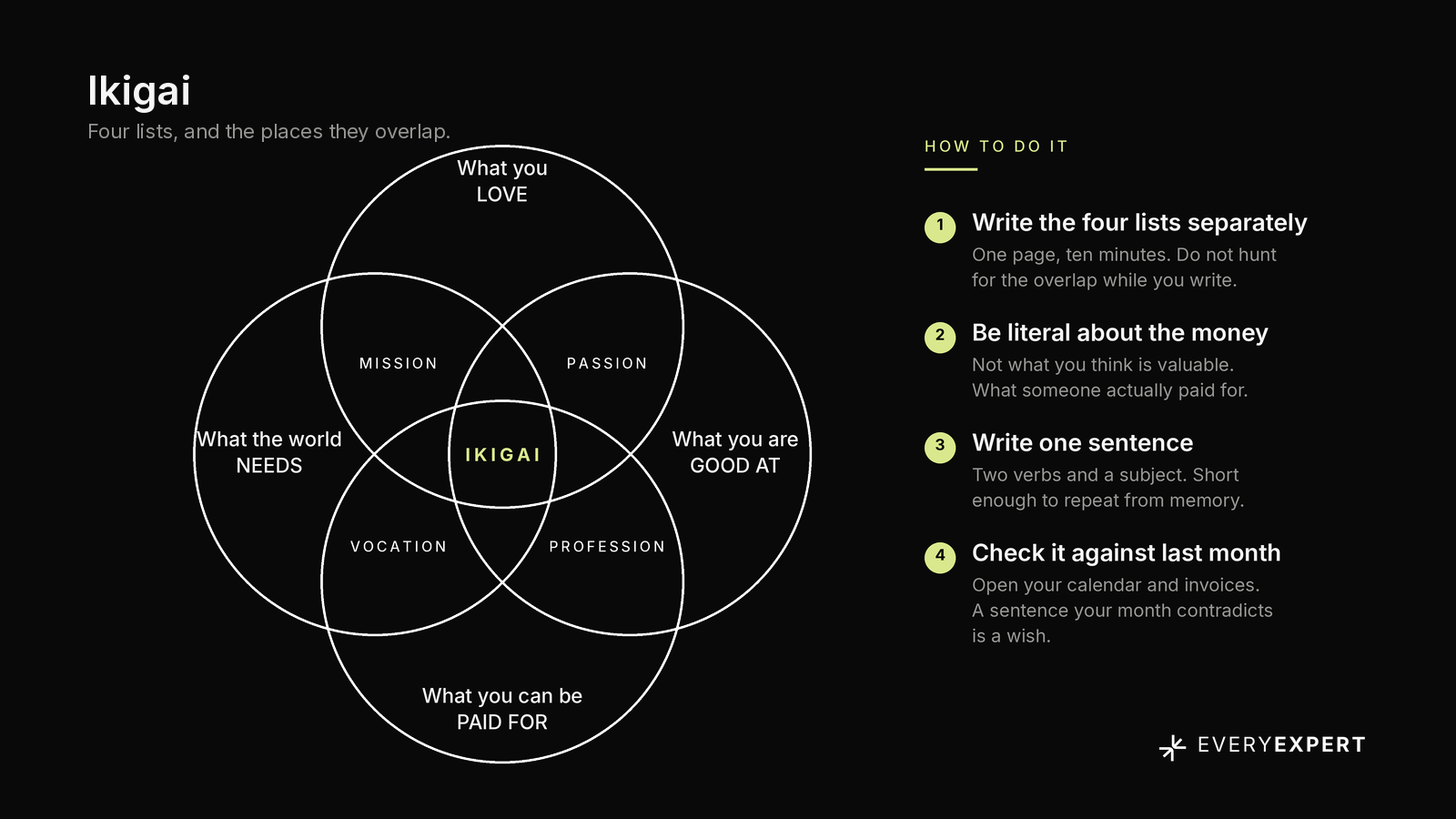
One honest caveat, because someone will raise it. The four-circle version is a Western adaptation that got attached to a Japanese word, and the original concept does not require anyone to pay you. That does not make the diagram useless. The added money circle is exactly what makes it work as a business check rather than a mood board. Use it knowing what it is.
How to actually run it
Write the four lists separately, and do not edit for overlap while you write. The moment you start hunting for the answer you stop recording the evidence.
Be literal on the fourth list. Not what you think is valuable. What money has actually changed hands for, including work inside a job.
Then write one sentence. Two verbs and a subject are enough. Mine came out as speak and write, about resilience and discernment. Short enough to be useless as a strategy document, specific enough to settle an argument about whether to take a piece of work.
Then check it against last month. Open your calendar and your invoices from the last thirty days and ask how much of that time your sentence actually describes. A sentence your own month contradicts is a wish.
The good news is you do not have to bet everything on it
This is where EveryExpert is genuinely useful, and it is why I am posting this here rather than anywhere else.
You are not choosing one offer for the rest of your life. You can run more than one. Keep your main offer where it is and put a second, smaller one next to it, built out of whatever the exercise surfaced. If nobody books it, you have lost an afternoon of setup rather than nine thousand dollars and three months.
I did this myself. My main offer is about AI systems. I added a second one around coaching on my own framework, Hard or Wrong, mostly to see what would happen. People have booked it.
That is the whole experiment. Put the thing you suspect is yours on the page next to the thing you know sells, and let people choose.
Your weekend homework
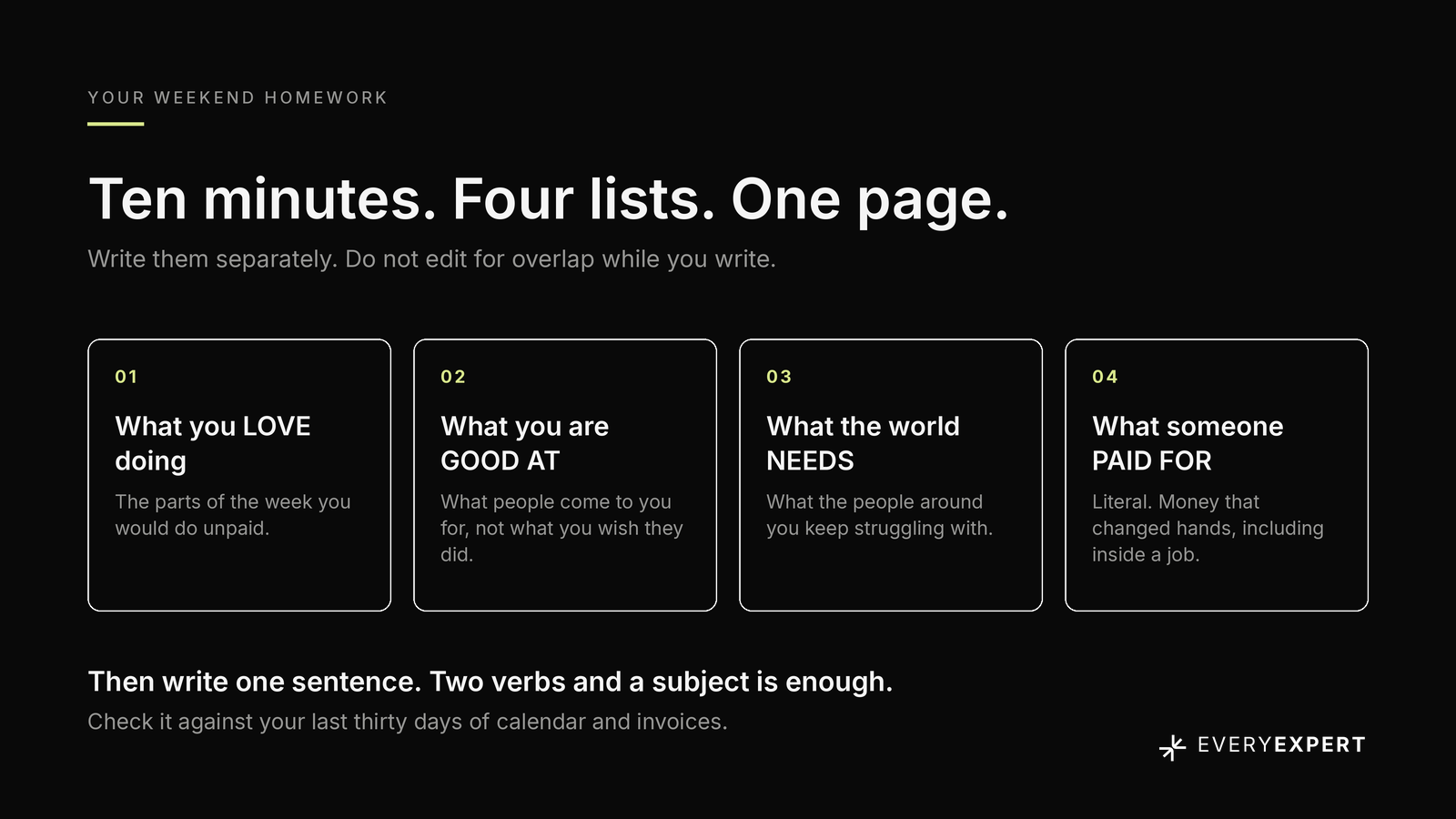
Set a timer for ten minutes. On one page, write the four lists without editing them. Do not look for the overlap yet. If you only get through two, notice which two you filled fastest, because that is information too.
Then post your one sentence in the channel. The version other people can react to is more useful than the version that stays in your notebook, and the near-miss you land on is usually more interesting to the room than the middle.
Then come to the session
If you want to work through it live, bring it to Harder to Replace on Thursday 24 September, 3:00 PM ET.
That hour is the same question from the other side. Which parts of your work should someone hand to AI, and which parts should they only ever hand to you? That second list and the middle of your diagram tend to be the same place.
Register here: https://kajabi.zoom.us/meeting/register/5zuxmxH2R2yeg18Z6p44yg
Try the exercise this weekend, bring the sentence, and I will see you Thursday. If you are stuck between two of them, that is a better question for the room than a finished answer.