How to get booked without turning into a marketer
Fifteen moves from October office hours, starting with the ten people who already know what you do.
Most people trying to get booked are told to add something. Another channel, another offer, another tool that builds it for you over a weekend.
Almost nobody is told the plainer thing, which is that your first paid call is probably going to come from a person who already knows you, and that you have not spoken to them in two years.
I ran office hours for the EveryExpert community on this. The full video is above. Below is a walk through it with the timecode for each section, so you can jump to the part you need, plus the takeaway and one thing to do about it.
If you want the short version: stop opening new doors and go back through the ones already open, because the people who trust you are a shorter path to a booked call than any audience you could build from scratch.
Publish your profile and set your price at www.everyexpert.com
Section 1. Even the marketers hate marketing themselves (00:19)
What this section covers. I opened by asking the room what their biggest challenge is in promoting their business, and admitted mine first. I spent ten years as a marketer. I am still bad at marketing myself, and I do not enjoy it.
One of the experts in the room went first. Decades in residential real estate and lending, and he has built something genuinely better: he looks at total cost of ownership instead of interest rate and monthly payment, and he wrote the software that does the maths. The product holds up fine. What he is up against is a much larger mouthpiece, and an audience that has already made up its mind before he opens his.
Key takeaway. What stops most experts here is that promotion feels like a different job from the one they are good at, and nobody hired them for that one.
Do this. Write down the one sentence you would say about your work if nobody were listening. That is usually closer to the truth than your current headline.
Section 2. A good problem to have (06:23)
What this section covers. Another expert works in project and programme management. He has a small number of clients who trust him completely, the engagements are substantial, and he does not need many of them. He wanted to know how to expand without turning into someone who chases.
My answer was to look backwards before looking forwards. How did you meet the ones you have? Go put yourself in those rooms again. You are not trying to be discovered, you are trying to be remembered by people who already rate you.
Key takeaway. A short client list built on trust is an asset, and the way to grow it looks nothing like the way to grow a following.
Do this. List how each of your last five clients found you. Repeat whichever channel shows up twice.
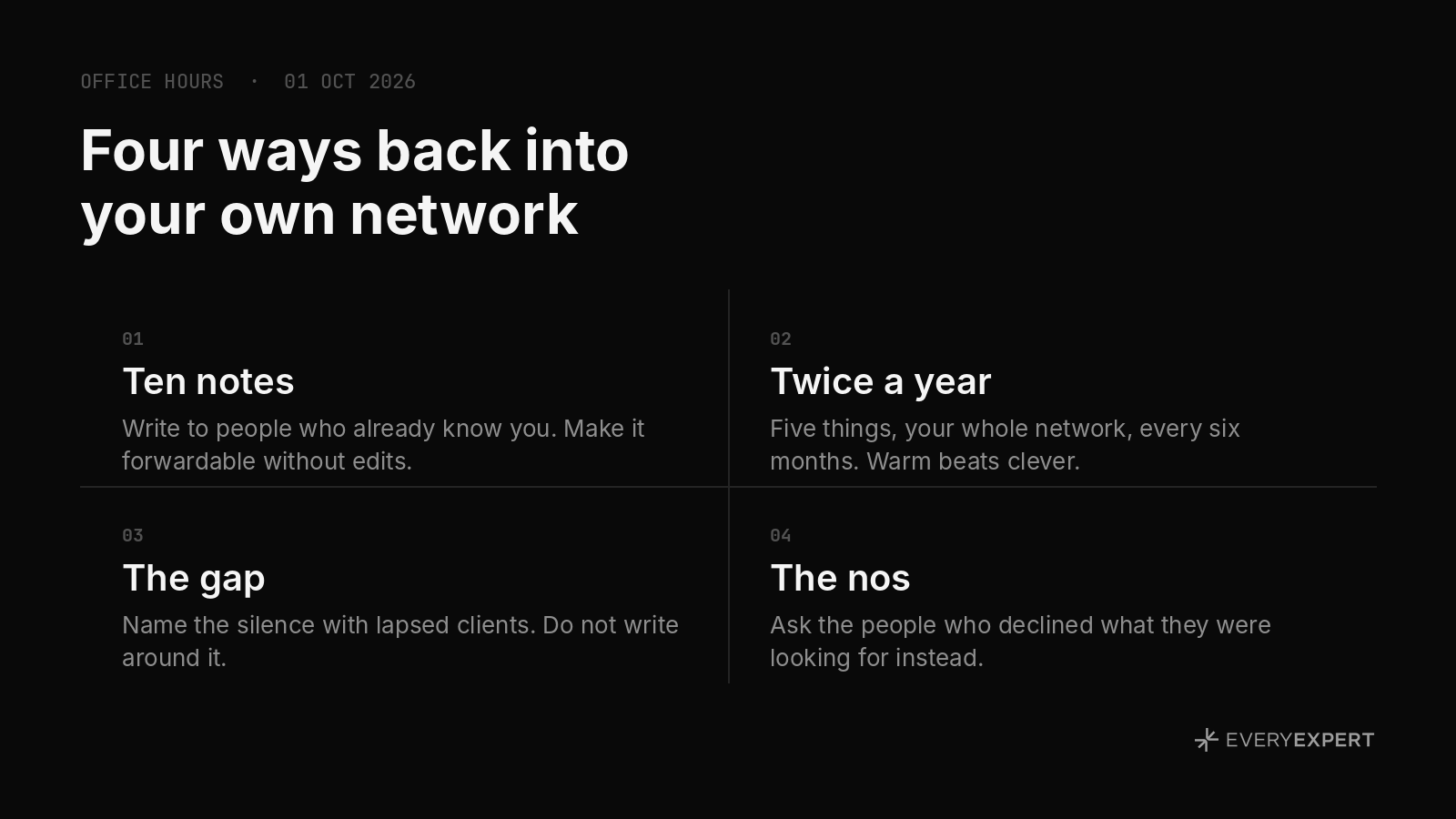
Section 3. Ten notes, and make them forwardable (09:11)
What this section covers. Here is the part that applies to everyone, whatever you sell. Write ten personal notes to people who already know you. Say what you do now, describe who a good fit looks like, and ask if anyone comes to mind.
The detail that makes it work: write it so they can forward it without editing a word. The person you are asking should not have to do any work on your behalf. If they have to rewrite your ask before passing it on, they will not pass it on.
Key takeaway. Most referral asks fail because they make the other person do the writing.
Do this. Draft one note that reads correctly whether it arrives from you or from someone forwarding it.
Section 4. The twice-a-year email (10:01)
What this section covers. On top of those ten notes, twice a year I write my whole personal and professional network. Five things: what is going on with my kids, what I am training for, a book I liked, one way they could help me, then a question about what they are working on and who in my network would be useful to them.
The first time I did it I thought it was goofy. I sent it to 250 people and got 40 replies inside two days.
I would love to tell you that turned into three speaking gigs and four podcasts. It did not. It turned into one strong speaking lead, which did convert. The return is not immediate and it is not the point. The point is that people are reminded you exist, so the next time you ask for something specific it does not arrive out of nowhere.
Key takeaway. Two emails a year is a whole networking system, and the measure is whether the next ask lands warm.
Do this. Put a recurring calendar block on the first week of January and the first week of July. Write the next one now.
Section 5. Lean into the gap (12:09)
What this section covers. That same expert raised the thing most of us are quietly embarrassed about. He has clients going back two, three, five years who would still take his call. He simply lost touch, and he said it was his fault.
Do not apologise your way back in. Say it plainly: I know we have not spoken in years, here is what I am doing now, here is why I am reaching out. Naming the silence is what takes the weight out of it. Writing around it is what makes the whole message read as awkward.
If you are comfortable with it, have your LLM read back through your own email and surface the people worth a check-in. Old workshop clients, old speaking hosts, old consulting engagements. "I did that session for you two years ago, want a checkup call?"
Key takeaway. The awkwardness of a long silence is smaller than you think, and naming it is what removes it.
Do this. Find three lapsed contacts in your inbox tonight and send one line each.
Section 6. Five posts you can write this month (15:22)
What this section covers. I walked through five post types that put you in front of your buyers without feeling like promotion. Debunk a myth in your field. Share an opinion and invite the pushback. Tell a story starting in the middle. Answer the question you get all the time. Or build in public while you are still in the middle of it.
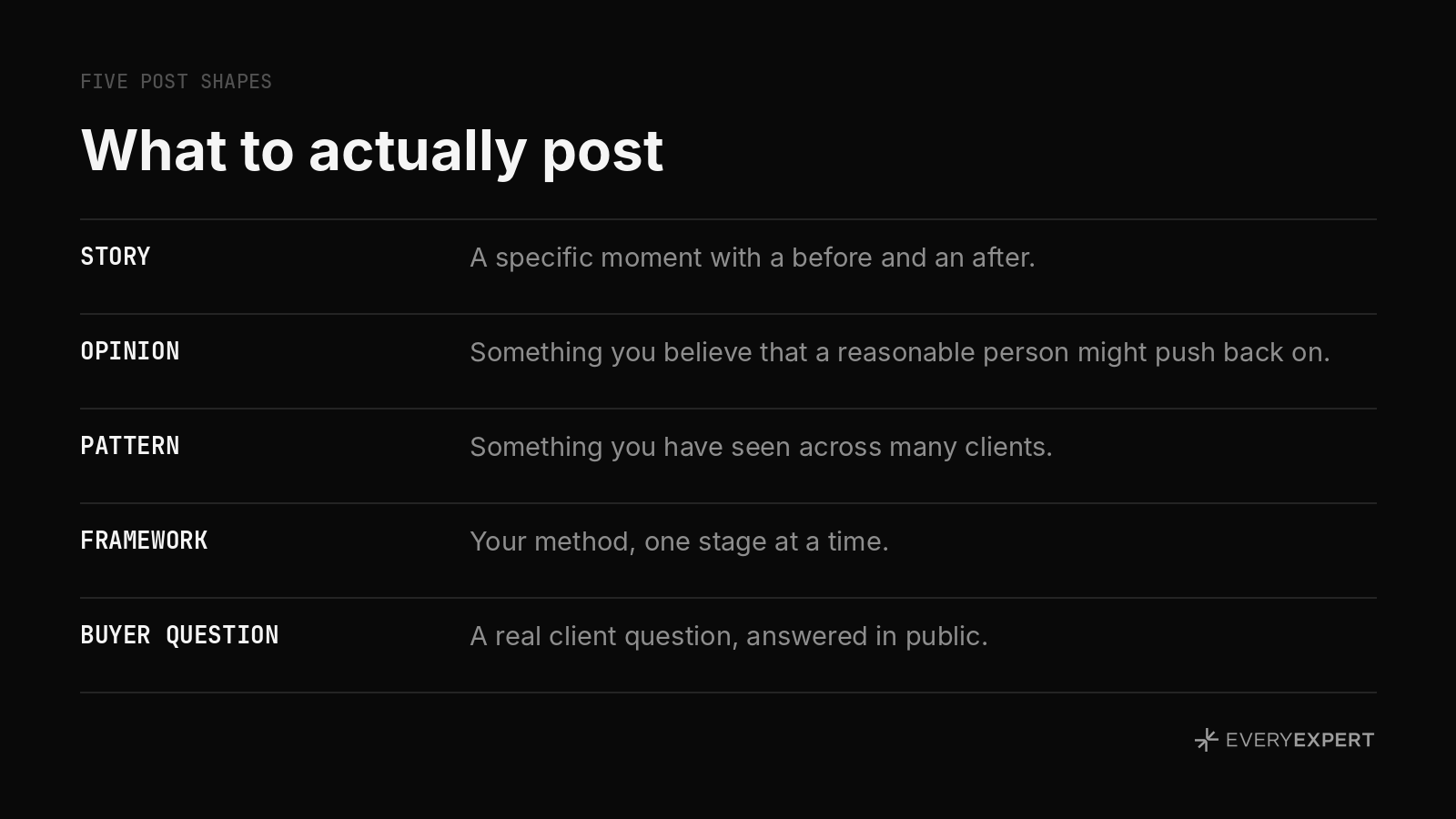
Each one ends the same way, quietly. If you want help with this, you can book a call with me on EveryExpert. A paid call, with a booking link, rather than a vague offer to grab coffee.
Key takeaway. The job of the post is to let the right person recognise their own problem in your description of it. Being seen is a side effect.
Do this. Pick the one of the five that makes you least uncomfortable and write it today.
Section 7. Do not let the swipe file flatten you (17:18)
What this section covers. Someone asked for the frameworks, which is fair, and I gave a caveat with them.
Frameworks exist to get you moving when you are staring at a blank page. The failure mode is obvious once you have seen it: someone buys a swipe file, follows the structure exactly, and produces something that reads fine and sounds like nobody. You know your audience far better than whoever wrote the template.
Key takeaway. Use the structure to get started, then write over it until it sounds like you.
Do this. Take your last post and cut every sentence you would not say out loud.
Section 8. Pivot in public (20:28)
What this section covers. One of the experts is moving off passive real estate investing toward helping people build their own micro family office, and she has the problem anyone changing lanes has. Her audience is still the old audience. They engage, they support her, and they are not who the new offer is for.
My answer: show the process instead of announcing the result. This is me updating my site. This is the thing I got wrong about how to explain it. People stay for the person, and your expertise is allowed to change underneath them. I was a digital marketing expert once. I do not do that anymore, and the people who know me did not go anywhere.
Key takeaway. Announcing a pivot once gets you a day of attention. Documenting it gives you six months of material and brings people with you.
Do this. Post one honest update about the change you are in the middle of, including the part you have not figured out.
Section 9. The honest contrarian (21:41)
What this section covers. I used the lending expert from section 1 as the live example of the opinion post, and he did not need much prompting. The 2008 housing collapse changed how he thinks about the entire business, and he came out of it looking at total cost of ownership rather than rate and payment. He jokes that he does financial planning for homeowners, which he is careful to say he is not licensed to call it.
What fires him up is the confident advice that you should never buy, built on a five minute analysis. He has decades of numbers that say otherwise. He gets to choose whether to open his mouth and stir people up, and that choice is exactly what the opinion post is for.
Key takeaway. A contrarian position you can actually defend with data is the most underused post type there is.
Do this. Write the sentence that starts "everyone in my field says X, and the numbers say otherwise."
Section 10. Let the AI find the rooms (30:07)
What this section covers. I gave Muse, Meta's assistant, one goal: get me booked on stages locally in Brooklyn. Not podcasts, not anything clever. Local rooms.
I spent a Saturday night setting it up and sent about thirty requests. Four replies inside two days and three yeses, one of which was local television that I never asked for and still do not entirely understand.
The woman at a conference I spoke to afterwards told me what actually moved her: the outreach was personal, and instead of a polished speaker reel I sent twelve unedited minutes of me talking, mistakes included. Get clear on who you are first, then automate the sending. Doing it the other way round just sends a vague pitch faster.
Key takeaway. Automation multiplies whatever you give it, so the work is in being specific before you scale.
Do this. Write your speaking topic in one sentence a stranger could repeat correctly, then let a tool go find twenty rooms.
Section 11. Forty rejections, and the question I did not ask (32:27)
What this section covers. I had tried automated outreach before and it went badly. Forty messages out over a weekend. A week of nothing. Two weeks. Three. At four weeks the replies finally came and every single one was a no.
I was annoyed for about a day before I understood what I had been handed. Forty people read my topic and declined it. That is a verdict on the topic. I changed it, and the next run is the one in the section above.
Then one of the experts pointed out the move I had missed, at 33:50. Reply to the no and ask what they were looking for instead. They have already declined, so you are risking nothing, and they have no reason to be diplomatic. I can automate that follow-up now too.
Key takeaway. A batch of rejections is the cheapest research you will ever get, and almost nobody reads it.
Do this. Go back to your last five nos and send each one a single line asking what they wanted instead.
Section 12. Comments are doing more work than your posts (36:39, 43:33)
What this section covers. When somebody comments on your post, do not thank them. Ask them what stood out. That starts an actual conversation, and some of those become calls. Most go nowhere, which is fine, because you still learn why people value what you said.
Later in the session I came back to the other half of this. LinkedIn works out what you are about from what you post and what you engage with, and if your About section says one thing while your posts say another you are working against yourself. Engagement pods make it worse, because you get reach from people who will never buy. Another expert in the room confirmed it from his own numbers: you can post all day, but if you are not in the comments on your target accounts, the algorithm does nothing for you.
Even with 30,000 followers, there are weeks where most of my views come from comments rather than posts. So treat a comment as a small post on someone else's page. "Great post" tells your network nothing.
Key takeaway. Your comment history is a portfolio, and most people are leaving it blank.
Do this. Leave three comments today that would stand alone as posts.
Section 13. Hard or Wrong, and the coffee mug (37:51)
What this section covers. My wife is from San Francisco and I am from New York, and we own exactly two mugs that say so. I claimed the New York one on what I considered obvious grounds. That did not go the way I expected, and I spent the walk back to my office deciding whether to apologise.
The test I use is this. What is the actual goal here? Is the thing in front of me hard, or is it wrong? Hard is not the enemy. Wrong is. Having a good marriage was the goal, and winning the mug argument was not the same thing as reaching it.
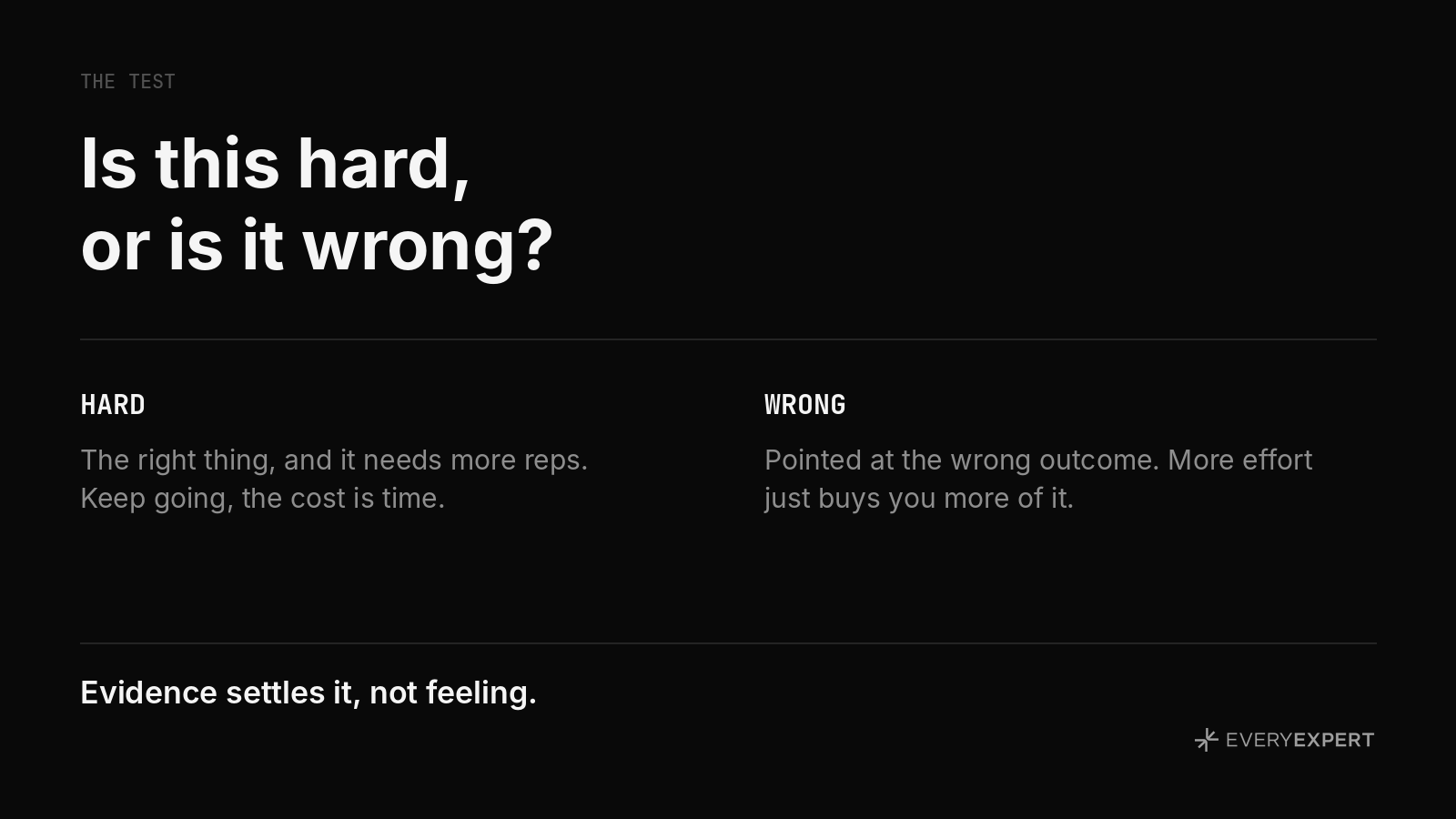
I use it on stage and in my content, and it is the spine of everything in the next section.
Key takeaway. Most decisions people circle for weeks are pointed at the wrong outcome, and naming which one you have in front of you is the whole job.
Do this. Take the decision you have been circling for a week and ask whether it is hard or wrong.
Section 14. Send It, and the part that transfers (39:22)
What this section covers. I built a digital card deck called Send It. You flip a card, you get a challenge, and you either do it or decide it is wrong for you. I almost did not send the email announcing it, which is funny given the name. Twenty decks sold on day one, and one of those buyers booked a call with me on EveryExpert to have a custom deck built from the conversation.
I am also running it live at an event in Washington, D.C., where the room draws cards and does the challenge. Same framework, different surface.
One of the experts named the transferable part before I did, at 42:44: what matters is having something uniquely yours that people can put their hands on. She has already built a quiz for people facing a hard financial decision. Another took it somewhere I had not thought of, at 53:27, turning the steps of his AI workforce readiness audit into a card a day, pulled at random until the set is done, which ties into the book he is writing.
Key takeaway. People support what they help build, so anything interactive beats anything you hand over finished.
Do this. Take your framework and find the smallest physical or interactive version of it someone could hold.
Section 15. The best answer in the room was not mine (45:32)
What this section covers. One expert solved another's audience problem in about forty seconds, and he did it better than I had.
Her network is full of commercial real estate people and her new audience is not. But commercial real estate people have high net worth clients and friends, and those are exactly who a family office conversation is for. So let them make the introduction. They look good doing it, and it costs her nothing.
Key takeaway. The person standing next to your new audience is usually easier to reach than the audience.
Do this. Name three people who sell something different to the buyers you want, and ask one of them who they would introduce you to.
Your next three moves
Publish your profile and set a price on an entry call. You can change it later. www.everyexpert.com
Write the ten notes. Five is fine. Make them forwardable and send them this week.
Come to office hours and bring the thing you are stuck on. It is free, it is weekly, and the room is small enough that you will get real time. Next one is Thursday, details at the bottom.
And when you get a win, tell me. I want to highlight it in the community and on the site.
Go deeper on any of these
Five pieces that take one part of this session further:
A rejection is the cheapest market research you can get
Two emails a year is the whole networking system
Five posts that get you booked, and when to use each one
Comment your way in
Make something only you could have made
Next office hours
Thursday, October 8, 12:00 PM ET. Lead Generation for People Who Hate Selling.
You do not need a funnel or a pitch to fill your calendar. We are covering three ways to generate leads that feel like helping: content that converts, conversations that lead to community invites, and getting on podcasts. Bring one offer and we will work out your first move live.
Register: https://kajabi.zoom.us/meeting/register/lLaE4dddTzOWm8_OWLJ6mA