Harder to Replace: what you can still charge for when AI does the part you used to get paid for
A room of experts working out what they can still charge for.
This one is long on purpose. It is a guide, not an article. Skim it now, then come back with an hour blocked off and do the work.
A client sends you a document and asks you to look it over. A year ago they would have paid you to write it. They wrote it themselves over the weekend with AI, and it is fine. Not good. Fine.
Most people read that moment as the beginning of the end. It is closer to a sorting problem. Part of what you sell just became free, part of it just became more valuable, and almost nobody has stopped long enough to work out which part is which.
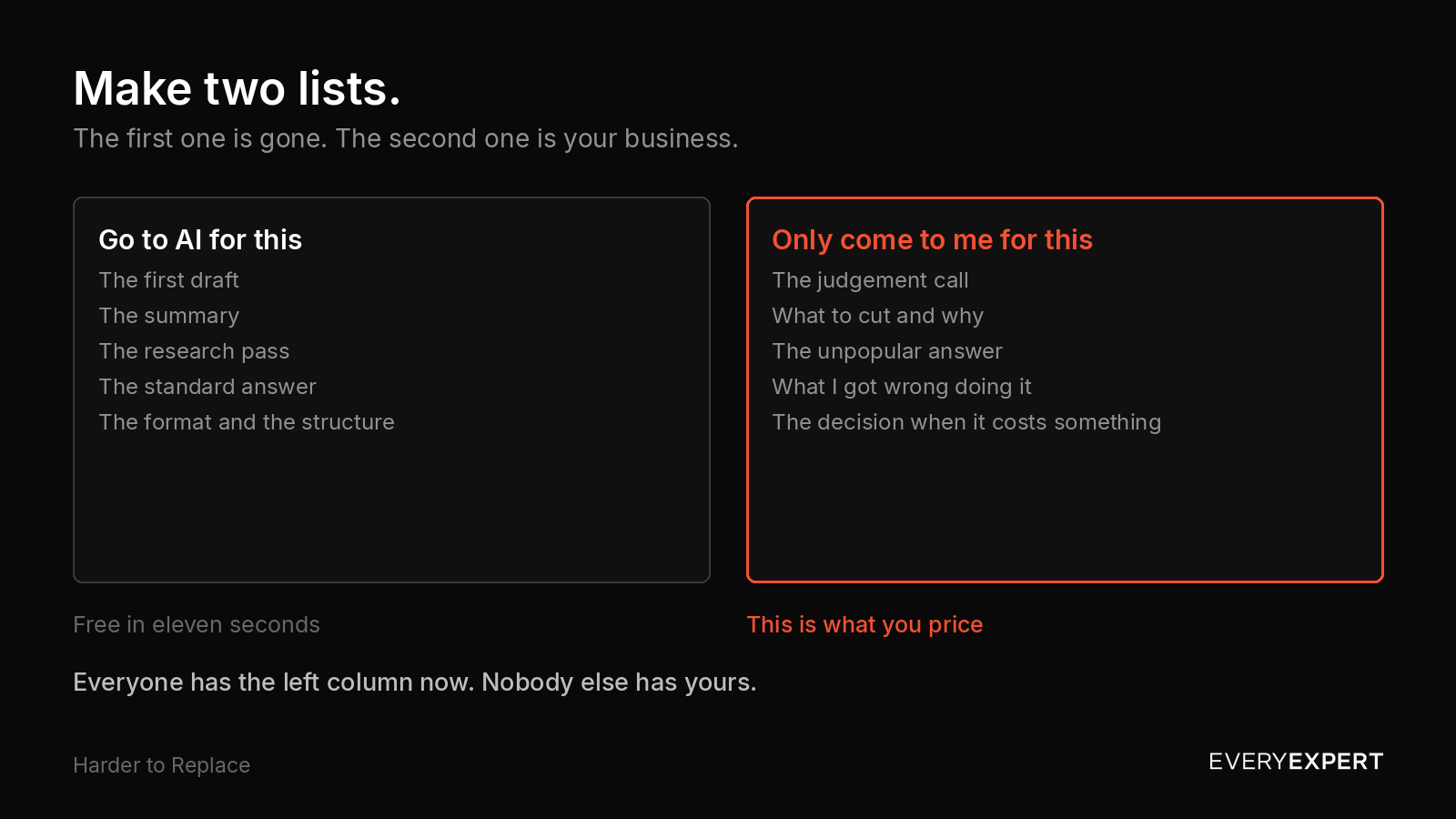
The EveryExpert community spent a live hour on that question. Among the people who spoke up: a speaking coach, a founder who started her first business as a teenager, a physician, and a marketer who formulated his own product line end to end. Different fields, same question. What can I still charge for?
The full session is above. Below is the walk through, section by section, with the timecode so you can jump straight to the part you need. Each one gives you the lesson and one thing to do about it.
Thirteen sections is more than anyone gets through in one sitting, and you are not meant to. Mark the two or three that match where you are actually stuck, and start there.
Publish your profile and set your price at www.everyexpert.com
Section 1. What you get for showing up (0:16)
A profile only earns its keep when you treat it as a reason to publish.
The platform gives you one link that carries the booking, the scheduling and the follow-up, which matters most to the people who are worst at follow-up. Around that sit free weekly office hours for any question about your knowledge business, not only platform support. Pricing questions are welcome. So is where do I even put this link.
Then there are the parts most members miss. Community spotlights, where you teach for three or four minutes and walk away with a cut for social and a slot in the newsletter. Member-led workshops that need guests. And the assets that come out of both, which is the actual point. Nobody makes money waiting for a platform to send them traffic.
Try this. Publish the profile, then claim a spotlight or workshop slot. The asset you walk away with is worth more than the slot.
Section 2. What one hundred dollars actually buys (4:29)
Someone who pays a small amount has already told you they value knowledge. That is the whole reason the price is low.
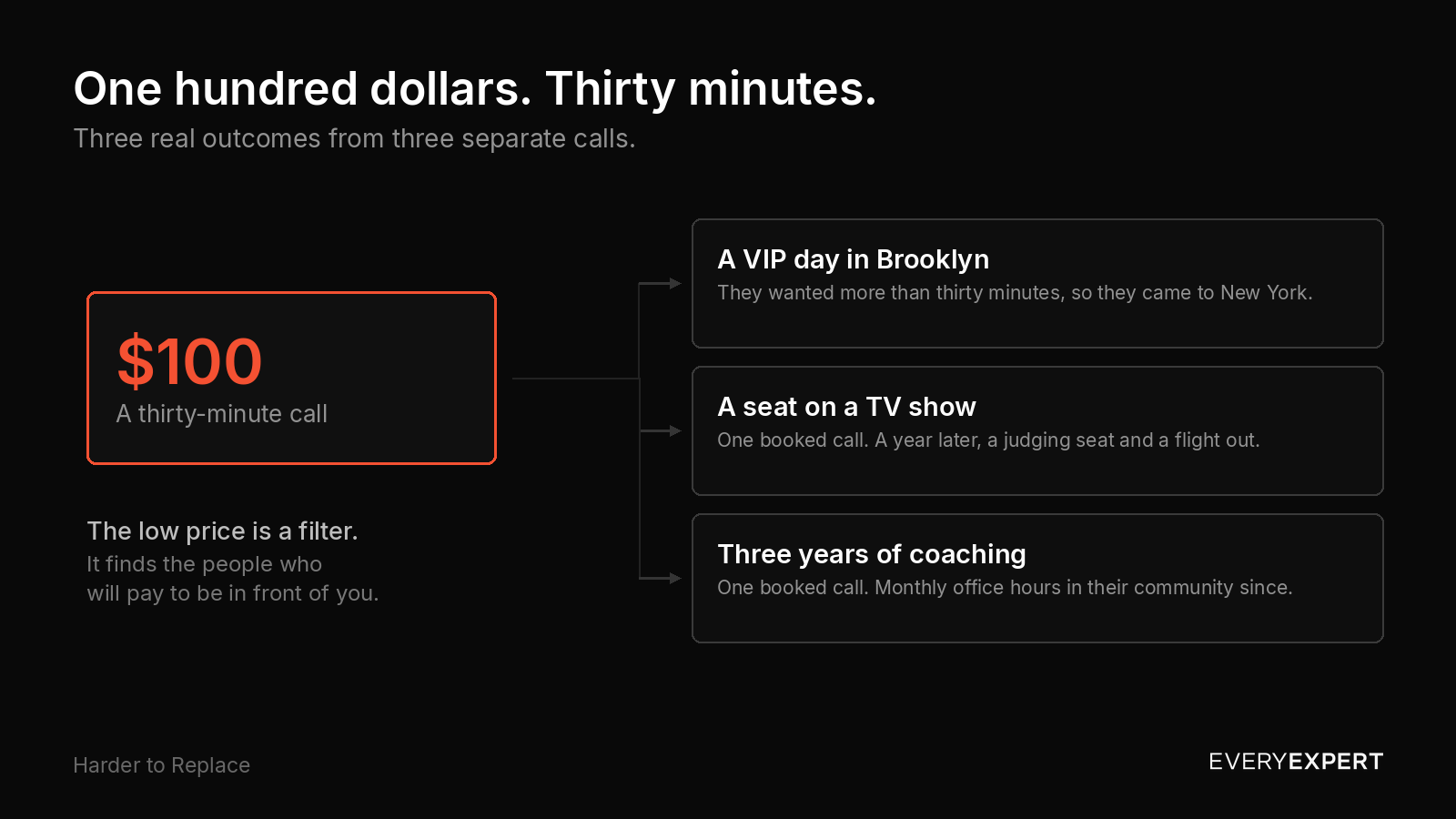
Three of the first bookings in this session's example came from a PS in a newsletter that was not even relevant to that issue, a single social post, and one line that almost got cut. That last one turned into a full in-person VIP day.
An entry call priced around a hundred dollars for thirty minutes does two jobs at once. It stays reachable for people who cannot pay several hundred an hour, and it catches the people who will pay anything to get in front of you. Both of those are useful. Neither shows up in a free call.
One of those calls led to a year of monthly sessions inside somebody else's paid community. Another led to a TV booking. The pattern is not the outcome, it is that a paid yes is a different signal from a free one.
Try this. Set an entry call low enough that yes is easy and high enough that yes means something.
Section 3. Stop constructing, start auditing (7:43)
The draft was never the valuable part. The judgement about the draft was.
A speaking coach called herself resistant to AI, then described feeding a seventy minute podcast into it, asking for the cuts, and letting the software make them. Her clients now arrive with speeches they wrote themselves, and she spends the session crossing out paragraphs.
That is a product. Someone writes their own speech, books a call, and finds out exactly where it falls apart. The work moves from building the thing to judging the thing. It takes less of your time and it prices about the same.
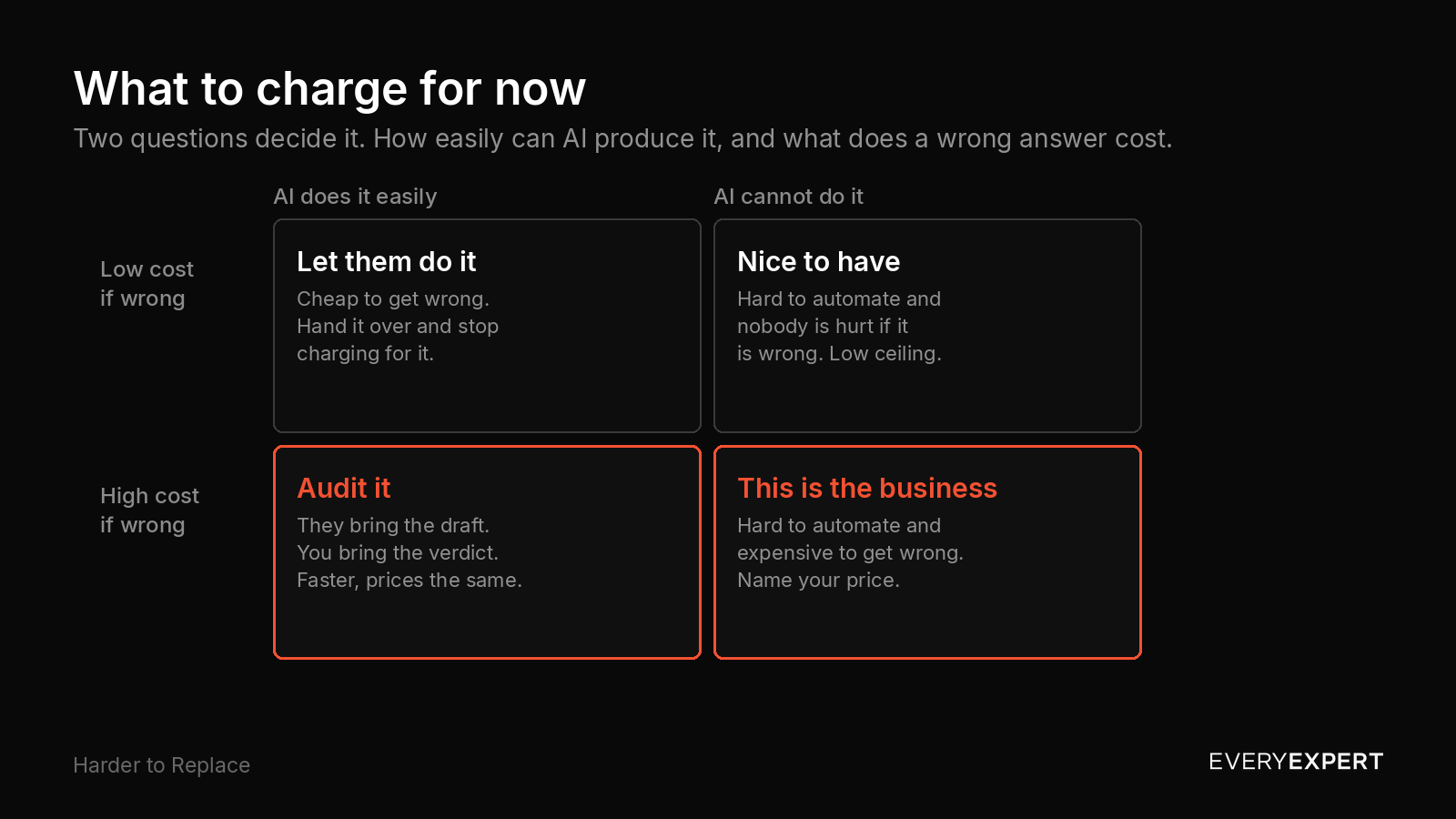
Try this. Rewrite one offer so the client brings the draft and you bring the verdict.
Section 4. The boundary that pays for itself (10:53)
The free ask is a qualification signal. You can read it as one instead of resenting it.
One founder has run businesses for twenty years, and the better she did, the more people asked to pick her brain. The expectation now is twenty free minutes, and it arrives constantly.
Her answer reframes the whole problem. If somebody will not pay, those twenty minutes were never going to be worth it, because a person who does not value your time now will not value it as a client later. The request carries information, arriving early and free.
She raised a second thing worth sitting with. AI now lets people look considerably more credible than they are, which means the burden of proof has moved onto anyone who is actually credible.
Try this. On the next brain-pick request, send the booking link instead of the calendar invite, and watch who converts.
Section 5. The posts that get you hired (14:41)
Character travels further than competence, and the posts you are least proud of are the ones that bring work.
The content that performs here is not the clever content. Videos about getting fired or coming back from addiction land around a hundred thousand views. The AI how-tos come nowhere close.
The structure worth copying is two layered types of story. Canon stories that establish who you are and cannot be faked, plus the small ones from ordinary life. One in this session was simply two meetings booked at the same time, the dean of an old school and a friend of thirty years, and the decision to ditch the friend. That is discernment in real time. It stayed a scheduling clash until it got told properly.
Another was a kid pulling somebody's pants down in a crowded theatre, and the meditation practice that stopped it becoming a scene. A parenting publication ran a feature off that post. A large tech company followed with an invitation to come and speak.
The part most people skip comes after publishing. Check who viewed your profile, then reach out to the ones who matter. That is a warm call, because they looked at you first. Nobody ever does it off the clever posts.
Try this. Post the personal one this week, then open your profile viewers and send three warm calls.
Section 6. So is everybody else (19:19)
When expertise is common, the scarce thing is a trustworthy person willing to say which parts of the common advice are wrong.
A physician put the hour's hardest sentence on the table. AI has become everyone's resident doctor, and being smart on social media has not worked for her. Her words: we are all smart, but so is everybody else now.
Two answers came back. The first is speed. You can ship ideas faster now, including the bad ones, which means you find out sooner. The old loop was pay a developer, wait three months, launch, and discover nobody cared. The new one is get to good enough over a weekend and see who responds.
The second is position. There is a real lane for a credentialed person who publicly corrects the dangerous advice AI hands out. Some of it plays funny. Some of it is serious enough that a reputable source would sponsor it.
Try this. Write down the three worst pieces of AI advice in your field. That is a content series, and possibly a sponsorship.
Section 7. The story only you can tell (23:16)
You get sick of your best story about four years before your audience does.
Asked for a story only she could tell, the founder described living her whole life with something about her body she cannot control. Rather than working around it, she built her framework on top of it. Improv principles for navigating uncertainty. Play the scene you are in, acknowledge what happened, make a choice from there.
Then she said the thing that made it useful to everybody else in the room. She has not told it widely, and she has not told it repeatedly.
That second half is where most people lose. The data behind it is plain enough. On a post with a hundred thousand views, the majority of that reach is out of network. Those people have never heard of you, never mind the story. Repetition feels loud from the inside and barely registers outside.
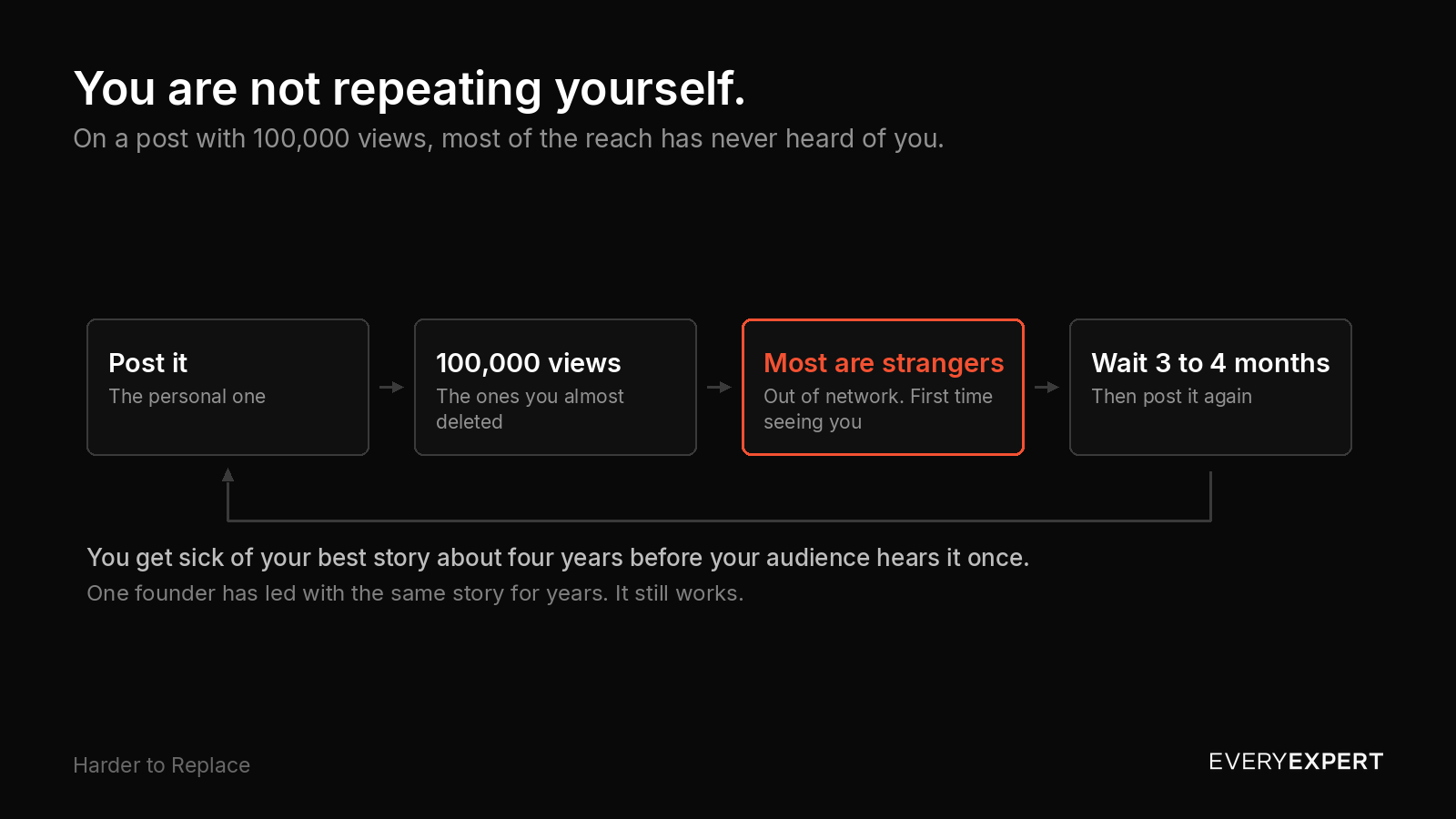
Try this. Take the story you are certain everyone has heard and post it again. Check the out-of-network share before you call it a repeat.
Section 8. Get clear before you build anything (29:29)
An offer that survives contact with your own honesty beats an offer that looks good on a slide.
The marketer described a pendulum plenty of people will recognise. The business does well, growth needs money, he takes a corporate role, the business fizzles, repeat. Deep marketing knowledge, a product line he formulated end to end, and no settled answer about which one to commit to.
The advice came in two halves. Get very clear on the offer before you build, and expect it to change anyway. Then have an AI interview you about it and argue back, because a model will happily hand you an offer, a marketing plan and a website that all look great and that you have no interest in running. Introspection is the missing ingredient in most businesses, because almost nobody stops to ask what they actually want to do all day.
The exercise named was ikigai. What you do, what you enjoy, what you are good at, and what the world will pay for. It only works to the extent you are honest inside it.
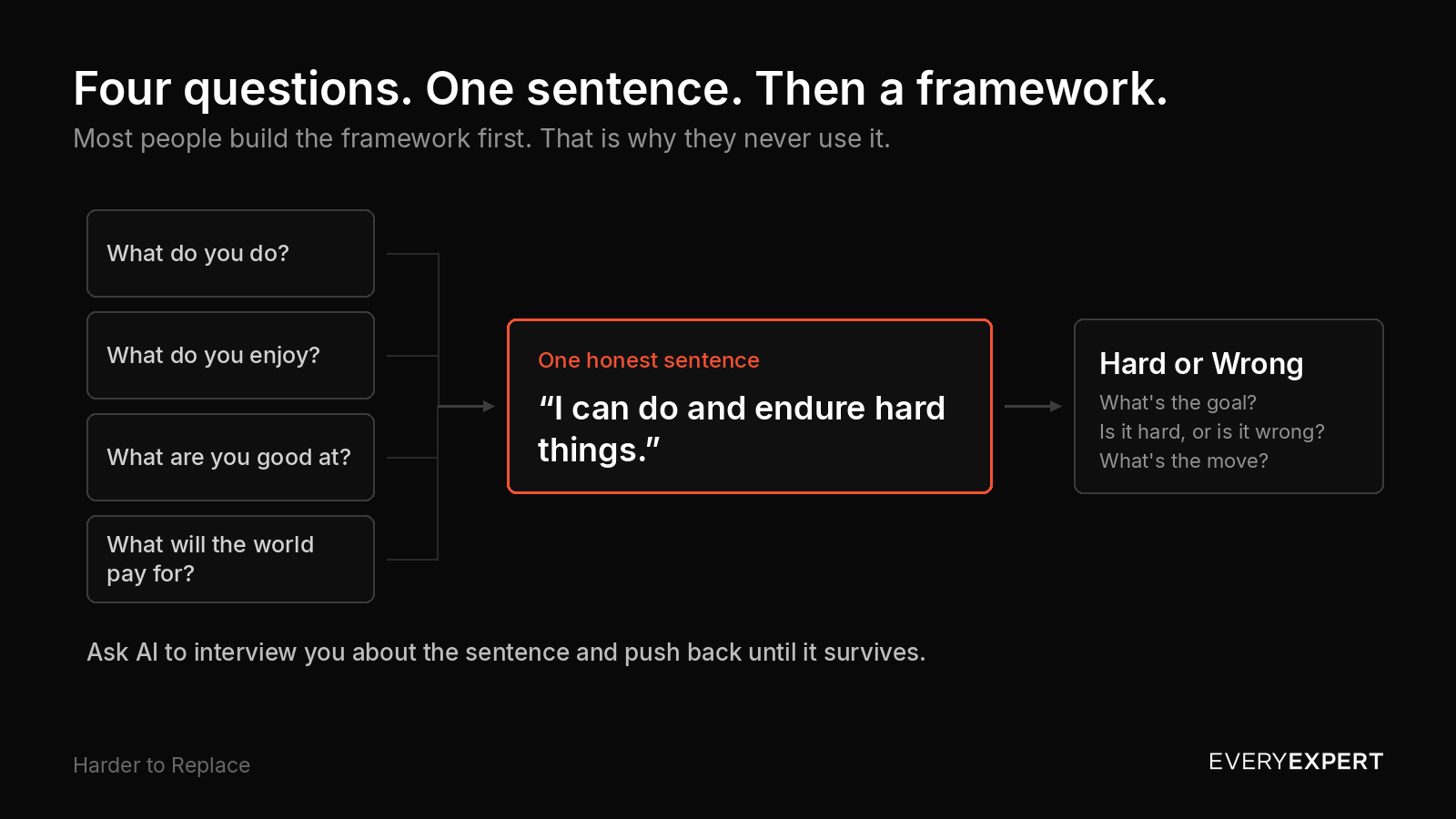
Try this. Run the ikigai pass, then have an AI argue with you about the answer until the offer is something you would happily deliver on a Tuesday.
Section 9. Build the ecosystem, not just the offer (35:32)
The test for anything new is simple. What could you actually do that would not annoy you if somebody said yes?
This section is what section 8 looks like once somebody acts on it. One sentence about enduring hard things became a card game, then physical decks, then a version for sales teams at off-sites, then venues running it live with a cut of the sales, and a sponsor conversation on top of that.
None of that was a business plan. It was one clear idea, followed outward until it touched things that already existed in the world.
The useful part for you is the test, not the card game. Most people build the thing they think they should build and then quietly dread delivering it. Running everything through that one question gets rid of half the list.
Try this. Run that test down your own pipeline. Anything that fails it comes off the list.
Section 10. How to say what you do, and where to say it (39:03)
Borrowing a room beats building an audience, and it is available to you this week.
Someone asked how you describe yourself when you do several things at once. The answer was to lead with the outcome rather than the titles. I help people make better decisions when the outcome is on the line, delivered through writing and speaking, sits better than a list of roles. Soften it with something human at the front so people have somewhere to grab on.
On distribution the answer was blunter. Promoting on a feed feels gross and mostly does not work. The channel is useful for growing a newsletter, and the newsletter is where the offer goes, always tied to whatever you were already talking about.
The move rated highest was other people's communities. Find a leader who is not a competitor and offer to teach. Trust transfers, the audience is already assembled, and you get thirty minutes instead of a few seconds in a feed. Becoming the one specialist inside a community is achievable. Becoming a niche on a social platform is mostly not.
Starting from nothing, the sequence is three steps. Give five free calls for the reps and the reviews. Ask every one of them for a testimonial. Then start charging, and take those testimonials into rooms that hold your buyers.
Try this. List five communities that hold your buyers and whose leader you do not compete with, then offer one of them a session.
Section 11. If you sell a course, sell the room (43:32)
A course that gets copied is a liability. A course that qualifies people for a room is an asset.
A consulting firm wanted a week on site. A week away was not possible, so the work got rebuilt as an online course for the baseline plus one live workshop. They took the deal.
If you are sitting on course content and worrying that a chatbot ate it, keep making the course. Use AI to make it, which is now fast enough that the build stops being the bottleneck. Then run it as pre-work, show up to teach the live session, and charge a premium, because they keep the course either way.
The founder already works this way. A six week live programme gates entry to the deeper labs where people work things out in real time. She is also sequencing a client across two sessions months apart, built around a launch.
The shape is pre-work, live session, homework. Price it in three parts and quote all three. If they decline one, fine. It anchors the price higher and it gives people something to say no to besides everything.
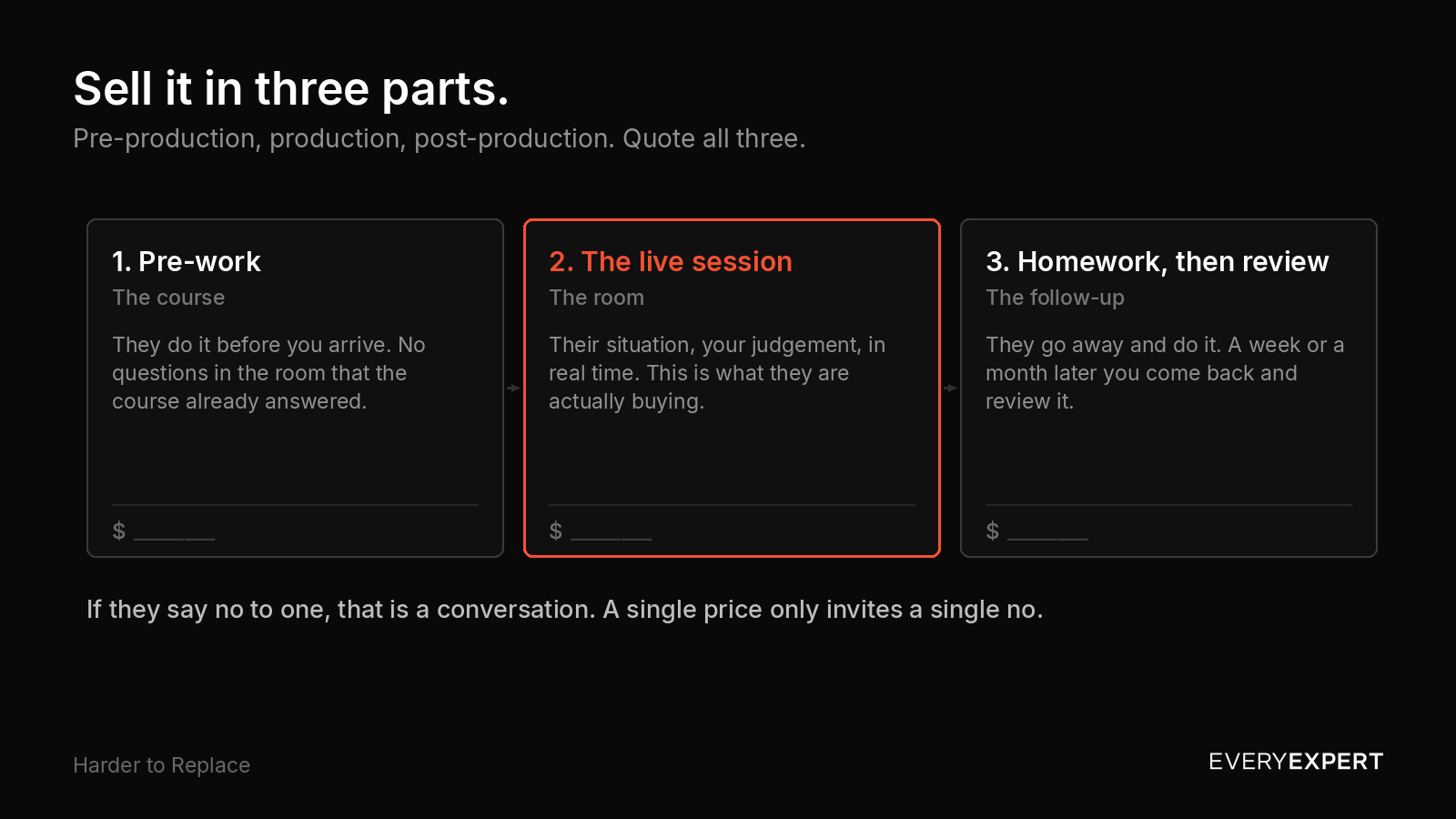
Try this. Break your next engagement into three priced parts and quote all three.
Section 12. Content that books calls, and the ladder underneath (48:13)
Most ladders are missing a bottom rung, a top rung, or both.
The content pattern first. One post in the session described a client who spent sixty thousand dollars building an agent to deploy their workforce, then booked one six hundred dollar call and heard that they did not need to spend it and probably should not put it anywhere near a client's systems. The post ends on a question rather than a demand. Did you ever overbuild something only to find the simple version worked better? The offer sits quietly at the end.
Then the ladder:
Something free. A PDF, a guide, sometimes a call. The test is tire kickers. Narrow corporate audience, give the free call. Broad consumer audience, probably not.
The paid entry call. Thirty minutes, one to two hundred dollars. Commitment starts here, and you both find out whether this is a fit.
The real work. Consulting, a project, a retainer.
The top. Enterprise work and in-person days.
What goes wrong is nearly always one of the two ends. No easy way in, or nothing expensive enough at the top to anchor everything else against.
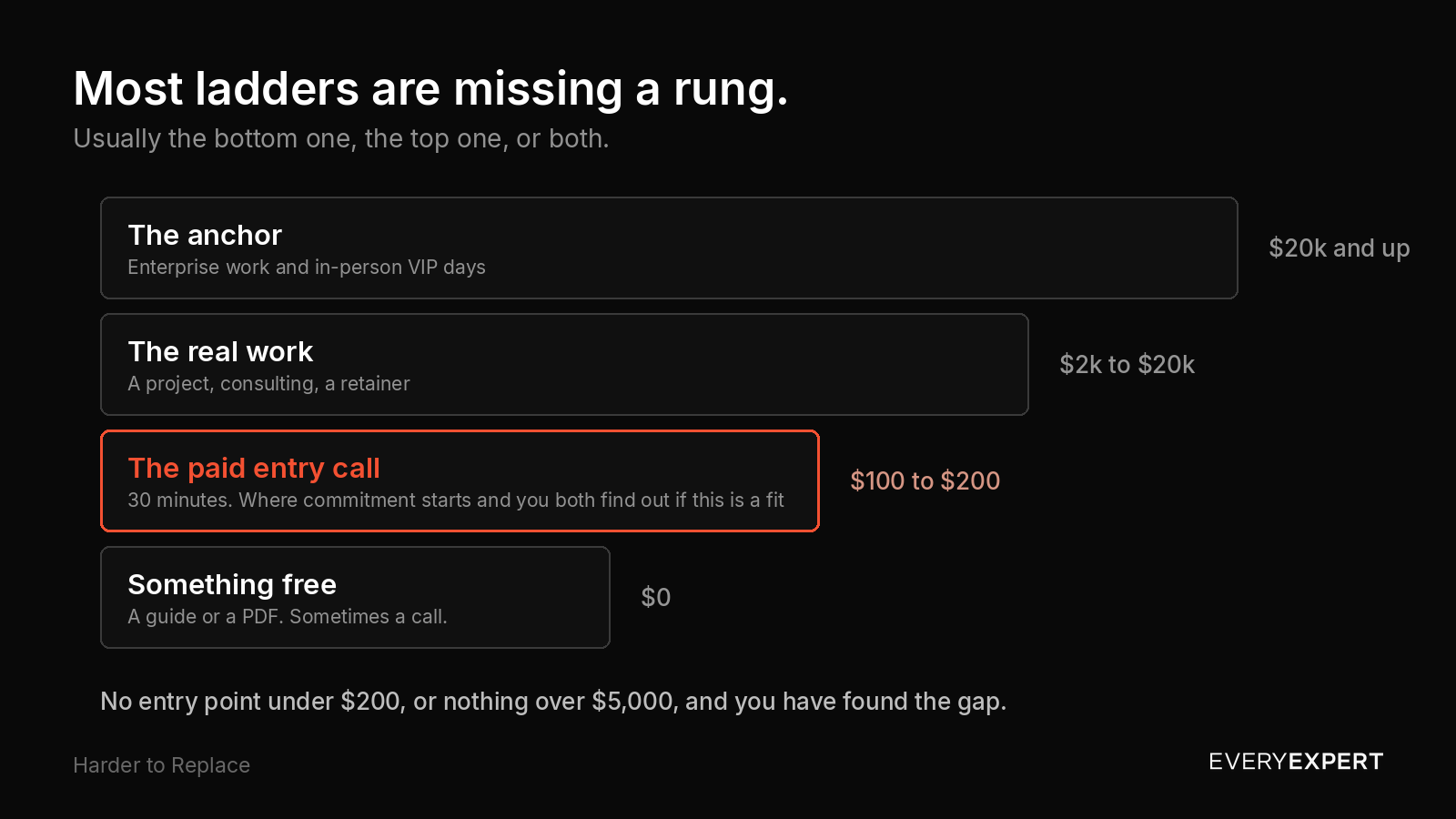
Try this. Draw yours. No entry point under two hundred dollars, or nothing over five thousand, and you have found the gap.
Section 13. The question the whole hour builds to (51:36)
The answer sits in the overlap between what you have lived and what you can still be bothered to do.
What should people only come to you for?
This is a different question from what you are good at. It is the one you answer better than anybody else out there, including AI, because of what you have lived, how you see it, and the way you answer it. That goes on your profile. That is the thing nobody can take off you.
Try this. Write one paragraph answering it.
Do this today
Write that paragraph, and put it at the top of your profile. Fifteen minutes. Everything else on this page can wait a week.
Bring it back
Post the paragraph in the community and let the room tell you whether it lands, because you are the worst possible judge of your own positioning. If you want to work on it live, bring it to office hours and ask the question this way: here is what I think people should only come to me for, and here is the offer I built on it, where is the gap. That is a question the room can actually answer.
And when you get a win, say so. Wins get highlighted in the community and on the site.